


The intersection of public policy, animal advocacy, and pet ownership has increasingly become a complex battlefield for aviculturists, pet bird owners, and exotic animal enthusiasts across the United States. At the forefront of this advocacy is the American Federation of Aviculture (AFA) and its dedicated Legislative Committee, which continually monitors local, state, and federal legislative actions. For bird owners—whether hobbyists with a single household parrot, commercial breeders, or dedicated conservationists—staying informed about legislative and regulatory shifts is no longer optional; it is an essential responsibility to protect the future of aviculture.
The Mechanics of Legislation: Bills, Ordinances, and Regulations
To effectively navigate the legislative environment, bird owners must first understand how laws are conceptualized, drafted, and implemented. Historically defined simply as the proposing of laws, modern legislation predominantly manifests in the form of a "Bill." A bill typically serves as the blueprint for a proposed law, outlining its intended objectives, enforcement mechanisms, and expected societal impacts. However, these introductory summaries can often be misleading or intentionally vague, masking the true operational scope of the legislation.
Bills are formally introduced by elected representatives, but they frequently originate from lobbying organizations. In many instances, well-funded animal rights and animal welfare organizations draft comprehensive bills and present them to lawmakers for introduction at the municipal, state, or federal levels. Critically, the ideological frameworks and long-term agendas of these lobbying groups rarely align with the practical needs, experiences, or views of the general public and responsible animal keepers.
Furthermore, it is vital to distinguish between different types of legislative and regulatory instruments:
- Bills and Statutes: Proposed at the state or federal level, these require passage by legislative bodies—such as a State General Assembly, the US Senate, and the US Congress—followed by executive approval.
- Ordinances: These are local laws enacted by city councils or county boards. Municipal ordinances frequently regulate property use, public nuisance, and animal limits within a specific jurisdiction.
- Regulations: Unlike primary laws, regulations represent the operational rules established by administrative agencies to enforce a law. Crucially, regulatory changes can often be enacted without a direct vote by elected officials, provided the agency follows established administrative procedures. An example includes the U.S. Fish and Wildlife Service (USFWS) adding a new species to the Endangered Species Act.
The Slippery Slope of Local Ordinances and Broad Definitions
A common misconception among aviculturists is that legislation targeting other animals, such as dogs or cats, has no bearing on bird ownership. However, legislative analysis reveals a recurring pattern: broad municipal ordinances initially drafted to address specific companion animals are frequently amended over time to encompass a much wider array of fauna.
For instance, a local government may propose an ordinance limiting the number of dogs or cats a household can own, citing public health, noise control, or overpopulation concerns. While such a law may initially appear reasonable or benign, its statutory definitions can easily be expanded. Consider a dedicated canary breeder maintaining six pairs of breeding canaries within a residential home. If a municipality passes an ordinance restricting total animal counts or later amends the code to include cage birds, small mammals, or aquatic species, that breeder instantly transitions from operating a legal hobby or business to violating local law.
Such violations carry significant real-world consequences. Ordinances are civil matters rather than criminal offenses. If an owner is found to be in violation of a municipal animal ordinance—much like maintaining an inoperable vehicle on residential property—they are typically subjected to progressive financial fines. While the owner is not facing incarceration or a criminal record, failure to comply or resolve the citation leads to court hearings where a judge can impose severe escalating penalties, mandate animal confiscation, or hold the citizen in contempt of court.
The Role of Lobbying and the Strategy Behind Anti-Animal Use Bills
The AFA Legislative Committee, working in tandem with a coalition of national animal-keeping organizations, closely scrutinizes legislative proposals that threaten the continuity of responsible bird keeping. Often, inexperienced observers are confused when advocacy groups express alarm over seemingly unrelated legislation, such as a municipal ban on traveling circuses or exotic animal displays.
Seasoned legislative analysts, however, recognize that vague or sweeping terminology embedded within these bills creates legal loopholes. These loopholes allow activist organizations to push for unchecked amendments that eventually ban private ownership of birds, restrict interstate transport, or impose impossible husbandry standards.
The volume of restrictive, anti-animal legislation introduced at both the state and local levels has reached unprecedented heights. While the introductory text of these bills invariably emphasizes noble goals—such as eliminating inhumane treatment, curbing animal overpopulation, or protecting public safety—the actual regulatory framework constructed under the resulting law frequently achieves a different objective: the systematic phase-out of private bird keeping, breeding, and exhibition.
Broader Impacts and the Domino Effect Across State Lines
Legislative trends do not exist in a vacuum. When a restrictive animal ordinance or state-level ban is successfully passed in one jurisdiction, it serves as a strategic blueprint for advocacy groups operating in other regions. This legislative "domino effect" means that a localized policy victory for animal rights lobbyists in one state can rapidly be replicated nationwide, threatening the viability of aviculture on a broad scale.
If unchecked, the cumulative impact of these legislative efforts threatens not only hobbyist bird owners and avian enthusiasts, but also commercial breeders, specialized avian veterinarians, educational facilities, and conservation breeding programs. Over time, poorly drafted laws and overreaching administrative regulations can effectively legislate the avicultural community out of existence.
Taking Action: Resources and Education for Aviculturists
Mitigating legislative threats requires proactive engagement, education, and constant vigilance. Aviculturists must monitor the legislative and regulatory landscape within their own municipalities and states rather than waiting for restrictive policies to reach their doorsteps.
The American Federation of Aviculture provides dedicated tools and educational resources to help bird owners stay informed. Members and the public can visit the dedicated Current Legislative Issues page on the AFA website to track active bills, review policy analyses, and understand pending legislative threats.
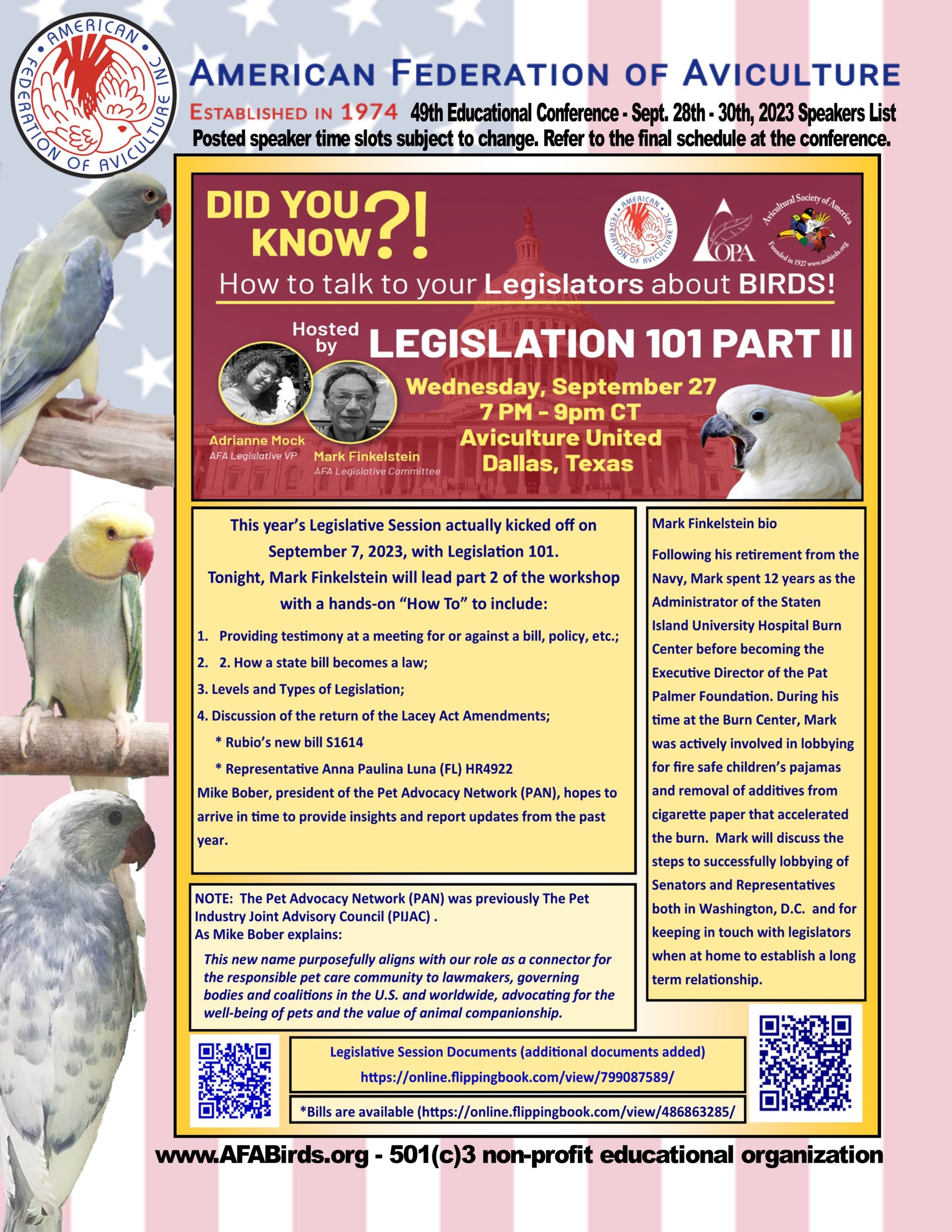
Additionally, organizations offer specialized educational initiatives, such as the Legislation 101 Training Course, designed to equip everyday citizens with the knowledge required to read legislative text, understand administrative processes, and effectively communicate with elected representatives. Furthermore, understanding overarching federal frameworks, such as the USDA Regulation under the Animal Welfare Act, provides crucial context for how federal oversight intersects with state and local animal management.
Ultimately, safeguarding the future of birds in human care depends on an active, educated, and vocal community. By understanding how laws are made, monitoring emerging policy trends, and engaging constructively with lawmakers, aviculturists can help ensure that responsible bird ownership remains protected for generations to come.

