


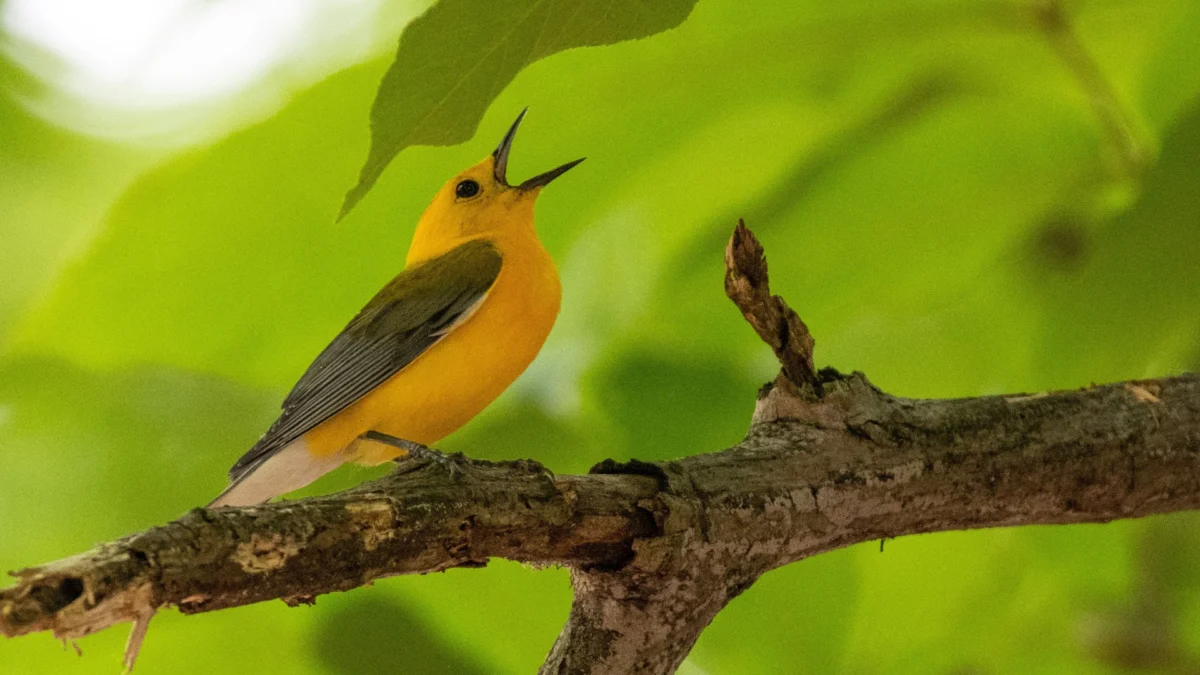
The Prothonotary Warbler, scientifically known as Protonotaria citrea, is a diminutive bird, roughly the size of a human palm, characterized by a deep, saturated yellow head and breast, and contrasting blue-gray wings. Unlike many of its warbler cousins that prefer high canopy foliage, the Prothonotary is a cavity-nester, often seeking out old woodpecker holes or, increasingly, artificial nest boxes near water. While their range is well-documented in the Mississippi River Valley and the Deep South, their presence in the western reaches of the Great Plains has historically been sporadic. That narrative shifted dramatically in 2023, when local observers, most notably Kathy Fox in Pittsburg, Kansas, documented the birds utilizing bluebird nest boxes for successful brood-rearing, confirming that these birds were not merely passing through on migration but were actively establishing a breeding presence.
A Shifting Landscape and the Expansion of Range
The colonization of southeast Kansas by this species is not occurring in a vacuum. Ornithologists and habitat specialists point to the restoration of wooded wetlands as a primary driver for this expansion. Much of the land in southeast Kansas has a legacy of industrial use, particularly from mid-20th-century strip mining. As these areas have been reclaimed and transitioned into riparian woodlands—often characterized by slow-moving water and mature, cavity-rich timber—the ecological niche required by the Prothonotary Warbler has been recreated.
This landscape-level change provides a fascinating case study in adaptive avian behavior. By occupying these human-altered, reclaimed habitats, the warblers are effectively pushing the western edge of their breeding range. While the majority of the activity is centered in the southeast, sightings have been reported as far west as Wichita, suggesting that the species is actively exploring the limits of its geographical distribution. For researchers, this offers a unique window into the mechanics of range expansion, illustrating how environmental reclamation projects can inadvertently—but successfully—bolster biodiversity.

The 5,000-Mile Odyssey: Tracking Technology in Action
The sudden establishment of a stable population in Kansas has provided an unprecedented opportunity for scientific inquiry. A team led by graduate researchers from Pittsburg State University, including Gabe McClain, has launched a multi-year, high-tech monitoring program. Beginning in June 2025, the team began fitting male Prothonotary Warblers with miniaturized, state-of-the-art geolocators.
These devices, which must be engineered to weigh less than a fraction of a gram to ensure the safety and flight efficiency of the bird, serve as microscopic data loggers. Because the technology requires the bird to be physically recaptured to retrieve the stored data, the study relies on the high site-fidelity of the species—the tendency for these birds to return to the exact same nesting box year after year. The results have been nothing short of extraordinary.
One male, identified by the research team as "Hydrogen," provided the first comprehensive map of this trek. After nesting in the vicinity of Kansas City in the summer of 2025, the warbler embarked on a journey that spanned approximately 5,000 miles. By late October, the tracking data confirmed his arrival in the tropical landscapes of Colombia. This trajectory underscores the immense physiological burden these small birds endure twice annually. The data retrieved from these trackers provides critical insights into stopover sites, migratory speed, and the specific wintering climates that these Kansas-bred birds favor, filling a significant knowledge gap in North American avian migration science.
Scaling Up: From Six Trackers to Scientific Maturity
The scope of this research has grown rapidly. In the pilot year of 2024, the team monitored only six birds. By the following season, that number was scaled to 36 individuals. This exponential increase in sample size is vital for statistical significance. As the dataset expands, researchers are gaining a clearer picture of whether the Kansas population follows a distinct migratory corridor compared to their counterparts in the Mississippi Valley.

The logistics of such a project are immense. Each nest box must be monitored with high frequency, and the researchers must possess the specialized training required to safely handle, band, and tag these delicate songbirds. The success of the project thus far has relied on a combination of rigorous academic oversight and the "citizen science" contributions of local birders who assist in monitoring the boxes throughout the nesting season.
Implications for Conservation and Climate Adaptation
The arrival of the Prothonotary Warbler in Kansas serves as a bellwether for larger ecological trends. As climate change alters the availability of food sources and the timing of spring emergence for insects, migratory birds are often forced to adjust their traditional ranges. The fact that the Prothonotary Warbler is finding success in Kansas suggests that the region’s current climatic profile may be becoming increasingly hospitable to species that once required more humid, eastern environments.
However, this transition also carries risks. If the population becomes reliant on man-made nest boxes, the long-term sustainability of the group could be threatened if those boxes are not maintained or if they are overtaken by invasive species such as House Sparrows. Consequently, the research is not just about tracking movement; it is about developing a management strategy to ensure that the habitat remains viable. Local conservationists are now advocating for the installation of more specialized, predator-resistant boxes to help the population flourish.
The Impending Migration: A Seasonal Window
As of late August, the migration cycle is beginning to hit its stride. For birdwatchers, the next several weeks represent a critical window of opportunity to observe the warblers before they vanish into the southern horizon. Unlike many other migratory birds that move in large, highly visible flocks, Prothonotary Warblers are often solitary or move in small groups, making them a prize for the patient observer.

Observers are encouraged to look for them near water, particularly in wooded areas near rivers, lakes, or reclaimed mine lands. The birds are known for their preference for low-hanging branches and their habit of foraging for insects among the leaves of riparian trees. Because they are currently preparing for their return journey to South America, they are often more active as they fuel up for the flight ahead.
A Broader Scientific Story
The story of the Prothonotary Warbler in Kansas is more than a simple record of a new bird sighting. It is a narrative of resilience and adaptation in the face of a changing world. By combining traditional field ornithology with cutting-edge telemetry, the researchers at Pittsburg State University are documenting a piece of natural history in real-time.
When a bird weighing roughly 15 grams can navigate thousands of miles across international borders and return to a single box in a Kansas woodland, it challenges our understanding of biological instinct and endurance. The data harvested from these tiny travelers will likely influence conservation policy for years to come, providing a template for how we might protect migratory species as their traditional ranges shift due to human impact and environmental flux.
For the residents of southeast Kansas, the presence of these birds is a reminder of the interconnectedness of their local ecosystem with the wider world. The "bright yellow visitor" that once seemed out of place is now a permanent, if seasonal, fixture—a small, golden thread connecting the reclaimed mines of the American Midwest to the tropical forests of South America. As the fall migration reaches its peak, scientists and birders alike remain on high alert, waiting to see what else these birds might reveal about the future of avian life in the heart of the United States. Through their continued, meticulous study, the researchers hope to ensure that this extraordinary migratory link remains unbroken, providing future generations the chance to witness one of nature’s most impressive journeys.

