


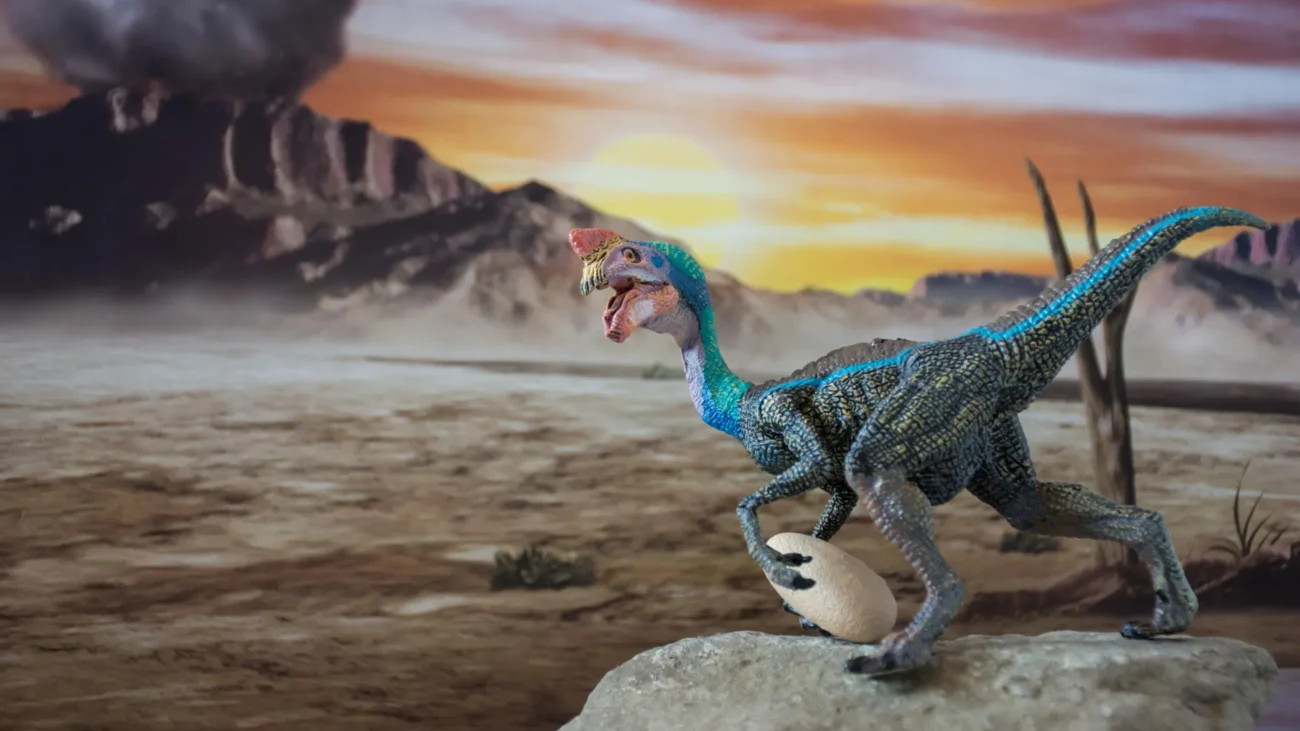
The enigmatic oviraptors, a group of feathered, bird-like dinosaurs that roamed the Earth during the Late Cretaceous Period (approximately 100 to 66 million years ago), have long captivated the scientific imagination. While their bird-like features and distinctive crests have provided crucial insights into the evolution of modern birds, one persistent question has eluded definitive answers: how did these non-avian dinosaurs bring their young into the world? Did they meticulously incubate their eggs, much like contemporary birds, or did they rely on the ambient warmth of their environment, akin to reptiles like crocodiles and turtles? A groundbreaking new study, published in the esteemed journal Frontiers in Ecology and Evolution, has embarked on an ambitious journey to illuminate this ancient puzzle by combining meticulous physical reconstructions with sophisticated computer simulations.
This pioneering research, spearheaded by a team of scientists in Taiwan, has dared to recreate an oviraptor nest and its brooding adult to rigorously test hypotheses about incubation. Their findings offer a compelling new perspective on oviraptor parental care, suggesting that the positioning of the adult dinosaur relative to its clutch played a pivotal role in egg development, and that their incubation strategy was demonstrably less efficient than that of modern avian species.
Reconstructing the Incubating Dinosaur and its Nest
The scientific endeavor began with a detailed focus on Heyuannia huangi, a specific species of oviraptor that inhabited what is now China between 70 and 66 million years ago. This dinosaur, estimated to be around 1.5 meters in length and weighing approximately 20 kilograms, is known from fossil evidence to have constructed semi-open nests, typically featuring multiple concentric rings of eggs.
To bring this ancient scene to life, the researchers meticulously constructed a life-sized model of an adult oviraptor. The anatomical structure of the model’s torso was built using a sturdy wooden framework, padded with polystyrene foam to represent musculature. Soft tissues were further simulated using layers of cotton, cloth, and bubble paper, aiming for a realistic approximation of the animal’s form. The eggs themselves, a critical component of the study, were cast from resin. Their size, shape, and number were carefully calibrated to match the arrangements observed in fossilized oviraptor nests, which often display eggs laid in double rings.
The creation of these artificial eggs presented its own unique challenges. "Oviraptor eggs are unlike those of any living species," explained Chun-Yu Su, the lead author of the study and a student at Washington High School in Taichung at the time of the research. "So, we invented the resin eggs to approximate real oviraptor eggs as best as we could." This dedication to detail underscores the commitment to scientific accuracy that underpins the entire project.
The Role of Adult Positioning and Environmental Heat
With their life-sized oviraptor model and meticulously crafted nest in place, the research team proceeded to conduct a series of physical experiments and computer simulations. The core of their investigation focused on how different environmental conditions, combined with the presence and positioning of the brooding adult, affected the temperature of the eggs.
The results revealed a significant correlation between the adult’s proximity and the thermal gradient across the nest. Under cooler ambient conditions, eggs situated in the outer rings of the nest, when attended by the oviraptor model, exhibited temperature differences of up to 6 degrees Celsius compared to those closer to the adult. Such a substantial temperature variation within a single clutch could have led to asynchronous hatching – meaning that some eggs would have hatched considerably earlier than others. This differential hatching could have implications for the survival and development of hatchlings, potentially creating a hierarchy within the brood.
However, when the experiments were conducted under warmer environmental conditions, the temperature disparity between the inner and outer eggs diminished significantly, dropping to a mere 0.6 degrees Celsius. This observation strongly suggests that sunlight played a crucial, and perhaps even dominant, role in regulating egg temperatures, particularly in warmer climates.
Dr. Tzu-Ruei Yang, the senior author of the study and an associate curator of vertebrate paleontology at Taiwan’s National Museum of Natural Science, elaborated on this finding: "It’s unlikely that large dinosaurs sat atop their clutches. Supposedly, they used the heat of the sun or soil to hatch their eggs, like turtles. Since oviraptor clutches are open to the air, heat from the sun likely mattered much more than heat from the soil." This indicates a behavioral adaptation where the oviraptor might have strategically positioned itself to maximize solar exposure for its eggs, or perhaps utilized its body heat more indirectly to create microclimates.
Comparing Oviraptor Incubation to Modern Birds
The study also delved into a direct comparison between the oviraptor’s hypothesized incubation strategy and that of modern birds. Most contemporary birds employ a method known as thermoregulatory contact incubation (TCI). This strategy is characterized by three key conditions: the parent must maintain direct physical contact with all the eggs, serve as the primary source of heat, and keep the entire clutch within a relatively narrow and consistent temperature range.
The researchers concluded that oviraptors were likely incapable of achieving TCI in the same manner as modern birds. The distinctive semi-open, multi-ringed structure of oviraptor nests, as evidenced by fossil discoveries, would have made it physically impossible for an adult to make direct contact with every egg simultaneously. Furthermore, the significant temperature variations observed, particularly under cooler conditions, suggest that oviraptors could not maintain the uniform thermal environment essential for TCI.
"Oviraptors may not have been able to conduct TCI as modern birds do," stated Su. "Instead, these dinosaurs and the sun may have been co-incubators – a less efficient incubation behavior than that displayed by modern birds." This co-incubation model, where the adult’s presence and the ambient environment (primarily solar radiation) worked in tandem, represents a fascinating evolutionary step. The study posits that this strategy might have been a behavioral adaptation linked to the transition from fully buried nests, which would have relied more heavily on geothermal or soil heat, to the more exposed, semi-open nests characteristic of oviraptors.
Dr. Yang emphasized that this comparison should not be interpreted as a hierarchical judgment. "Modern birds aren’t ‘better’ at hatching eggs," he clarified. "Instead, birds living today and oviraptors have a very different way of incubation or, more specifically, brooding. Nothing is better or worse. It just depends on the environment." This nuanced perspective highlights the adaptive nature of evolution, where different strategies evolve to suit specific ecological niches and environmental pressures.
Broader Implications for Understanding Dinosaur Parenting and Evolution
The findings of this Taiwanese research team carry significant implications for our understanding of dinosaur parenting and the broader evolutionary trajectory from non-avian dinosaurs to birds. Oviraptors, with their feathered bodies, nesting behaviors, and likely parental care, are already considered vital links in this evolutionary chain. This new study adds another layer of complexity to their parental strategies, suggesting a sophisticated, albeit less efficient by modern bird standards, method of reproduction.
The estimated lower incubation efficiency of oviraptors compared to modern birds, as noted by Su, might have necessitated longer incubation periods or perhaps a higher rate of egg loss due to environmental fluctuations. This could also explain the semi-open nest design, which, while allowing for better solar access, also exposed the eggs to greater risks from predators or extreme weather.
This research also serves as a powerful testament to the innovative methods that can be employed in paleontology. By integrating physical reconstructions with thermal modeling, scientists can now probe questions about dinosaur reproduction that were previously difficult or impossible to answer through the analysis of fossils alone. This interdisciplinary approach opens up new avenues for future research, potentially allowing for the reconstruction and analysis of other dinosaur behaviors and life cycles.
Moreover, the study has a personal and inspiring dimension. Dr. Yang highlighted the significance of this work for students in Taiwan, a region not known for its dinosaur fossil discoveries. "It also truly is an encouragement for all students, especially in Taiwan," he concluded. "There are no dinosaur fossils in Taiwan, but that does not mean that we cannot do dinosaur studies." This sentiment underscores the global nature of scientific inquiry and the power of dedication and ingenuity in overcoming geographical limitations.
A Glimpse into the Late Cretaceous Ecosystem
To fully appreciate the significance of these findings, it is important to contextualize the Late Cretaceous period. This era was marked by a vastly different global climate than today, with potentially higher average temperatures and different atmospheric compositions. The presence of large continents and varied ecosystems would have presented oviraptors with a range of environmental conditions under which they had to evolve successful reproductive strategies.
The name "oviraptor," meaning "egg thief," itself is a fascinating historical footnote that highlights how scientific understanding evolves. The first oviraptor fossil was unearthed near a nest, leading early researchers to erroneously believe the dinosaur was raiding it. However, subsequent discoveries, including fossils of oviraptors found in brooding positions atop their own nests, have overturned this misconception, revealing them to be likely devoted parents. This reevaluation of their role further emphasizes the importance of careful scientific investigation and the willingness to revise hypotheses based on new evidence.
The Late Cretaceous was also a period of immense biodiversity and significant evolutionary change. The rise of flowering plants, the diversification of mammals, and the continued reign of dinosaurs, alongside the emergence of early birds, painted a dynamic and complex ecological tapestry. Oviraptors, with their unique characteristics and evolutionary position, were an integral part of this vibrant world. Their role in this ecosystem, particularly their reproductive strategies, offers a crucial window into the intricate relationships and adaptations that defined this pivotal period in Earth’s history.
Future Directions and Unanswered Questions
While this study provides substantial new insights, the researchers acknowledge certain limitations and areas for future exploration. The conclusions are inherently tied to the specific reconstructed nest used in the study, and variations in nest construction among different oviraptor species could lead to different incubation dynamics. Furthermore, the significant differences in Earth’s climate between the Late Cretaceous and the present day mean that direct extrapolation of results requires careful consideration.
The hypothesis of longer incubation periods for oviraptors compared to modern birds, for instance, could have further implications for their reproductive success and life history. Future research could explore this by examining bone histology or other fossil evidence that might shed light on growth rates and incubation times. Additionally, understanding the full spectrum of oviraptor nesting behaviors, including potential variations in clutch size, egg orientation, and nest site selection, could provide a more comprehensive picture of their reproductive ecology.
The study’s innovative methodology, however, sets a precedent for future paleontological research. By bridging the gap between physical reconstruction and advanced computational modeling, scientists are better equipped to tackle complex questions about the biology and behavior of extinct organisms. As more data becomes available and analytical techniques advance, our understanding of the ancient world, and the remarkable creatures that inhabited it, will continue to deepen and evolve. The oviraptor, once mistakenly labeled an "egg thief," is steadily revealing itself to be a complex and fascinating parent, a vital piece in the grand puzzle of life’s evolutionary journey.

