


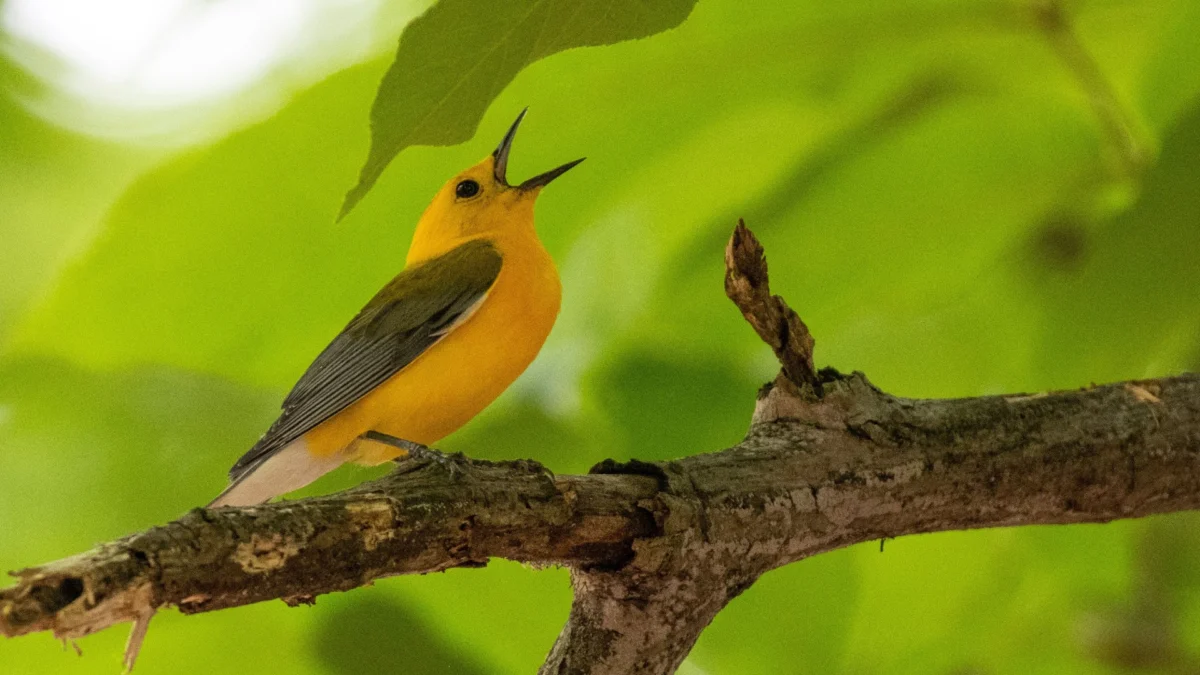
The arrival of these birds in Kansas represents a significant shift in the known breeding geography of the species. While sightings have been recorded as far west as Wichita, the core of the newly established population is firmly rooted in the southeastern corner of the state. This development was not immediately recognized as a permanent expansion. In 2023, local resident Kathy Fox, based near Pittsburg, Kansas, made a startling discovery: the birds were not merely passing through during a migratory stopover but were actively utilizing bluebird nesting boxes to raise their young. This observation served as the catalyst for a formal scientific investigation, as researchers sought to determine whether this was an isolated event or the beginning of a broader range expansion.
Environmental Drivers of Population Expansion
The presence of the Prothonotary Warbler in Kansas is inextricably linked to the changing landscape of the region. Historically, this warbler prefers mature, bottomland hardwood forests and swampy environments where it can nest in tree cavities near standing water. The transformation of former strip-mining sites into reclaimed, forested wetlands has provided a novel habitat that mimics the conditions the species prefers. As these reclaimed areas have matured over the last several decades, they have created a "green corridor" that may have allowed the Prothonotary Warbler to move further inland than its traditional range would suggest.
Ecologists point to this as a classic example of "habitat-induced expansion," where the creation of niche-specific environments allows species to colonize previously unoccupied territories. For the Prothonotary Warbler, the abundant, insect-rich, and sheltered environments of these reclaimed wetlands provide an ideal breeding ground, free from the intense competition found in more crowded, historical ranges. The success of these nesting attempts suggests that the birds are not just surviving, but thriving in their new Kansas home, with nesting success rates that appear to match or exceed those observed in their core southern habitats.

Tracking the 5,000-Mile Odyssey
The establishment of this population has provided a unique, once-in-a-lifetime opportunity for researchers to track the migratory habits of a "pioneer" population. Led by graduate student Gabe McClain from Pittsburg State University, a team of biologists began a comprehensive tracking study in June 2025. The study utilizes state-of-the-art geolocators—miniature, lightweight devices that record light-level data to estimate the bird’s location over time.
Because these warblers weigh only about 12 to 15 grams, the weight of the tracking equipment is a critical concern. Researchers ensure that the devices represent less than three percent of the bird’s total body mass, a safety threshold established by the Ornithological Council to prevent physical stress or behavioral interference during migration. These devices do not transmit real-time data via satellite; instead, they function as "black boxes" that must be retrieved once the bird returns to its nesting site.
The data harvested from the first successful recovery of a tagged bird, nicknamed "Hydrogen," was nothing short of extraordinary. The bird was tagged in the Kansas City area in June 2025. The tracking data revealed that by late October, Hydrogen had completed a grueling 5,000-mile round trip, reaching as far south as Bolivar, Colombia. This migration highlights the immense physiological demands placed on such a small creature, which must navigate thousands of miles of ocean, forest, and urban development to reach its wintering grounds before returning to the exact same nesting box the following spring.
Scaling the Research Effort
The success of the initial tracking phase led to a rapid expansion of the project. While only six birds were fitted with trackers in 2025, the research team increased this capacity to 36 individuals in the subsequent season. This surge in data is allowing scientists to build a more robust statistical model of how these birds navigate. Preliminary findings suggest that the Kansas population does not follow a monolithic route; rather, there is evidence of individual variation in the paths taken, stopover sites selected, and timing of arrival in South America.

This research has significant implications for migratory biology. By studying a population at the edge of its range, scientists can observe the mechanisms of natural selection in real-time. Are these birds "genetically programmed" to explore new frontiers, or is the expansion a result of sheer population pressure in traditional ranges? Understanding these dynamics is crucial for conservation efforts, particularly as climate change continues to alter the distribution of available habitats across the North American continent.
Implications for Conservation and Biodiversity
The Prothonotary Warbler serves as an "indicator species," meaning its presence or absence can tell researchers a great deal about the overall health of an ecosystem. Because they require specific types of cavity-rich, wet woodlands, their success in Kansas is a testament to the effectiveness of wetland restoration programs. The transition of former industrial sites, such as abandoned strip mines, into biodiverse, functioning ecosystems demonstrates that land management practices can have a direct, positive impact on avian populations.
However, this expansion is not without its challenges. The reliance of these birds on artificial nesting boxes in the Kansas population suggests that natural nesting sites—such as dead trees or abandoned woodpecker holes—may still be in short supply. Ornithologists are monitoring this closely, as the availability of natural cavities is a limiting factor for the long-term sustainability of the population. If the number of birds continues to grow, the demand for nesting resources will eventually outstrip the current supply of man-made boxes.
The Seasonal Window: What Birdwatchers Should Know
As the calendar turns toward the end of summer, the local population of Prothonotary Warblers is entering a critical phase: the preparation for fall migration. Unlike some species that remain in the region until the first frost, these warblers are early migrants. By mid-to-late August, the intensity of their singing begins to wane, and their behavior shifts toward foraging to build up the fat reserves necessary for the trans-continental journey.

For amateur birdwatchers, the next few weeks offer the best opportunity to catch a glimpse of these vibrant birds. Observers are encouraged to focus their efforts on riparian corridors, lake edges, and any managed wetlands in southeast Kansas. The birds are often found in the lower canopy, moving quickly through the foliage in search of insects. Because they are highly territorial during the nesting season, they may be found near their boxes, but as the breeding season concludes, they become more elusive.
The scientific community has expressed gratitude for the public’s cooperation in this endeavor. Local birders have been instrumental in reporting sightings, which helps researchers map the spread of the population across the state. This citizen-science component is vital for a project of this scale, providing a level of "boots-on-the-ground" surveillance that a small team of graduate students could not achieve alone.
Looking Toward the Future
As the 2026 migration season progresses, the eyes of the birding world are on Kansas. The success of the Prothonotary Warbler is a rare, tangible piece of good news in the context of global bird population declines. It illustrates that when habitats are restored and protected, nature often finds a way to fill those spaces, even in unexpected places.
The research conducted by the team at Pittsburg State University will continue for the foreseeable future. The goal is to accumulate enough multi-year data to determine if this Kansas population is stable enough to be considered a permanent fixture of the regional ecosystem. For now, the sight of a golden-yellow blur darting through a Kansas wetland remains a testament to the resilience of migratory birds and the surprising ways in which our landscapes are constantly evolving. As these birds take flight for their wintering grounds in South America, they carry with them the data that will eventually unlock the mysteries of their historic arrival in the heart of the American Midwest.

