


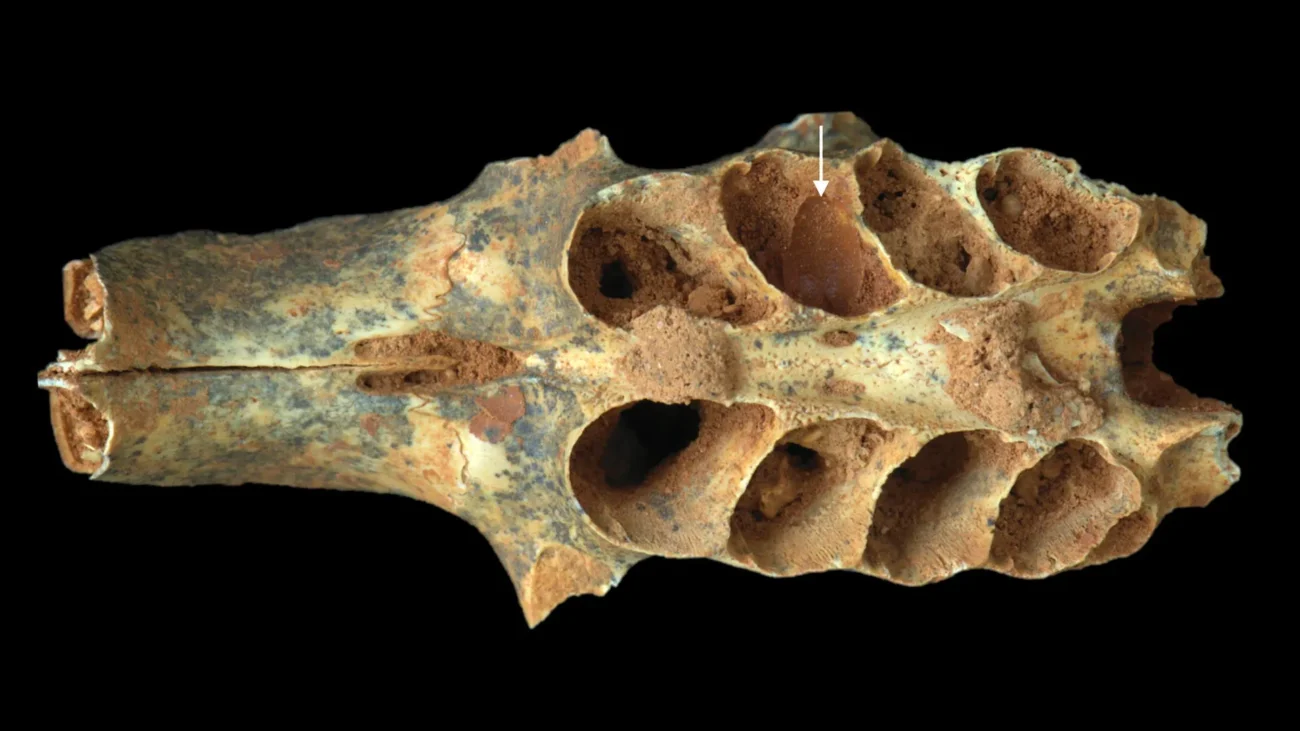
Deep within a limestone cave on the Caribbean island of Hispaniola, a remarkable prehistoric ecosystem has yielded an entirely unprecedented scientific discovery. According to a groundbreaking study recently published in the academic journal Royal Society Open Science, ancient solitary bees utilized the fossilized jawbones of small mammals—specifically capitalizing on empty tooth sockets—as microscopic nurseries for their offspring approximately 20,000 years ago. This revelation marks the first time in the history of paleontology and entomology that researchers have documented bees using animal skeletal remains as nesting sites. The finding not only expands our understanding of insect reproductive behavior in prehistoric epochs but also highlights the complex, interconnected nature of ancient island ecosystems.
The investigation was spearheaded by Lazaro Viñola López, a postdoctoral researcher at the Field Museum in Chicago, alongside an international team of paleontologists. The research originated while Viñola López was completing his doctoral studies at the University of Florida and the Florida Museum of Natural History. The fossil-rich cave system itself was initially identified and cataloged by Juan Almonte Milan, the curator of paleobiology at the Dominican Republic’s Museo Nacional de Historia Natural, who has dedicated decades to uncovering the paleontological treasures of Hispaniola.
The Setting: Navigating a Prehistoric Vault in Hispaniola
The geography of Hispaniola—an island shared politically by the nations of Haiti and the Dominican Republic—is heavily defined by karst topography. The landscape is perforated by thousands of limestone caves and sinkholes, a geological formation where acidic rainwater slowly dissolves soluble bedrock over millennia.
"In some areas, you’ll find a different sinkhole every 100 meters," Viñola López explains. Accessing the specific cave investigated in this study required technical fieldwork, including securing ropes to the surface and rappelling down a vertical shaft. The subterranean environment presented its own distinct atmosphere. Upon descending, researchers frequently encountered resident tarantulas lurking in the darkness before navigating a ten-meter-long horizontal tunnel that opened into the primary fossil repository.
This subterranean vault preserved multiple distinct stratigraphical layers, separated by carbonate deposits that accumulated during ancient, highly localized rainy periods. The sedimentary record functioned as a natural archive, capturing a diverse cross-section of the island’s Late Pleistocene fauna. While the vast majority of recovered remains belonged to extinct rodents, the site also yielded fossils from ground sloths, ancient birds, reptiles, and over 50 distinct vertebrate species.
The accumulation of such a massive bone bed was not the result of a single catastrophic event, but rather the cumulative activity of avian predators over millennia. "We think that this was a cave where owls lived for many generations, maybe for hundreds or thousands of years," Viñola López notes. These raptors would forage across the surrounding landscape, return to the safety of the subterranean alcoves, and regularly regurgitate indigestible material in the form of pellets containing the skeletal remains of their prey. Over generations, the floor of the cave became densely carpeted with these osteological remnants, alongside the bones of the owls themselves and occasional unfortunate reptiles, such as turtles and crocodiles, that fell into the vertical shafts.
Serendipitous Discovery in the Laboratory
The discovery of the prehistoric bee nests was entirely accidental. While cleaning and examining mammalian jawbones recovered from the owl pellets, Viñola López noticed structural anomalies within the empty alveolar spaces—the hollow sockets left behind by missing teeth.
Unlike the loose, chaotic sediment that naturally filled many of the fossil cavities, these particular deposits featured smooth, concave, meticulously shaped surfaces. "It was a smooth surface, and almost concave. That’s not how sediment normally fills in, and I kept seeing it in multiple specimens. I was like, ‘Okay, there’s something weird here,’" he recalls. The morphological regularity of the structures triggered a memory from his undergraduate years during a fossil excavation in Montana, where a colleague had demonstrated fossilized wasp cocoons—small, hardened mud chambers where insect larvae develop into adulthood. The resemblance between those ancient wasp chambers and the structures nested within the Hispaniolan mammal jaws was striking.
To confirm his suspicions without compromising the integrity of the fragile fossils, the research team subjected the jawbones to high-resolution X-ray computed tomography (CT) scanning. This non-invasive imaging technique generated detailed, three-dimensional digital models of the internal architecture of the tooth sockets, revealing complex chambers constructed from compacted fine-grained sediment.
Further analysis of the CT data confirmed that the structures bore an exact morphological match to the mud nests built by contemporary solitary bees. Moreover, microscopic examination revealed preserved grains of ancient pollen trapped within the mud chambers. This discovery provided a smoking gun: female solitary bees had actively gathered mud, mixed it with saliva, and built secure individual brood cells inside the hollow bones, stocking them with pollen provisions to nourish their developing larvae.
Solitary Bees and Evolutionary Ingenuity
In contemporary public perception, bees are frequently associated with highly social, colony-building species such as honey bees or bumblebees, which construct elaborate communal hives. However, entomologists emphasize that the vast majority of bee species worldwide are solitary.
Unlike their social relatives, solitary bees do not possess queens, workers, or complex caste systems. Instead, a single female bee mates, independently constructs a nest within a pre-existing cavity or a self-excavated burrow, provisions the space with a mixture of pollen and nectar, lays an egg, and seals the chamber. The offspring develop independently without direct maternal care.
To find suitable nesting environments, solitary bees exhibit remarkable behavioral plasticity. Species across the globe utilize hollow plant stems, abandoned beetle burrows in dead wood, crevices in rocks, or tunnels excavated directly into the earth. Certain specialized species indigenous to parts of Europe and Africa are even known to repurpose empty land snail shells as portable or sheltered nurseries.
The utilization of vertebrate bone cavities—specifically the tiny tooth sockets of rodents—adds an entirely new category to the known repertoire of solitary bee nesting substrates. Measuring less than the dimensions of a pencil eraser, each individual nest fit perfectly within the anatomical constraints of a rodent jaw.
Beyond providing a readymade physical boundary, nesting inside the hollow bones of larger animals offered distinct evolutionary advantages. The thick, mineralized bone walls likely provided superior structural protection against environmental fluctuations, humidity, and potential invertebrate predators, such as parasitic wasps seeking to lay their eggs inside host nests.
Taxonomic Classification: Introducing Osnidum almontei
Because the warm, humid climate of Hispaniola is exceptionally detrimental to the preservation of fragile, chitinous insect exoskeletons, the researchers did not recover any fossilized bee bodies within the mud chambers. The absence of physical insect remains initially presented a significant challenge for identification, preventing scientists from determining the exact species responsible for the construction.
Nevertheless, the architectural distinctiveness of the trace fossils—structures left behind by the behavior of an organism rather than the organism itself—was sufficient to warrant formal scientific description and taxonomic classification. The research team named the new ichnotaxon Osnidum almontei. The genus name reflects the specialized nature of the trace fossils, while the species designation honors Juan Almonte Milan, recognizing his foundational contributions to Dominican paleontology and his initial discovery of the cave site.
The identity of the bees that built Osnidum almontei remains an open question in evolutionary biology. Because so little is documented regarding the contemporary ecology and distribution of native insect species across Caribbean islands, it remains entirely plausible that the architect bee species survives today, persisting largely unnoticed in remote forested pockets of Hispaniola. Conversely, given that a substantial percentage of the vertebrate species preserved alongside the nests in the Pleistocene fossil layers are now extinct, the bee species itself may have vanished during past ecological upheavals.
Environmental Pressures and Evolutionary Drivers
The emergence of bone-nesting behavior in Hispaniola’s Pleistocene bees was almost certainly dictated by severe environmental constraints. Geological and paleoenvironmental reconstructions of the island during the last glacial maximum indicate that the extensive limestone karst terrain featured very shallow, rocky soils. This paucity of deep earth would have severely limited the availability of traditional ground-nesting substrates utilized by many solitary bee lineages.
Simultaneously, the continuous, long-term occupation of the cave by generations of predatory owls resulted in a relentless accumulation of skeletal debris. To an opportunistic solitary bee navigating a resource-scarce landscape, the scattered rodent jaws littering the cave floor represented an abundance of readymade, pre-formed cavities of optimal size. This convergence of geological scarcity and biological abundance created a unique evolutionary pressure, driving the bees to adopt a novel, highly specialized reproductive strategy.
The findings carry broader methodological implications for paleontologists and evolutionary biologists. Researchers studying fossiliferous deposits frequently focus their analytical efforts on large vertebrate remains—mammals, reptiles, and birds—while treating adhering sediments or micro-fossils as extraneous matrix to be cleared away. Viñola López emphasizes that this discovery underscores the critical importance of maintaining vigilance for trace fossils and micro-evidence during excavation and preparation.
"This discovery shows how weird bees can be—they can surprise you. But it also shows that when you’re looking at fossils, you have to be very careful," Viñola López notes. "Even if you’re looking primarily for fossils of larger, vertebrate animals, you should keep an eye out for trace fossils that can tell you about invertebrates like insects. Knowing about insects can tell you a lot about a whole ecosystem, so you have to pay attention to that part of the story."
As researchers continue to analyze the rich stratigraphic layers of Hispaniola’s cave systems, the discovery of Osnidum almontei serves as a powerful reminder of the hidden complexities embedded within the fossil record. By bridging the fields of vertebrate paleontology and invertebrate paleoecology, scientists are gaining a more holistic appreciation of how ancient species adapted, survived, and intertwined their fates in prehistoric island worlds.

