


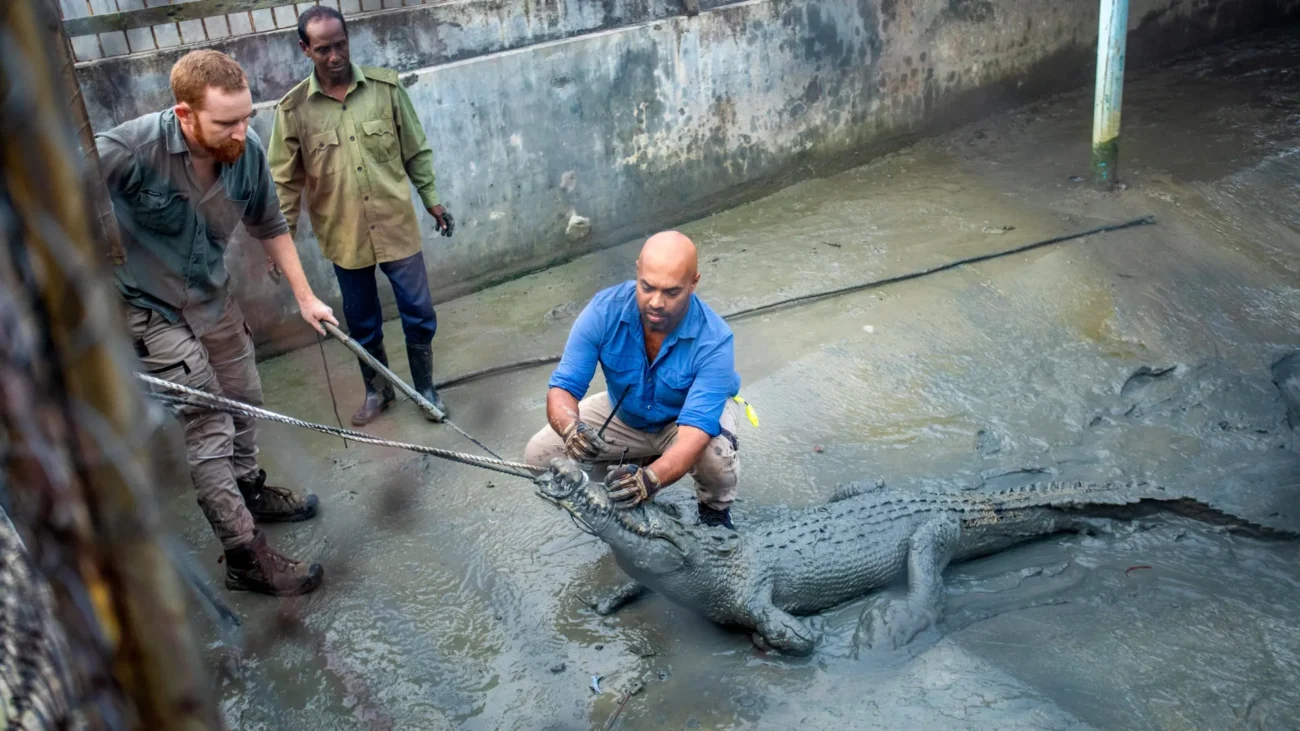
The global framework of wildlife conservation has long struggled with the complex behavioral biology of apex predators, particularly when attempting to restore depleted populations through captive-rearing initiatives. A groundbreaking study recently published in the journal Wildlife Research offers a significant breakthrough in this domain, suggesting that saltwater crocodiles born or raised in captivity do not exhibit the persistent urge to return to their breeding facilities once released into natural habitats. This behavioral insight could fundamentally reshape how environmental scientists approach the recovery of declining estuarine crocodile populations across the tropics and subtropics.
For decades, conservationists have observed that many animal species possess a sophisticated internal compass, a natural homing instinct critical for survival and reproduction. While some creatures execute short, routine journeys between food sources and nesting grounds, others navigate across hundreds of kilometers of unfamiliar terrain over extended periods. Among the most formidable navigators are crocodilians—the massive apex predators that command freshwater and brackish ecosystems. However, this powerful homing instinct has historically proven to be a double-edged sword for conservation programs, frequently undermining efforts to relocate nuisance animals or reintroduce captive populations to safe habitats.
Understanding the mechanics of this behavior has challenged wildlife biologists, especially regarding how prolonged captivity alters an animal’s spatial orientation and psychological attachment to its enclosure. To investigate this critical knowledge gap, an international team of researchers focused their efforts on the Sundarbans mangrove forest in Bangladesh, a fragile and globally significant ecosystem serving as one of the country’s final refuges for the saltwater crocodile, scientifically known as Crocodylus porosus.
Historical Decline and the Vulnerable Sundarbans Ecosystem
The historical context of the saltwater crocodile in Bangladesh is marked by severe anthropogenic pressure. Throughout the early and mid-twentieth century, heavy commercial hunting for high-value crocodile skins decimated populations across the region. By the 1970s, the species had been pushed to the brink of localized extinction. Although the government of Bangladesh enacted legal protections for saltwater crocodiles in 1973, subsequent decades have failed to yield a measurable demographic recovery.
Today, the vast majority of Bangladesh’s remaining wild saltwater crocodiles are restricted to the Sundarbans mangrove forest, a sprawling tidal wetland shared with India and recognized as a UNESCO World Heritage site. Despite its protected status, the ecosystem faces continuous threats from rising sea levels, increased salinity, human encroachment, and localized poaching. Most concerningly, recent ecological surveys estimate that the mature saltwater crocodile population within the Bangladeshi Sundarbans stands at a precariously low 140 individuals. Such a small gene pool leaves the population acutely vulnerable to stochastic environmental events and inbreeding depression.
Traditional conservation strategies have typically relied on releasing hatchlings into the wild to bolster numbers. However, this approach carries severe limitations. Hatchling mortality rates in natural environments are exceptionally high, driven by predation from birds, fish, and larger reptiles. Furthermore, it takes many years for a newly hatched crocodile to reach reproductive maturity, delaying any positive impact on population growth rates. Consequently, conservationists have increasingly wondered whether utilizing larger, older, captive-bred subadults and adults could provide a more viable shortcut to population restoration.
The Crucial Dilemma of Captive Reintroduction
The primary obstacle to utilizing mature captive-reared crocodiles in reintroduction programs has always been the fear of homing behavior. Behavioral ecologist and Adjunct Associate Professor Ru Somaweera from Murdoch University, a key collaborator on the research project, highlights the core dilemma facing wildlife managers.
"If crocodiles who are bred and raised in captivity subsequently return to their enclosures or breeding facilities after being released, attempts to reintroduce them into the wild as part of conservation efforts will ultimately fail," Associate Professor Somaweera explains. "Crocodiles are remarkably good at finding their way home, often returning to their original capture sites and limiting the success of relocation programs. What we still don’t fully understand, though, is how this behavior plays out in individuals that have been bred or kept in captivity for long periods before being released back into the wild."
To address this critical uncertainty, researchers designed a targeted empirical study to monitor and compare the post-release spatial ecology of different categories of mature saltwater crocodiles. The project was led by IUCN Bangladesh and the Bangladesh Forest Department, with significant financial backing from the Deutsche Gesellschaft für Internationale Zusammenarbeit (GIZ).
Methodology and Satellite Tracking of Test Subjects
The scientific team implemented a rigorous tracking methodology, deploying advanced satellite telemetry units to monitor the real-time movements of selected test subjects within the Sundarbans. The study cohort comprised five mature saltwater crocodiles representing distinct life histories, allowing researchers to draw direct comparisons between captive-reared and wild-origin animals.
The experimental group included three captive-reared females that had spent between 8 and 22 years housed within artificial breeding and holding facilities. To serve as behavioral baselines, the researchers also tracked two wild-caught individuals: a local wild crocodile that was captured and promptly released at the exact same site, and a translocated wild crocodile that was captured and intentionally moved a significant distance away from its home range.
Following the attachment of the satellite tracking devices, the scientists monitored the spatial behavior, daily displacement distances, and habitat selection of all five apex predators over several consecutive months.
Absence of Homing Instinct in Captive-Reared Subjects
The empirical results yielded unexpected and highly encouraging data regarding the captive-reared cohort. Contrary to traditional assumptions that long-term captive animals would immediately attempt to navigate back to their human-managed facilities, none of the three captive-reared females showed any behavioral inclination to return to their former enclosures.
"Instead, they settled into small, well-defined areas and moved in much the same way as the local wild crocodile we tracked, which tells us they are possibly able to adapt to their new environment seamlessly," Associate Professor Somaweera noted.
The tracking data revealed that these captive-reared individuals quickly established home ranges, engaged in localized foraging behaviors, and avoided erratic long-distance wandering. Their movement profiles closely mirrored those of the native wild crocodile, suggesting an innate behavioral plasticity that enables them to interpret natural environmental cues and establish ecological stability without prior wilderness experience.
Contrasting Behavior in Translocated Wild Crocodiles
In sharp contrast to the seamless integration observed among the captive-reared individuals, the translocated wild crocodile—designated in the study as Jongra—exhibited classic, highly pronounced homing behavior after being moved approximately 132 kilometers away from his original capture site.
"Unfortunately, the results weren’t as good for the wild crocodile Jongra, who was translocated about 132km from his home before being released," Somaweera stated. "Although Jongra didn’t make it back to his original capture site during the study, his movements were very clearly going in that direction. He traveled far more each day than any other crocodile we tracked, covered an exceptionally large area, and even recorded single-day movements of more than 30 kilometers: all typical signs of homing behavior."
Jongra’s frantic navigational efforts underscore the powerful psychological mapping possessed by wild adult crocodilians. When forcibly displaced from established territories, wild individuals experience high stress levels and expend enormous metabolic energy attempting to return home, frequently bringing them into dangerous proximity to human settlements along riverbanks and increasing human-wildlife conflict.
Broader Implications for Global Conservation Strategies
The stark contrast identified between the captive-reared crocodiles and the translocated wild subject carries profound practical value for wildlife management agencies and conservation practitioners worldwide. As freshwater and estuarine habitats face mounting pressures from industrial development, climate change, and habitat fragmentation, the need for effective species recovery protocols has never been more urgent.
The study provides empirical justification for shifting reintroduction paradigms. By demonstrating that subadult and adult crocodiles raised in captivity do not possess an active homing drive toward their breeding centers, the research opens a viable pathway for utilizing mature individuals in supplementation programs. Because older crocodiles have already bypassed the vulnerable hatchling phase, their survival rates upon release are theoretically much higher, and they can contribute to reproductive output within the wild population much sooner.
However, the findings also sound a cautionary note for the management of nuisance wildlife. Conservation managers frequently attempt to resolve human-crocodile conflicts by capturing problem animals and relocating them to remote areas. Given the intense homing drive demonstrated by wild specimens like Jongra, simple translocation without physical barriers or careful release planning is likely to fail or exacerbate regional conflicts. The study emphasizes that translocated wild crocodiles require meticulous release planning and site selection to manage their persistent drive to return home.
Future Directions for Estuarine Predator Management
As the scientific community digests the conclusions of the study—formally titled What is home? Post-release movements of captive-reared and translocated mature saltwater crocodiles in Bangladesh—conservation authorities in South Asia and beyond are reviewing their operational protocols.
In Bangladesh, where the Sundarbans population remains perilously close to functional extinction, the integration of captive-reared subadults and adults offers a renewed sense of optimism. Forest Department officials, in partnership with international conservation organizations, are currently assessing how captive-breeding facilities can scale up their rearing programs to supply candidate animals for carefully monitored, science-based releases.
Ultimately, balancing the recovery of apex predators with the realities of human-dominated landscapes requires nuanced, data-driven approaches. By demystifying the spatial behavior of captive and wild crocodilians, this research equips conservationists with the empirical tools necessary to rebuild fragile ecosystems, one carefully monitored release at a time.

