


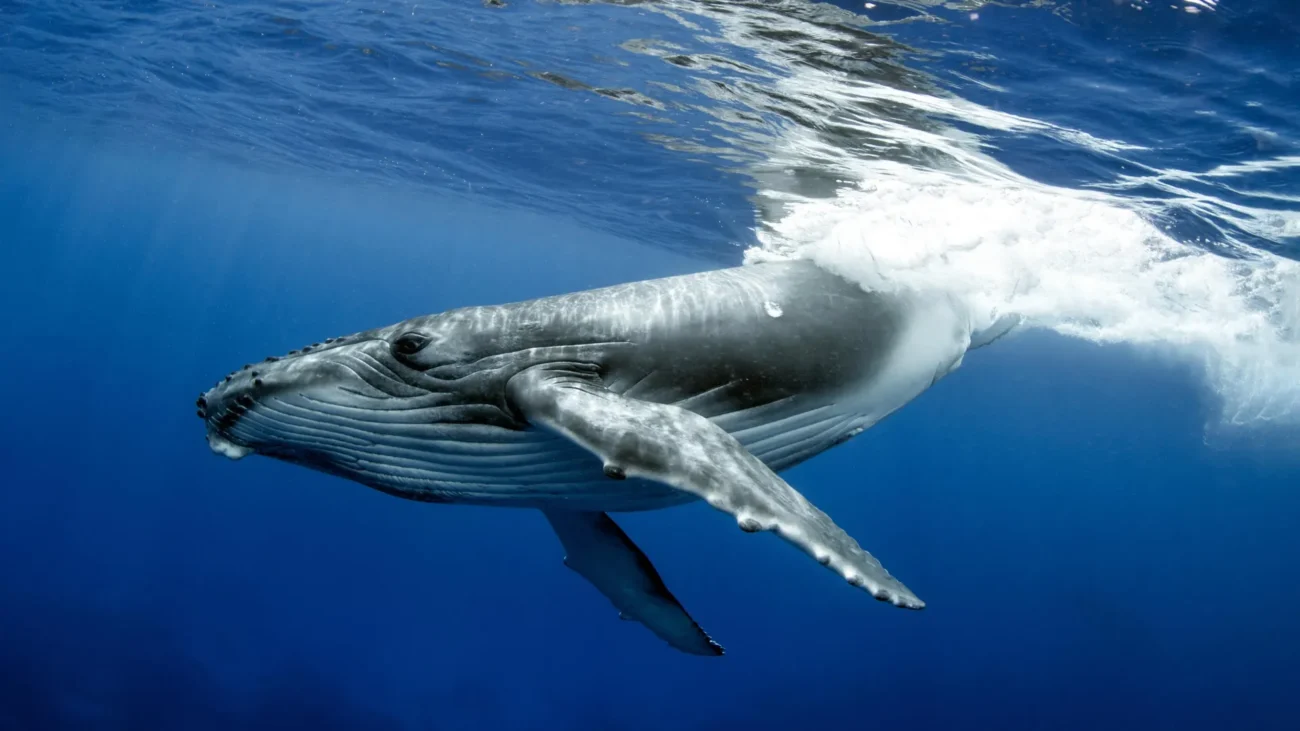
Marine biologists have documented an extraordinary and unprecedented milestone in marine ecology, confirming for the first time that humpback whales have crossed vast swaths of open ocean between breeding grounds in eastern Australia and Brazil. This astonishing aquatic journey spans a staggering distance of more than 14,000 to 15,000 kilometers, shattering previous assumptions about the geographic boundaries of individual whale migrations and setting a new global benchmark for the longest known movements of individual humpback whales ever recorded in scientific literature.
The groundbreaking discovery was recently published in the esteemed journal Royal Society Open Science under the title First evidence of bidirectional exchange between distant humpback whale breeding populations in eastern Australia and Brazil. By analyzing decades of visual data, marine researchers proved that these marine mammals are capable of making transoceanic journeys that bridge two entirely different hemispheres and cross multiple ocean basins. This revelation provides critical insights into marine mammal behavior, population connectivity, and the dynamic adaptability of baleen whales in a changing global climate.
The Anatomy of a Discovery: Fluke Photography and Global Collaboration
Unraveling a migration route of this magnitude required a monumental effort in international scientific collaboration, archival research, and cutting-edge digital data processing. The foundation of this discovery rests on the analysis of 19,283 high-quality photographs of humpback whale tails, universally known to researchers as flukes. Much like human fingerprints, the underside of a humpback whale’s tail features a unique pattern of pigmentation, scars, and serrated edges that remain consistent throughout the animal’s adult life. This biological uniqueness allows marine researchers to identify and track individual whales across vast expanses of time and geography.
The imagery used in the study was compiled over a period spanning more than four decades, stretching from 1984 through September 2025. This vast repository of data was not gathered by a single research vessel or institution; rather, it represents a massive synthesis of fieldwork conducted by professional marine biologists, academic researchers, and dedicated citizen scientists. A crucial catalyst for this research was Happywhale, a global online platform designed to aggregate and match whale sightings submitted by eco-tourists, whale-watching operators, and amateur photographers from around the world.
Once the photographs were aggregated, researchers employed automated image recognition software to screen thousands of images for potential matches. Following initial digital sorting, scientists manually verified every single feature of the candidate flukes to ensure absolute accuracy. The resulting matches revealed transoceanic connections that stunned the marine science community.
"Discoveries like this are only possible because of investment into long-term multi-decadal research programs and international collaboration," explained Stephanie Stack, a PhD candidate at Griffith University and co-author of the study. "These whales were photographed decades apart, by different people, in opposite parts of the world, separated by two different oceans, and yet we can connect their journey."
A Chronological Timeline of Record-Breaking Encounters
The study details two distinct, highly remarkable case studies that substantiate the phenomenon of bidirectional transoceanic migration. Together, these two individual whales provide irrefutable proof that inter-basin movement, though exceptionally rare, is a biological reality for the species.
The first documented whale provided a multi-stage puzzle for researchers. This individual was initially captured on camera in 2007 within the sheltered waters of Hervey Bay along the coast of Queensland, Australia. Six years later, in 2013, the exact same whale was spotted returning to the identical Australian coastal region. Years passed before the animal materialized thousands of miles away across the globe. In 2019, citizen scientists and researchers photographed the matching fluke pattern near the coast of São Paulo, Brazil.
Calculating the minimum straight-line distance between the Australian breeding grounds and the South American coast yielded a staggering figure of approximately 14,200 kilometers. To put this into perspective, this direct path is roughly equivalent to traveling from Sydney, Australia, to London, United Kingdom. However, marine biologists emphasize that this figure represents the absolute bare minimum distance traveled. Because scientists only captured the beginning and terminal points of the migration, the whale almost certainly swam an even greater distance by navigating around oceanic currents, underwater topographical features, and coastlines.
While the first whale’s journey was astonishing, a second individual produced an even more extreme record. First documented in 2003 at Brazil’s Abrolhos Bank—the premier humpback whale nursery situated off the coast of Bahia—this whale was initially photographed swimming within a lively social group consisting of nine adult whales. For over two decades, the animal vanished from the records of researchers monitoring the South Atlantic.
Then, in September 2025, twenty-two years after its initial sighting in Brazil, the same whale was photographed swimming entirely alone in Hervey Bay, Australia. Upon comparing the fluke images, researchers confirmed that this individual had traveled a documented straight-line distance of 15,100 kilometers. This incredible journey officially established a new global record for the longest known movement of an individual humpback whale anywhere on Earth.
The Rarity of Transoceanic Crossings
Despite the profound implications of these findings, the research team was quick to contextualize how unusual these events are within the broader scope of marine biology. Across more than forty years of systematic data collection encompassing nearly 20,000 uniquely identified humpback whales in eastern Australia and Latin America, only two individuals were confirmed to have made this transoceanic crossing.
Statistically, this represents a mere 0.01 percent of all whales included in the comprehensive dataset. Dr. Cristina Castro, lead researcher from the Pacific Whale Foundation, emphasized the value of every single observation in uncovering these needle-in-a-haystack events.
"This kind of research highlights the value of citizen science," Dr. Castro noted. "Every photo contributes to our understanding of whale biology and, in this case, helped uncover one of the most extreme movements ever recorded."
The extreme rarity of these migrations underscores the robustness of traditional migratory pathways. Humpback whales are renowned for exhibiting strong site fidelity, meaning they typically return year after year to the exact same breeding and feeding grounds utilized by their maternal lineages. Calves learn these traditional migration corridors from their mothers during their first year of life, reinforcing fidelity to specific regional habitats and reducing the evolutionary incentive to explore uncharted oceanic territories.
Ecological and Genetic Implications: Why Rare Crossings Matter
Even though only a minuscule fraction of humpback whales undertake these epic transoceanic journeys, marine scientists stress that these rare events carry outsized importance for the evolutionary resilience and long-term survival of the species.
"Despite their rarity, these exchanges matter for the long-term health of whale populations," Stephanie Stack remarked.
One of the primary biological benefits of such long-distance movements is the maintenance and enhancement of genetic diversity. Historically, whaling industries decimated global humpback populations to near-extinction during the 19th and 20th centuries, leaving surviving populations vulnerable to the negative genetic consequences of inbreeding and reduced gene pools. The occasional movement of an individual whale between geographically isolated breeding populations—such as those in Oceania and the South Atlantic—facilitates gene flow across vast distances, effectively serving as a natural mechanism to prevent genetic stagnation.
Furthermore, these rare crossings act as vectors for cultural transmission among marine mammal communities. Humpback whales are famous for their complex, evolving vocalizations, often referred to as whale songs. These songs are shared, adapted, and passed down within populations, spreading culturally across entire ocean basins in a manner remarkably similar to human musical trends. An individual migrating from Brazil to Australia, or vice versa, could theoretically introduce entirely novel song styles, behavioral tactics, or foraging knowledge to a completely foreign population.
The Southern Ocean Exchange Hypothesis and Climate Pressures
To explain how these whales managed to navigate between eastern Australia and Brazil, scientists point toward a prevailing ecological theory known as the "Southern Ocean Exchange" hypothesis.
During the polar summer months, humpback whales from diverse global breeding stocks converge upon the nutrient-rich waters of Antarctica to feed intensively on Antarctic krill, their primary food source. In these shared feeding grounds, whales from the Australian breeding stock and those from the South American stock occupy overlapping geographic zones.
Researchers theorize that during these seasonal aggregations, an individual whale from one population might occasionally become disoriented, follow members of a different migratory group, or simply choose to return north along an unfamiliar trajectory. Instead of migrating back to its natal breeding ground, the whale inadvertently follows a novel path that leads it to a completely different continental nursery, where it successfully integrates into a new population.
Looking toward the future, marine scientists warn that anthropogenic climate change could dramatically alter these migration patterns, potentially increasing the frequency of such extreme crossings. Rapid environmental shifts in the Southern Ocean, including the accelerated melting of Antarctic sea ice, warming ocean temperatures, and unpredictable fluctuations in the distribution and abundance of Antarctic krill, are actively modifying the traditional feeding ecology of baleen whales. As their primary food sources shift in response to warming seas, whales may be forced to travel further, explore new feeding grounds, and adapt their historic migration routes accordingly.
As research programs continue to expand with the integration of satellite tracking, genetic sampling, and crowdsourced photographic databases like Happywhale, the scientific community expects to uncover even more secrets regarding the behavior, resilience, and adaptability of the world’s most charismatic marine mammals. For now, the confirmation of a 15,000-kilometer transoceanic journey serves as a powerful reminder of the vast, interconnected nature of our global oceans and the enduring capacity of wildlife to continually surprise those who study them.

