


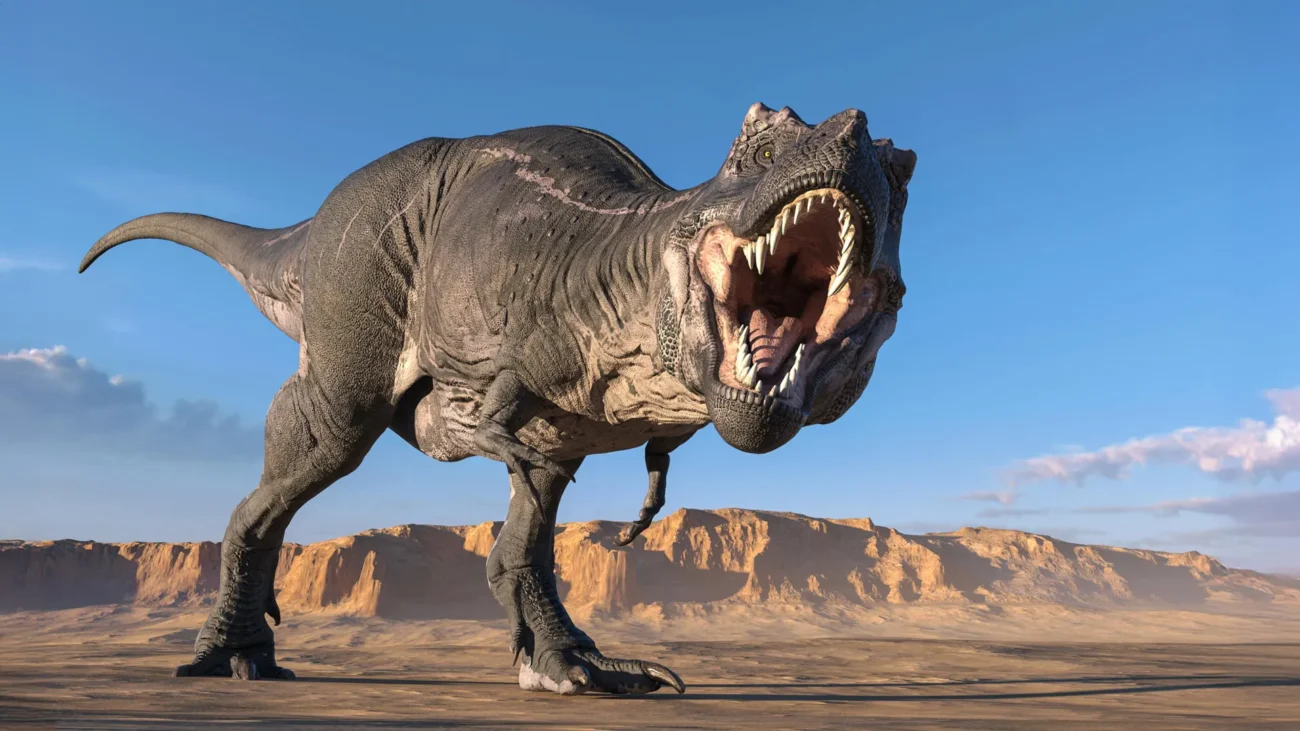
For more than a century, the physiological nature of Tyrannosaurus rex has remained one of paleontology’s most fiercely debated mysteries. Traditionally, scientists attempted to reconstruct the biology of this apex predator entirely from bones, teeth, footprints, and other trace fossils left behind more than 60 million years ago. While these physical remains offered extensive clues regarding its locomotion, bite force, and skeletal architecture, the exact nature of its internal metabolism remained elusive. Was the king of the tyrant lizards a sluggish, cold-blooded reptile dependent entirely on the sun for warmth, or did it possess an internal furnace akin to modern birds and mammals?
Clues discovered in remote northern regions—such as fossils unearthed in Alaska—long ago hinted that T. rex could tolerate cold, harsh conditions. This biogeographical evidence suggested that the giant dinosaur was transitioning away from the ectothermic (cold-blooded) physiology of modern reptiles and moving toward the endothermic (warm-blooded) metabolism seen in contemporary birds. However, these geographical clues remained circumstantial.
Now, a team of researchers has accomplished a feat that once seemed entirely impossible: they have effectively taken the internal temperature of a T. rex.
A breakthrough method developed by geobiologists at the University of California, Los Angeles (UCLA) has allowed scientists to estimate the body temperature of extinct animals using fossilized tooth enamel. When applied to specimens housed at the Natural History Museum of Los Angeles County, the results revealed that T. rex maintained a steady internal body temperature of approximately 97 degrees Fahrenheit (36 degrees Celsius)—remarkably close to the average internal temperature of a healthy human being.
Published in the peer-reviewed journal Science Advances, this landmark study bridges a critical gap in evolutionary biology. It reinforces the prevailing theory that T. rex was an active, highly energetic predator or scavenger with a rapid metabolism, while simultaneously explaining how these colossal creatures managed to thrive in environments that would have proven fatal to strictly cold-blooded reptiles.
A Decade-Long Technological Evolution
The journey toward taking the temperature of a 66-million-year-old apex predator required a decade of meticulous refinement in geochemistry. The UCLA research team originally developed their prehistoric thermometer method roughly ten years ago, seeking a reliable chemical proxy to determine whether long-extinct vertebrates were warm-blooded or cold-blooded.
When the technique was first conceived, applying it to T. rex presented a major logistical and ethical obstacle. The early iteration of the method required a substantial amount of fossil material—far more than any reputable museum would reasonably allow researchers to destroy or sacrifice from such an important, rare, and irreplaceable specimen. Preserved fossils of T. rex are exceptionally scarce, and curators guard them with intense scrutiny.
Over the ensuing ten years, however, the UCLA team dramatically optimized their analytical protocols. By refining the extraction and preparation phases, the researchers reduced the required quantity of ancient tooth material for testing by roughly 90 percent.
This technological leap was the turning point. Armed with a method that required only minuscule samples, the research team approached the Natural History Museum of Los Angeles County. Convinced by the precision and safety of the updated technique, the museum agreed to provide tiny portions of two teeth belonging to "Thomas"—one of the most complete and structurally intact T. rex skeletons ever discovered, proudly displayed in the museum’s prominent dinosaur hall.
Although various anatomical and bone-growth studies over the past twenty years had increasingly pointed toward endothermy, the September 16 publication marked the first time scientists successfully recorded an actual thermal measurement for the species.
"No one’s been able to make a temperature measurement like this before," said Robert Eagle, a UCLA geobiologist and co-author of the study. "We found T. rex was 36 Celsius (97 Fahrenheit), about the same as humans. The temperature is about what I would have guessed—higher than a reptile or a slow mammal like a sloth, but lower than an avian."
While T. rex remained fundamentally a scaly, egg-laying archosaur, its 36-degree Celsius internal baseline aligned it much more closely with warm-blooded mammals than with modern-day reptiles. For comparison, modern ectothermic reptiles typically maintain internal temperatures ranging between 28 and 30 degrees Celsius (82 to 86 degrees Fahrenheit). Conversely, modern birds—which serve as the direct evolutionary descendants of theropod dinosaurs—often exhibit considerably higher body temperatures, generally soaring between 40 and 43 degrees Celsius (104 to 109 degrees Fahrenheit).
Inside the Fossil Thermometer: The Chemistry of Tooth Enamel
The secret to this historic measurement lies not in the gross anatomy of the bones, but deep within the microscopic crystalline architecture of fossilized tooth enamel.
Within the mineral matrix of the enamel, rare isotopes of carbon and oxygen can bond together. The frequency with which these specific isotope bonds form is heavily dependent on temperature: a greater number of these bonds will form under cooler conditions, whereas significantly fewer bonds will form when temperatures are elevated.
This thermodynamic relationship allows geochemists to use the stable isotope signatures preserved in fossilized teeth as a molecular paleothermometer. Theoretically, a warm-blooded animal that internally regulates its heat will leave behind a demonstrably lower concentration of these specific isotope bonds compared to a cold-blooded animal whose body temperature fluctuates with the ambient environment.
"That’s the basis of using the isotopes as a thermometer," Eagle explained. "In theory, we can make measurements using any part of the skeleton, but the bones in our body are constantly being remodeled and dissolved and replaced. Tooth enamel has large crystalline structures that are extremely durable, making it the part of the skeleton that most resists chemical alteration by the environment over the eons."
To execute the measurement, Eagle and lead author Randy Flores utilized a precision dental drill to extract a micro-sample of enamel powder from the museum’s T. rex teeth. This powder was subsequently dissolved in concentrated phosphoric acid, a chemical process that released carbon dioxide gas containing the exact isotope bonds the team aimed to analyze.
The gas was then introduced to a high-precision mass spectrometer to measure the precise isotope ratios. To overcome the technical limitations of working with minuscule samples, the researchers pressurized the carbon dioxide gas to generate a denser stream, allowing the sensitive instrumentation to secure accurate, usable data from quantities of fossil material previously thought to be far too small.
Validating the Data: The Crocodilian Control
In any paleobiological study involving chemical analysis of ancient artifacts, ruling out diagenesis—the chemical alteration of fossils due to surrounding groundwater, pressure, and heat over millions of years—is paramount. Critics might argue that the chemical signatures found in the T. rex teeth were simply the result of the geological environment in which the fossils rested rather than the animal’s living biology.
To rigorously test and validate their findings, the UCLA researchers utilized a built-in control provided by the excavation site itself. Thomas the T. rex was originally unearthed from the Hell Creek Formation in Montana, a rich geological deposit that also frequently yields ancient crocodilian fossils.
The research team analyzed teeth from an ancient crocodilian recovered from the exact same sedimentary context. The analysis yielded a distinct body temperature of 30 degrees Celsius (86 degrees Fahrenheit) for the prehistoric croc—substantially lower than the 36 degrees Celsius (97 Fahrenheit) recorded for the T. rex.
This stark temperature differential effectively neutralized concerns regarding environmental contamination or geological alteration. If the surrounding bedrock chemistry or thermal history had altered the molecular composition of the fossils uniformly, both species would have produced nearly identical temperature readings. Instead, the contrasting thermal profiles confirmed that the isotopic signatures accurately reflected the distinct biological realities of the living animals.
Built for the Hunt: Metabolic Implications for the Apex Predator
Establishing that T. rex maintained a warm-blooded metabolism carries profound implications for our understanding of dinosaur ecology, behavior, and evolutionary success.
An internal temperature of 97 degrees Fahrenheit provides robust physical evidence that tyrannosaurs were energetic, highly active animals with elevated metabolic rates. Maintaining such internal warmth would have required a tremendous caloric intake, supporting the contemporary scientific consensus that T. rex was an active, formidable hunter capable of sustained bursts of energy rather than a sluggish ambush predator that relied exclusively on passive solar heating.
Furthermore, this metabolic advantage sheds light on how tyrannosaurs managed to colonize and dominate higher-latitude environments. T. rex lived during the Cretaceous Period, an epoch when Earth’s global climate was considerably warmer than it is today—with global baseline temperatures estimated to be 11 to 25 degrees Fahrenheit warmer than modern norms.
Despite this greenhouse world, winters in regions like ancient Alaska would have still posed severe survival challenges, characterized by extended periods of reduced sunlight and freezing temperatures. The fossil record clearly reflects this environmental filter: paleontologists have systematically failed to recover fossils of lizards, turtles, crocodilians, and other cold-blooded reptiles from Cretaceous deposits in Alaska. Yet, fossils of large tyrannosaurs have been found there.
"Now we have empirical evidence using this geologic thermometer," said Alessandro Chiarenza, a paleontologist at University College London and co-author of the study. "Using paleoclimate models of the past, we were able to reconstruct a range in North America 66 million years ago that stretched from Mexico to Alaska, based on where T. rex could have survived with a 97-degree Fahrenheit body temperature."
By generating and regulating their own internal heat, T. rex and its close relatives possessed a physiological passport to colder, more challenging habitats that remained entirely closed to traditional cold-blooded competitors.
Curatorial Stewardship: Balancing Preservation and Discovery
The realization of this study depended entirely on a delicate cooperative dialogue between academic researchers and museum curators. Destructive analysis—the practice of drilling, cutting, or dissolving portions of a museum specimen—is a contentious topic within the global paleontology community.
Luis Chiappe, curator of the Natural History Museum’s Dinosaur Institute and head of research and collections, noted the heavy responsibility institutions bear when evaluating requests to alter irreplaceable fossils.
"We’re asked for fossils for use in destructive analysis all the time," Chiappe stated. "The museum contains tens of millions of specimens of minerals, animals, and fossils that are irreplaceable. We have to make decisions that balance the damage to the specimen against gaining knowledge about the natural world. Sacrificing small portions of two teeth to learn about T. rex‘s body temperature is definitely worth the trade-off."
By ensuring that the sampling was conducted on teeth safely tucked away from public display and utilizing micro-drilling techniques that left the structural integrity of the skeletal mount visually unimpaired, the museum minimized aesthetic and structural loss while maximizing scientific output.
A New Era in Paleontological Research
The successful thermal profiling of T. rex marks a watershed moment in the study of deep-time biology. By pushing the boundaries of stable isotope geochemistry, scientists have transitioned from making educated guesses based on skeletal proportions and geographical distribution to securing hard, biochemical data from extinct organisms.
As analytical techniques continue to advance, researchers anticipate applying this refined paleothermometer to a broader array of dinosaur species across diverse branches of the evolutionary tree. This expanding thermal dataset promises to illuminate the broader evolutionary transition from ectothermy to endothermy, charting how the ancient rulers of the planet managed their internal environments on a changing Earth.
The research was supported in part by grants from the National Science Foundation, paving the way for future explorations into the inner lives of creatures that vanished from the planet tens of millions of years ago.

