


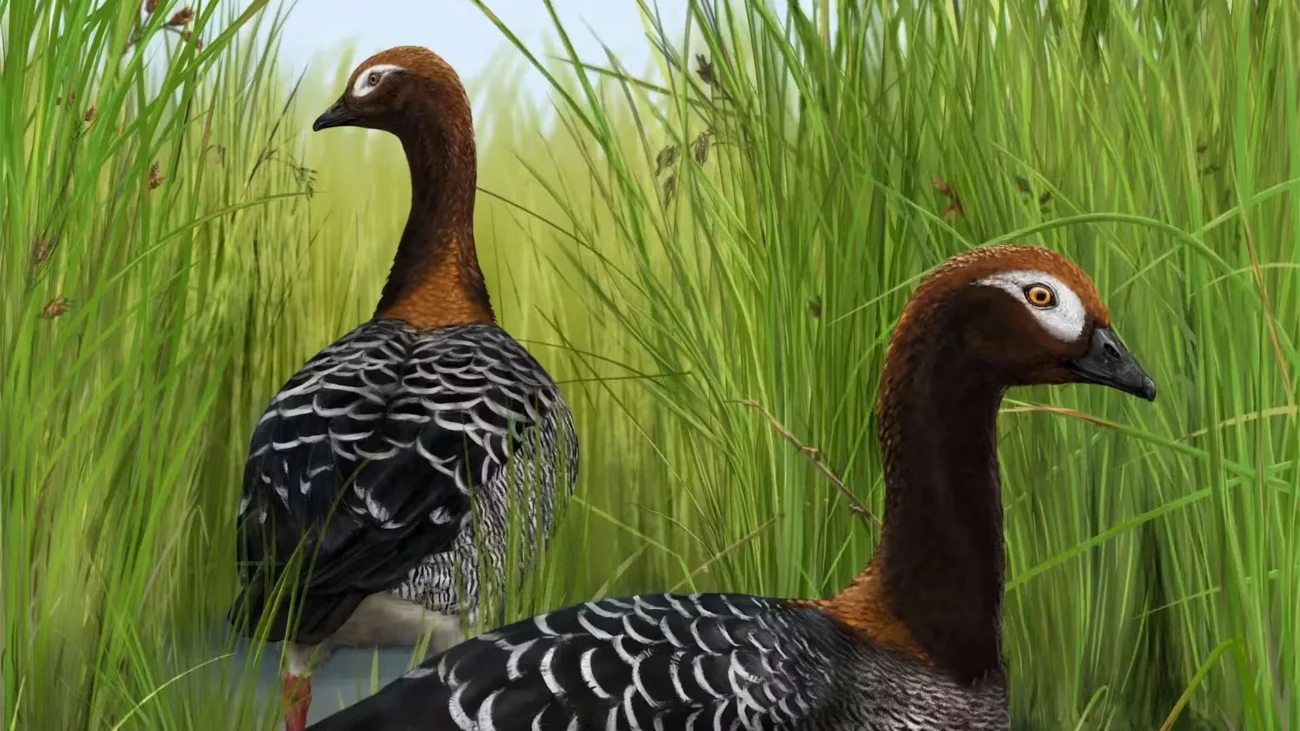
Deep within the ancient, sediment-rich layers of a prehistoric lakebed in Central Otago, New Zealand, an international coalition of paleontologists and evolutionary biologists has uncovered a stunning piece of the evolutionary puzzle. The discovery of a rare fossil goose—now officially named Meterchen luti—is fundamentally reshaping our understanding of how Aotearoa’s world-renowned and distinct avian fauna came to be. Far from being a static sanctuary of ancient lineages that remained isolated since the break-up of the supercontinent Gondwana, New Zealand’s prehistoric ecosystem was a dynamic melting pot of ancient endemic species and surprisingly recent arrivals.
The research, which was recently published in the peer-reviewed scientific journal Historical Biology, was spearheaded by a multidisciplinary team hailing from the University of Otago (known in te reo Māori as Ṳtākou Whakaihu Waka), the Museum of New Zealand Te Papa Tongarewa, and the University of Cambridge in the United Kingdom. By pairing cutting-edge paleogenetics with meticulous osteological comparisons, the research team has successfully illuminated a previously hidden chapter of island biogeography, demonstrating that the evolutionary history of New Zealand birds is far more complex, fluid, and tumultuous than scientists previously dared to imagine.
Unveiling the St Bathans Fossil Deposits
The focal point of this groundbreaking discovery is the famed St Bathans fossil deposit located in Central Otago. For decades, this site has served as a treasure trove for paleontologists, offering a rare window into the Early Miocene epoch, roughly 16 to 19 million years ago. During this period, much of what is now the modern South Island of New Zealand was submerged or characterized by extensive, warm-water lake systems surrounded by lush, subtropical vegetation.
As rivers and streams emptied into these ancient water bodies, the bones of birds, reptiles, fish, and mammals settled into the muddy lake bottoms. Over millions of years, tectonic activity uplifted these lakebeds into the dry, windswept landscapes of Central Otago seen today, preserving a fragile snapshot of an ecosystem long vanished. While waterfowl fossils—particularly those of ducks and other swimming birds—are relatively abundant at the St Bathans site, complete or identifiable goose remains have historically been exceptionally rare. This scarcity left a significant gap in scientists’ understanding of ancient Anatidae (the biological family that includes ducks, geese, and swans) in prehistoric Zealandia.
Recognizing this gap, an international team of researchers set out to re-examine every single fossilized bird bone from the St Bathans collection that had ever been tentatively classified as belonging to geese. Led by senior researchers and paleontologists, the team undertook a painstaking morphological analysis. They cross-referenced these ancient fragments against an extensive global library of modern avian skeletons as well as other extinct fossil waterfowl specimens housed in international museum archives.
The Emergence of Meterchen luti
Through this rigorous comparative analysis, the research team realized that a subset of the bones did not match any known living or extinct species. Instead, they belonged to an entirely undescribed, medium-sized goose roughly matching the dimensions of a modern small goose. To honor both the scientific nature of the find and its unique preservation, the researchers christened the new species Meterchen luti.
The etymology of the binomial name is both clever and deeply rooted in the context of the discovery. The genus name Meterchen is derived from ancient Greek roots translating loosely to "mother goose," serving as a playful nod to the classic nursery rhyme character Old Mother Goose. This literary reference captures the poetic imagery of an ancient goose literally emerging from the primordial mud of a fossil deposit. Meanwhile, the specific epithet luti is derived from the Latin word for "of the mud," directly describing the taphonomic environment where the bones were preserved for millions of years.
Associate Professor Nic Rawlence, Director of the Otago Palaeogenetics Laboratory and a co-author of the study, emphasized the distinctiveness of the new find. He noted that despite its classification as a goose, Meterchen luti bears no close evolutionary relationship to the recently extinct giant, flightless New Zealand geese belonging to the genus Cnemiornis, nor is it closely tied to their living Australian ecological counterparts, such as the Cape Barren goose (Cereopsis novaehollandiae). Instead, Meterchen luti represents an ancient lineage that trod a completely different evolutionary path before ultimately fading into extinction.
Challenging Long-Held Evolutionary Dogma
The discovery of Meterchen luti is much more than the mere naming of a new prehistoric bird; it serves as a critical data point in a long-standing academic debate concerning the timeline of New Zealand’s bird evolution. For decades, scientists subscribed to a dominant theory known as vicariance biogeography. This school of thought argued that the vast majority of New Zealand’s unique flora and fauna were ancient evolutionary relics that had ridden along on the landmass of Zealandia as it broke away from the supercontinent Gondwana around 80 million years ago.
Under this older theoretical framework, paleontologists assumed that the St Bathans goose fossils represented the direct, uninterrupted ancestors of the giant, flightless Cnemiornis geese that would later roam the islands. If true, this hypothesis would mean that the goose lineage had enjoyed a continuous, uninterrupted history on Zealandia spanning at least 14 million years.
However, this neat narrative began to fracture as modern genetic techniques matured. Recent DNA analyses of various New Zealand bird groups revealed a glaring contradiction: the genetic markers of Cnemiornis suggested that their lineage diverged from Australian relatives only about seven million years ago. This meant that the ancestors of these giant geese could not possibly have evolved directly from the 16-to-19-million-year-old St Bathans goose lineage, as the timelines were wildly incompatible. Proponents of the older theory initially dismissed the genetic evidence, viewing it as an artifact of incomplete data or methodological error.
The new study, however, firmly bridges the gap between fossil morphology and molecular genetics. Lead author Alan Tennyson of the Museum of New Zealand Te Papa Tongarewa explained that the rigorous reassessment conducted by the research team strongly supports the later-arrival theory, upending the long-cherished notion of unbroken, ancient residency for every prominent bird lineage in the country.
A Dynamic History of Island Colonization
The implications of the Meterchen luti discovery extend far beyond waterfowl, casting new light on the broader biological history of Aotearoa. According to the research findings, the arrival of avian species in New Zealand has been a continuous, rolling wave over tens of millions of years, rather than a single colonization event tied to the break-up of Gondwana.
While ancient lineages like Meterchen luti arrived on Zealandia more than 14 million years ago and eventually died out without leaving modern descendants, many other iconic New Zealand birds made their way to the isolated islands much later than previously assumed. Genetic and fossil data now demonstrate that the ancestors of several well-known large New Zealand birds arrived on the islands a mere four to five million years ago. This surprisingly recent wave of colonizers includes such familiar and remarkable species as the takahē, Forbes’ harrier, and the apex avian predator of the Southern Hemisphere, the colossal Haast’s eagle.
Associate Professor Rawlence highlighted how the integration of multiple scientific disciplines has transformed modern paleontology. "Using all the tools in the toolbox, including DNA and fossils, we can reconstruct how the dynamic geological, climatic, and human history of Zealandia has shaped the evolution of Aotearoa fauna in ever more detail," he stated.
The Interplay of Geology, Climate, and Biology
To fully appreciate the significance of this research, one must understand the volatile geological and climatic history of Zealandia. As the continent drifted northward and experienced periods of dramatic tectonic uplift, mountain building, and climate fluctuation, its ecosystems were subjected to profound stress. Sea levels rose and fell, subtropical rainforests gave way to cooler, alpine environments in certain regions, and island geography shifted continuously.
These environmental shifts acted as an evolutionary crucible. Species that arrived on Zealandia were forced to adapt rapidly to newly opened ecological niches, free from the heavy mammalian predation pressures found on larger continental landmasses. This environment of relaxed mammalian competition frequently triggered extraordinary evolutionary phenomena, such as island gigantism and the loss of flight.
The giant flightless Cnemiornis geese serve as one of the most striking examples of this rapid evolutionary transformation. Standing roughly one meter tall and tipping the scales at up to 18 kilograms, Cnemiornis species held the title of the largest geese in the world. Yet, genetic evidence reveals that these mammalian-sized birds evolved their massive frames and flightless status within a remarkably short geological timeframe following the arrival of their ancestors from Australia approximately seven million years ago.
By contrast, the St Bathans goose lineage represents an evolutionary experiment that played out over an entirely different epoch. Meterchen luti and its contemporaries inhabited a much warmer, wetter Zealandia that bore little resemblance to the landscapes encountered by later arrivals. Their eventual extinction underscores the reality that island ecosystems are perpetually in flux, subject to the whims of climate change, ecological competition, and demographic stochasticity long before human arrival altered the landscape.
Broader Scientific Implications and Future Research
The publication of this study in Historical Biology arrives at a time of renewed vigor in Australasian paleontology. By demonstrating that morphological taxonomy and ancient DNA must be used in tandem, the research sets a new methodological standard for studying island biogeography globally.
In the broader context of conservation and evolutionary biology, understanding the past dynamics of colonization and extinction helps scientists contextualize how modern ecosystems respond to environmental pressures. As global climate change accelerates today, the historical lessons encoded in the St Bathans deposits offer sobering insights into how fragile island species adapt—or fail to adapt—to shifting environmental baselines.
The international research team, comprising experts from Otago, Te Papa, and Cambridge, plans to continue their excavations and analytical work at the St Bathans fossil beds and other sites across New Zealand. With countless micro-fossils still awaiting extraction and categorization from the Central Otago mud, scientists are confident that Meterchen luti is merely the first of many hidden chapters yet to be recovered from the deep time of Aotearoa.
Through meticulous fieldwork, advanced genetic sequencing, and interdisciplinary collaboration, researchers are slowly piecing together a comprehensive biography of New Zealand’s prehistoric wildlife. What emerges is not a static postcard from the distant past, but a vibrant, ever-changing narrative of survival, migration, and evolution—one that continues to challenge our assumptions about the natural history of the southern hemisphere.

