


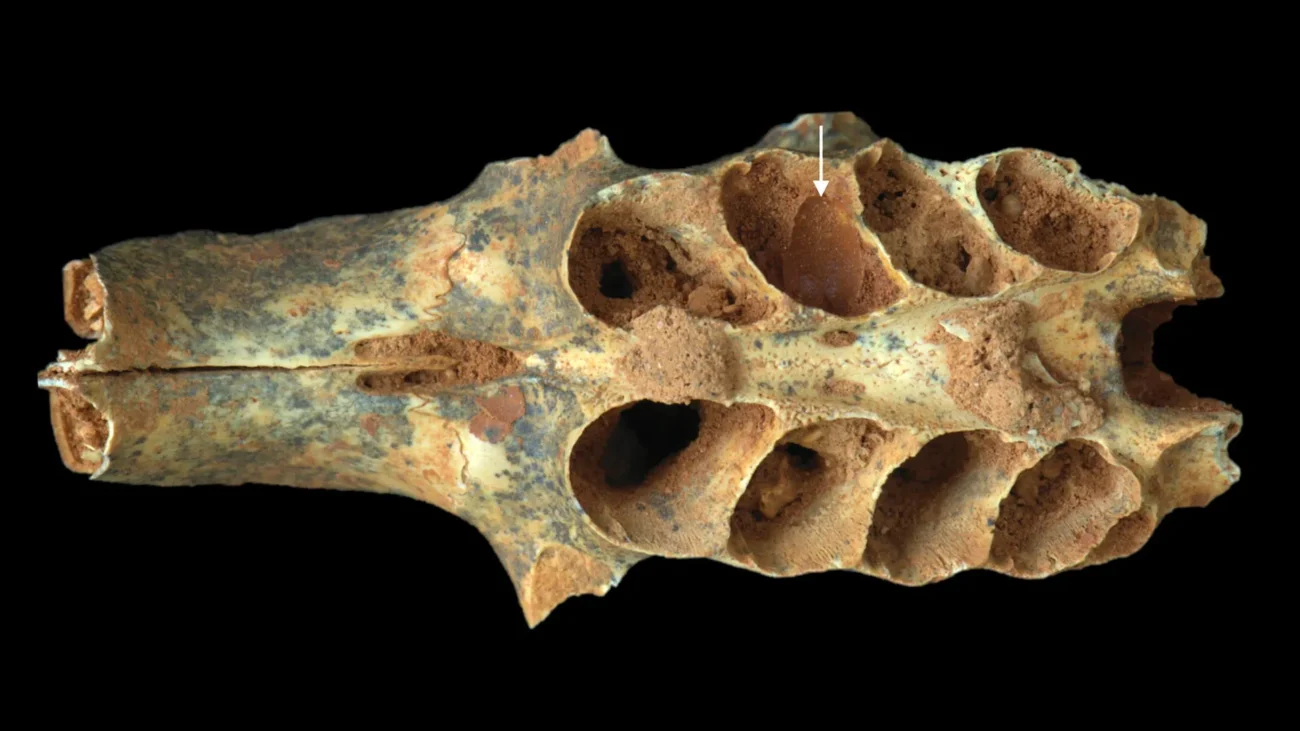
Deep within the labyrinthine limestone cave systems of the Caribbean island of Hispaniola, scientists have uncovered an extraordinary and previously undocumented ecological interaction from the last Ice Age. Approximately 20,000 years ago, generations of nocturnal raptors utilized a dark, subterranean cavern as a roosting site, continually regurgitating indigestible pellets containing the skeletal remains of their small vertebrate prey. Millennia later, these discarded bone fragments—specifically the hollow tooth sockets of ancient rodent jaws—became an unexpected real estate market, repurposed by prehistoric solitary bees as micro-nurseries for their developing offspring.
Published in the peer-reviewed journal Royal Society Open Science, this discovery provides the first known physical evidence of bees utilizing animal skeletal structures to rear their young. The finding sheds new light on the behavioral adaptability of Pleistocene insects, the complex web of interactions within ancient island ecosystems, and the methodological rigor required in modern paleontological fieldwork.
Unearthing an Ice Age Time Capsule
The geographical setting of this discovery is the island of Hispaniola, politically divided between the nations of Haiti and the Dominican Republic. Characterized by extensive karst topography, the landscape is riddled with thousands of limestone caves and sinkholes. "In some areas, you’ll find a different sinkhole every 100 meters," notes Lazaro Viñola López, a postdoctoral researcher at the Field Museum in Chicago and the lead author of the study.
The specific subterranean site at the center of the research was initially identified by Juan Almonte Milan, curator of paleobiology at the Dominican Republic’s Museo Nacional de Historia Natural. Widely recognized as a leading figure in regional paleontology, Almonte Milan cataloged the location as an exceptionally rich fossil deposit. Viñola López and an international team of researchers explored the depths of the cave while he was completing his doctoral research at the University of Florida and the affiliated Florida Museum of Natural History.
Accessing the fossil bed required navigating a rugged environment. Field expeditions involved anchoring ropes to the limestone rim of the sinkhole and rappelling approximately ten meters downward. Upon descent, researchers frequently encountered local wildlife, including resident tarantulas. Navigating a ten-meter-long horizontal tunnel led the team directly to the primary fossil-bearing strata.
Stratigraphic analysis revealed that the cave preserved multiple distinct fossil layers, separated cleanly by carbonate flowstone deposits that formed during ancient periods of heavy rainfall. The faunal assemblage was remarkably diverse, yielding over 50 species of vertebrates. While the vast majority of the recovered bones belonged to extinct and extant rodents, the matrix also contained remains of native sloths, various birds, reptiles, and occasional larger animals such as turtles and crocodiles that likely tumbled accidentally into the open sinkhole.
The Role of Raptors in Ancient Ecosystems
The accumulation of this dense vertebrate graveyard was not a random geological event. Taphonomic analysis—the study of how organisms decay and become fossilized—indicated that the cave served as a long-term roost for generations of owls, potentially spanning hundreds or thousands of years.
Owls are carnivorous birds of prey that swallow small mammals, reptiles, and birds whole or in large chunks. Incapable of digesting fur, feathers, and bones, their digestive tracts compress these hard tissues into compact pellets, which the birds subsequently regurgitate. The accumulation of these pellets over centuries created a thick, bone-rich sediment on the cave floor. When unfortunate amphibians or reptiles fell into the pit, their remains were added to the mix, creating a comprehensive snapshot of the local Pleistocene biodiversity on Hispaniola.
Serendipitous Discovery in the Laboratory
The discovery of the bee nests was entirely accidental. While meticulously cleaning and preparing mammal jawbones recovered from the owl pellets, Lazaro Viñola López noticed anomalous structures nestled inside the empty tooth sockets of several specimens.
Rather than being filled with the expected cave sediment or mineral crusts, the tooth sockets contained smooth, concave deposits. "It was a smooth surface, and almost concave. That’s not how sediment normally fills in, and I kept seeing it in multiple specimens. I was like, ‘Okay, there’s something weird here,’" Viñola López recalls.
The visual geometry of the deposits triggered a memory from his undergraduate days in Montana, where another paleontologist had shown him fossilized wasp cocoons—small, mud-based chambers where larval wasps mature. The architectural similarities between those ancient insect cocoons and the sediment formations inside the rodent jaws pointed toward an invertebrate origin.
To test this hypothesis without compromising the structural integrity of the rare vertebrate fossils, the research team subjected the jawbones to high-resolution X-ray computed tomography (CT scanning). These digital scans generated precise, three-dimensional models of the material compacted within the tooth sockets.
The resulting digital reconstructions confirmed that the structures were identical in morphology to the mud nests constructed by modern solitary bees. Crucially, the scans also detected microscopic grains of ancient pollen preserved within the chambers. This pollen represented the nutritional provisions that female solitary bees systematically collected and left behind for their larvae to consume upon hatching.
Behavioral Ecology of Solitary Bees
While the popular imagination often associates bees with the large, highly social colonies of honeybees or bumblebees, the vast majority of bee species worldwide are solitary. Unlike social insects that build massive communal hives, female solitary bees operate independently.
"Most bees are solitary. They lay their eggs in small cavities, and they leave pollen for the larvae to eat," explains Viñola López. "Some bee species burrow holes in wood or in the ground, or use empty structures for nests. Some species in Europe and Africa even build their nests in empty snail shells."
The prehistoric Hispaniola bees adapted this cavity-nesting strategy to an unprecedented substrate: animal bone. The researchers deduce that the mother bees mixed fine cave dirt with their own saliva to construct tiny, durable partitioned cells inside the hollow dental spaces of the rodent jaws. Each individual nest was remarkably diminutive, measuring smaller than the eraser on the end of a standard pencil.
This unusual nesting location likely offered significant evolutionary advantages. By utilizing enclosed, protected skeletal cavities deep within a cave, the bees shielded their vulnerable eggs and developing larvae from external environmental fluctuations and natural predators, such as parasitic wasps.
Taxonomic Classification: Osnidum almontei
Because the warm, humid climatic conditions typical of Caribbean caves are exceptionally destructive to delicate insect exoskeletons, no fossilized bee bodies were recovered from the site. Without physical specimens of the insects themselves, the research team could not definitively identify the exact species responsible for the construction.
Despite the absence of body fossils, the distinctive architectural morphology of the trace fossils warranted formal scientific classification. Trace fossils—geological records of biological activity rather than the preserved remains of the organism’s body—are assigned binomial scientific names under the International Code of Zoological Nomenclature.
The researchers named the new ichnospecies Osnidum almontei. The specific epithet honors Juan Almonte Milan, acknowledging his foundational work in discovering the cave deposit and his decades of dedication to advancing paleontology in the Dominican Republic.
The absence of skeletal remains leaves open two distinct evolutionary possibilities regarding the identity of the builders. "Since we didn’t find any of the bees’ bodies, it’s possible that they belonged to a species that’s still alive today—there’s very little known about the ecology of many of the bees on these islands," Viñola López notes. Alternatively, given that a substantial portion of the vertebrate fauna preserved in the same cave strata is now extinct, the bees that engineered Osnidum almontei may themselves represent an extinct lineage.
Environmental Drivers and Evolutionary Implications
The documentation of Osnidum almontei marks a milestone in paleoentomology, establishing the first known instance of bees utilizing bone material for reproduction. Scientists analyzing the paleoenvironment of Pleistocene Hispaniola have identified several converging factors that likely drove this specialized behavior.
Geologically, the limestone karst terrain of the region features minimal topsoil accumulation. This scarcity of soil would have severely limited the availability of traditional ground-nesting substrates for solitary bees. Simultaneously, the persistent presence of roosting owls ensured a continuous, reliable supply of lightweight, hollow skeletal elements—specifically skulls and jawbones containing empty tooth sockets—scattered across the cave floor. Confronted with a shortage of soil and an abundance of pre-formed tubular cavities, the bees exhibited behavioral plasticity by exploiting an entirely novel ecological niche.
Methodological Takeaways for Paleontology
Beyond its ecological significance, the study serves as a methodological cautionary tale for paleontologists and fossil preparators. In standard laboratory processing, extraneous sediment, dirt, and unrecognized trace materials adhering to vertebrate fossils are frequently cleaned away to reveal the underlying bone.
Had Viñola López lacked prior exposure to fossilized insect architecture from his time in Montana, the subtle mud deposits inside the rodent jaws might have been dismissed as ordinary cave silt and scrubbed away during preparation.
"This discovery shows how weird bees can be—they can surprise you. But it also shows that when you’re looking at fossils, you have to be very careful," Viñola López emphasizes. He advocates for broader interdisciplinary awareness among paleontologists studying vertebrate sites, urging researchers to remain vigilant for trace fossils left by invertebrates.
"Even if you’re looking primarily for fossils of larger, vertebrate animals, you should keep an eye out for trace fossils that can tell you about invertebrates like insects. Knowing about insects can tell you a lot about a whole ecosystem, so you have to pay attention to that part of the story."
As researchers continue to analyze the rich fossil layers of Hispaniola, the discovery of Osnidum almontei underscores the hidden complexities of ancient ecosystems. It demonstrates that even the smallest biological remnants—from an owl’s discarded meal to a microscopic grain of pollen preserved within a rodent’s jaw—can preserve intricate narratives of survival, adaptation, and interspecies interaction across the span of twenty millennia.

