


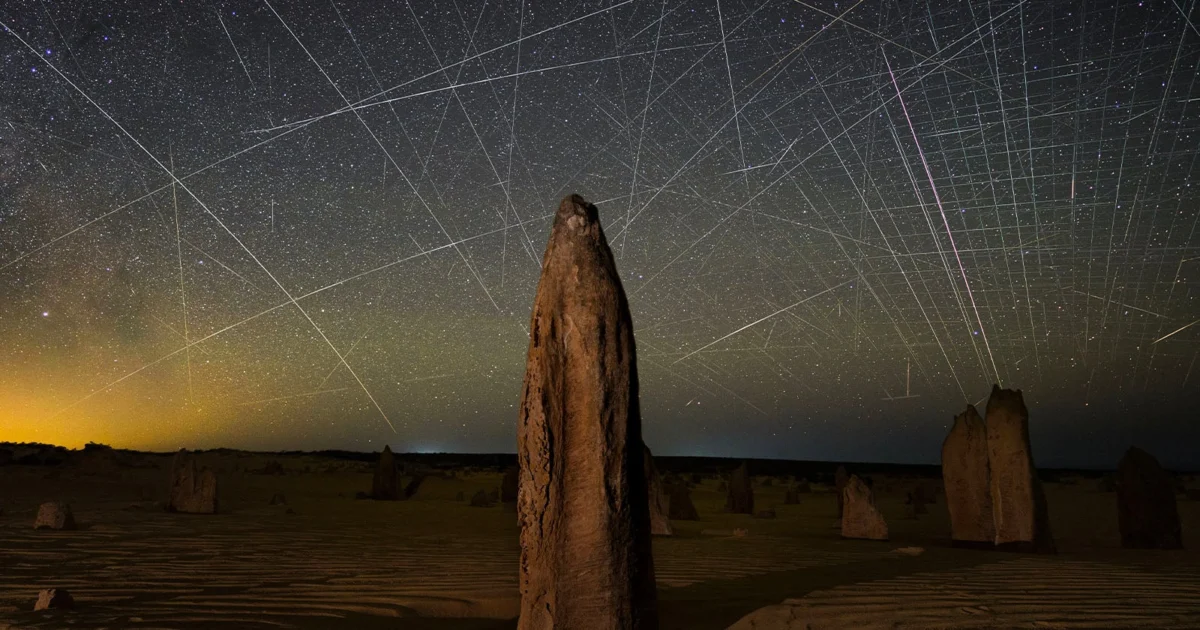
SpaceX recently reached a significant milestone in the history of aerospace engineering by launching its 10,000th active Starlink satellite into low-Earth orbit (LEO). This achievement underscores the rapid transformation of the night sky, a phenomenon captured with striking clarity by Australian photographer Joshua Rozells. Through his composite image titled "Swamped Skies," Rozells provides a visual manifesto of the sheer density of human-made objects now traversing the celestial sphere. The image, a meticulous blend of hundreds of individual exposures, serves as both a technical marvel and a sobering warning about the future of ground-based astronomy and the preservation of the natural night sky.
As the private space sector continues to accelerate, the tension between global connectivity and astronomical conservation has reached a critical juncture. The deployment of mega-constellations—thousands of small satellites working in tandem to provide high-speed internet—is fundamentally altering the visual and radio environment of our planet. While these networks offer life-changing utility to remote populations, they introduce unprecedented challenges for scientists, photographers, and anyone seeking an unpolluted view of the universe.
The Genesis of Swamped Skies
Joshua Rozells did not initially set out to document the encroachment of orbital infrastructure. In January 2021, he traveled to the Pinnacles Desert in Western Australia, a location renowned for its ancient limestone formations and exceptionally dark skies. His original objective was traditional astrophotography, specifically the capture of star trails—the long, circular paths stars appear to take due to the Earth’s rotation.
However, upon reviewing his frames, Rozells discovered that the sky was far from empty. "I was surprised," Rozells noted during an interview with PetaPixel. "I had previously seen satellite streaks in my photos but never this many. Previously I might have seen a few over the course of the night, but this night had streaks in almost every photo, particularly those taken in the 90 minutes or so after sunset."
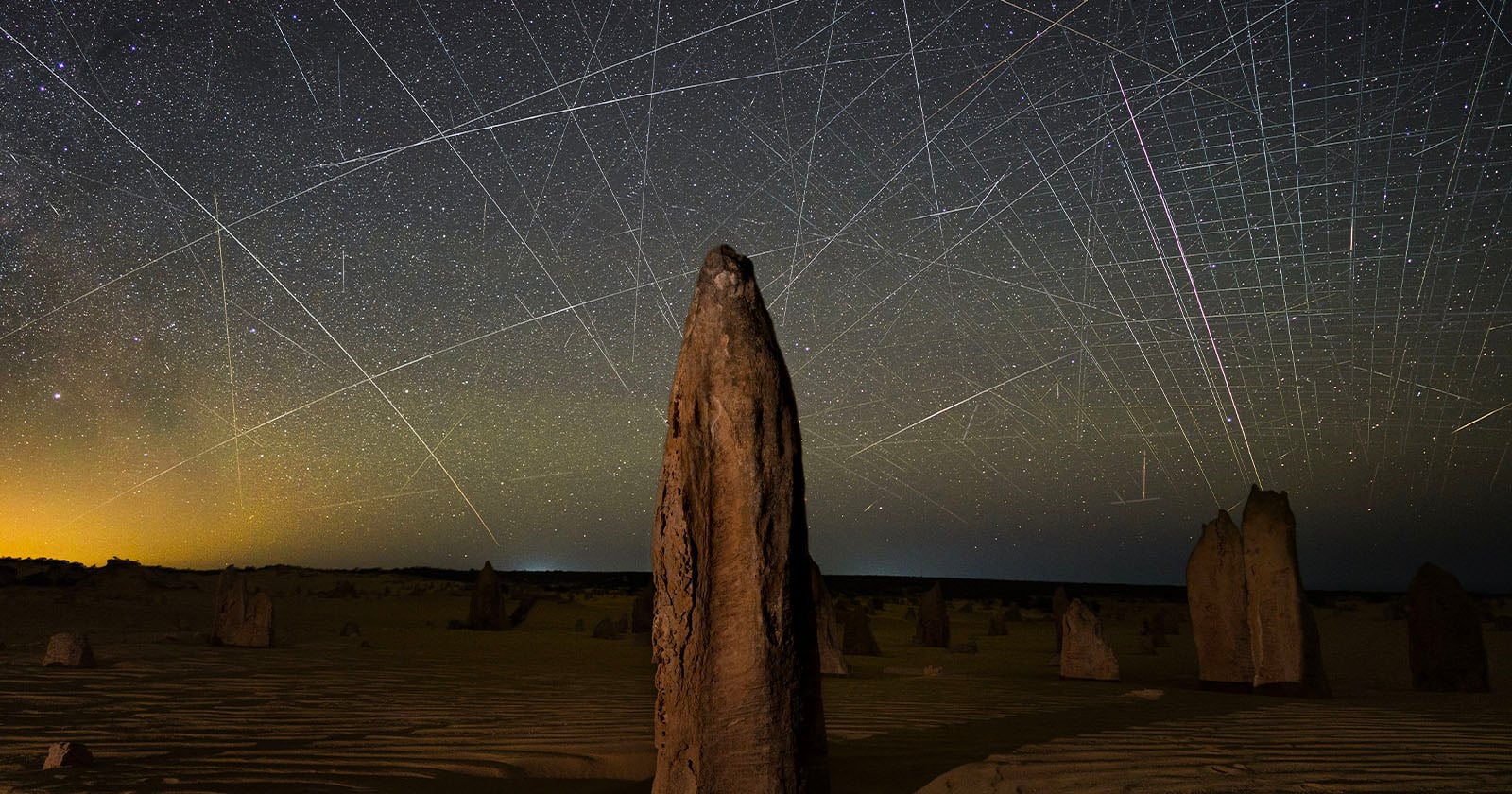
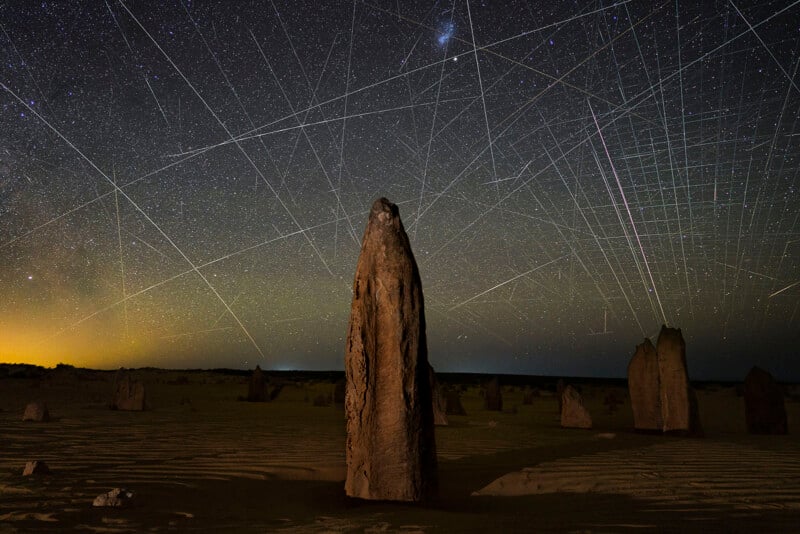
To illustrate the magnitude of what he witnessed, Rozells compiled 343 individual photographs taken over an 85-minute period. Each of these frames contained at least one satellite streak. The final result, "Swamped Skies," is a composite where the satellite trails are emphasized through post-processing, while a low-light foreground image of the limestone pillars provides a sense of scale and earthly grounding.
The technical process was grueling. Because the atmosphere produces a natural luminosity known as airglow, Rozells had to manually mask each satellite streak in Photoshop to maintain color consistency across the sky. This labor-intensive work highlights the difficulty modern photographers face: as the number of satellites grows, the "cleaning" of astronomical data becomes increasingly complex and time-consuming.
A Chronology of the Orbital Explosion
The rapid saturation of low-Earth orbit is a relatively recent phenomenon. For decades, the number of active satellites in orbit remained in the low thousands. This changed dramatically with the advent of the "New Space" era, characterized by lower launch costs and the miniaturization of satellite technology.
- Pre-2019: The orbital environment consisted primarily of large telecommunications satellites in geostationary orbit and a modest number of scientific and military assets in LEO.
- May 2019: SpaceX launched the first dedicated batch of 60 Starlink satellites. This event sparked immediate concern among astronomers as the "train" of bright satellites was visible to the naked eye shortly after deployment.
- January 2021: At the time Rozells captured "Swamped Skies," SpaceX had roughly 1,000 satellites in orbit. Even at 10% of today’s volume, the impact on long-exposure photography was already pervasive.
- 2023–2024: The pace of launches accelerated to nearly one every few days. Other players, such as OneWeb and Amazon’s Project Kuiper, began or prepared their own deployments.
- March 2025: SpaceX surpasses the 10,000-satellite milestone. Current projections suggest that the total number of satellites in LEO could exceed 60,000 within the next decade if all proposed constellations are realized.
Supporting Data: The Magnitude of the Issue
The visibility of satellites is primarily a function of their altitude and reflectivity. Satellites in LEO are most visible during twilight hours—the period after sunset and before sunrise—when the observer on the ground is in darkness, but the satellites overhead are still illuminated by the sun.
According to data from the International Astronomical Union (IAU), the brightness of first-generation Starlink satellites often reached a magnitude of 4 or 5, making them easily visible to the naked eye in dark-sky locations. While SpaceX has worked to mitigate this by installing "VisorSats" (sunshades) and using darker coating materials, the sheer volume of objects ensures that at least a few will be present in almost any wide-field astronomical image.
The impact is not limited to optical photography. Radio astronomy is also under threat. These satellites communicate using radio frequencies that can "leak" into protected bands reserved for deep-space observation. A study published in Astronomy & Astrophysics indicated that unintended electromagnetic radiation from large constellations could interfere with the detection of faint signals from the early universe.
Official Responses and Mitigation Efforts
The astronomical community has not remained silent. The American Astronomical Society (AAS) and the IAU have formed working groups to engage with satellite operators. In 2022, the IAU established the Center for the Protection of the Dark and Quiet Sky from Satellite Constellation Interference (CPS) to coordinate global efforts to mitigate these effects.
SpaceX has been the most proactive of the major operators in responding to these concerns. In collaboration with astronomers, they developed "dielectric mirror film" and other darkening technologies to reduce the Albedo (reflectivity) of their spacecraft. However, as Rozells points out, the industry remains largely unregulated.
"In most countries, there are very few restrictions for launching satellites, as long as you have a legitimate purpose for doing so," Rozells explains. "Big businesses have been able to launch as many as they like with very little pushback."
Currently, the Federal Communications Commission (FCC) in the United States and the International Telecommunication Union (ITU) at the global level handle licensing, but their mandates focus primarily on frequency allocation and debris mitigation rather than "light pollution" or the preservation of the visual sky.
Broader Impact and Scientific Implications
The implications of a "swamped sky" extend far beyond ruined photographs for hobbyists. Professional observatories, which represent billions of dollars in public and private investment, face a significant degradation of data quality.
- Survey Telescopes: Projects like the Vera C. Rubin Observatory in Chile, designed to conduct a 10-year Legacy Survey of Space and Time (LSST), are particularly vulnerable. Because these telescopes have a wide field of view and high sensitivity, nearly every image they take could be "streaked" by multiple satellites, requiring complex algorithms to remove the artifacts and potentially masking transient events like supernovae or near-Earth asteroids.
- Space-Based Assets: Even space telescopes are not immune. NASA has reported that the Hubble Space Telescope, which orbits in LEO, has seen an increase in the percentage of its images affected by satellite crossings. While the James Webb Space Telescope (JWST) is located much further away at the L2 Lagrange point, the general cluttering of LEO complicates the launch and maintenance of all future space missions.
- The Kessler Syndrome: Beyond light pollution, the sheer density of satellites increases the risk of orbital collisions. A single collision can create thousands of pieces of debris, potentially leading to a chain reaction known as the Kessler Syndrome, which could render certain orbits unusable for generations.
Analysis: Connectivity vs. Conservation
The debate over satellite constellations is often framed as a conflict between two noble goals: the democratization of the internet and the preservation of science. SpaceX’s Starlink and its competitors provide essential services to war zones, disaster areas, and rural communities where traditional fiber-optic infrastructure is impossible to build. This connectivity is a powerful tool for education, healthcare, and economic development.
However, critics argue that this progress should not come at the expense of the "global commons." The night sky has been a source of inspiration, navigation, and scientific inquiry for the entirety of human history. The rapid, unilateral transformation of that sky by a handful of private corporations represents a significant shift in how humanity manages shared natural resources.
Joshua Rozells’ work captures this duality perfectly. While his image serves as a "warning of the effects of satellite light pollution," he also acknowledges the technological feat involved. "It shows the means in which humans have been able to connect people in the most remote areas of the world to the internet—something that is truly remarkable," he says.
Conclusion
The milestone of 10,000 satellites is likely only the beginning of a new era in orbital infrastructure. As more nations and corporations join the race to populate LEO, the visual landscape of our planet will continue to change. For photographers like Joshua Rozells, the challenge will be to find new ways to document the universe while navigating an increasingly crowded foreground.
The "Swamped Skies" project serves as a vital historical record of this transition. It reminds us that the sky is no longer a pristine void, but a busy extension of our digital world. Whether through stricter international regulations, advanced technological mitigations, or a shift in how we value the dark, the global community must soon decide how much of the stars we are willing to obscure in exchange for the signals we beam between them. Without a concerted effort to balance these interests, the "grandeur of the unpolluted night sky" may soon become a relic of the past, accessible only through the archives of photographers who were there to witness the change.

