


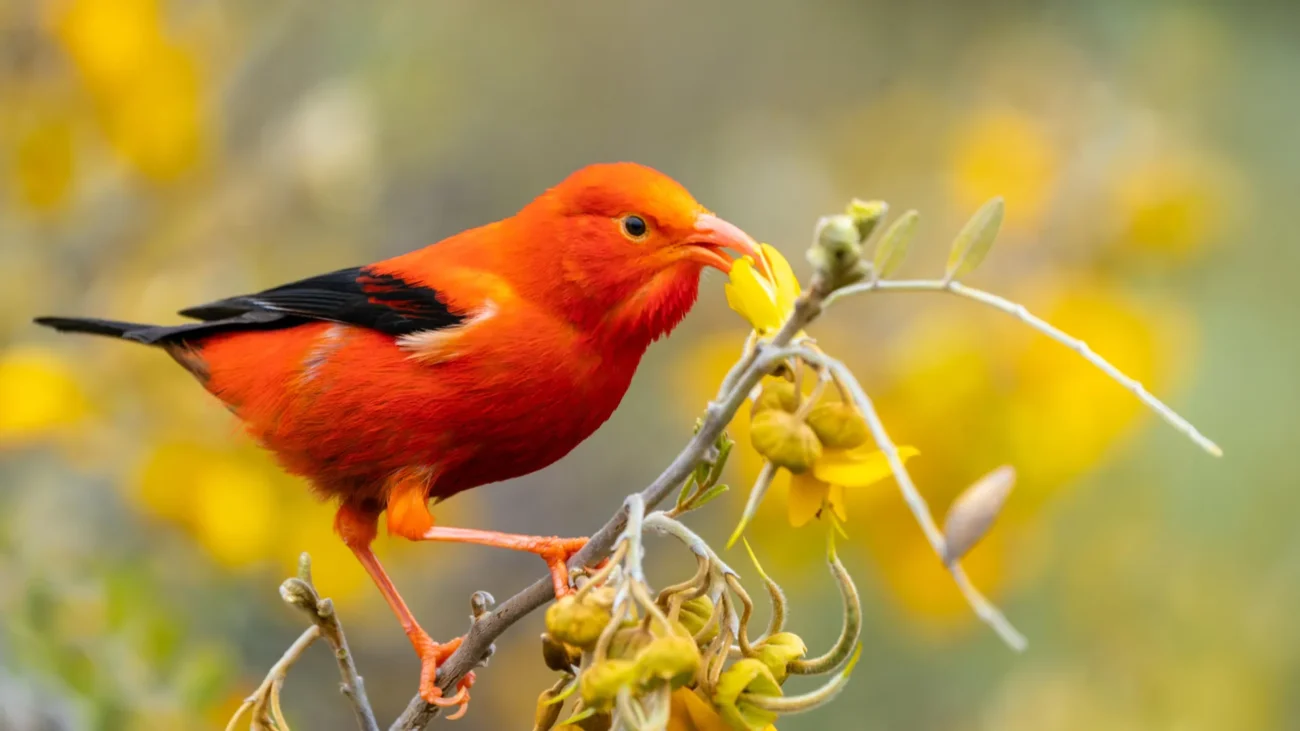
A groundbreaking study led by researchers at the University of Hawaiʻi at Mānoa has revealed a startling reality for Hawaii’s native forest birds: nearly every species possesses the ability to transmit avian malaria. This pervasive capacity for spreading the deadly parasite, Plasmodium relictum, is now understood to be a key factor explaining the widespread presence of the disease across the islands, even in habitats where mosquitoes are found. The findings, published on February 10 in the prestigious journal Nature Communications, paint a grim picture for the future of these iconic avian populations, already decimated by the very disease now confirmed to be so readily propagated.
The comprehensive research effort detected avian malaria at an astonishing 63 out of 64 tested locations across the Hawaiian archipelago. These sites encompassed a diverse array of forest ecosystems, each with its unique composition of bird species. The study’s implications are profound, directly addressing why containment efforts have historically proven so challenging and offering critical insights into the complex dynamics of this devastating avian pathogen.
A Devastating Toll on Native Avifauna
Avian malaria, caused by the versatile parasite Plasmodium relictum, has been a central driver behind the dramatic population declines and extinctions of native Hawaiian honeycreepers. These vibrant and unique birds, found nowhere else on Earth, have been particularly vulnerable to the disease, which attacks their red blood cells. The consequences are severe, leading to anemia, organ failure, reduced survival rates, and, in many cases, outright death.
Christa M. Seidl, the mosquito research and control coordinator for the Maui Forest Bird Recovery Project, who spearheaded this research as part of her doctoral studies at the University of California, Santa Cruz, emphasized the scale of the problem. "Avian malaria has taken a devastating toll on Hawaiʻi’s native forest birds, and this study shows why the disease has been so difficult to contain," Seidl stated. "When so many bird species can quietly sustain transmission, it narrows the options for protecting native birds and makes mosquito control not just helpful, but essential."
The study highlights a stark contrast to many other infectious diseases, which often rely on a limited number of host species to persist. In Hawaii, avian malaria has evolved a more insidious strategy. The research demonstrates that most forest birds, regardless of whether they are native or introduced species, exhibit a moderate to high capability of infecting the southern house mosquito (Culex quinquefasciatus), the primary vector for the parasite. Alarmingly, even birds carrying minuscule quantities of the malaria parasite were found to be capable of infecting mosquitoes. This means that a broad spectrum of avian communities can act as reservoirs, ensuring continuous transmission of the disease throughout the islands.
"We often understandably think first of the birds when we think of avian malaria, but the parasite needs mosquitoes to reproduce and our work highlights just how good it has gotten at infecting them through many different birds," Seidl elaborated, underscoring the dual dependency of the parasite on both avian hosts and insect vectors.
Understanding the Mechanics of Transmission
The research involved an extensive field and laboratory investigation, with scientists examining blood samples from over 4,000 birds across the islands of Kauaʻi, Oʻahu, Maui, and Hawaiʻi Island. These field data were then integrated with controlled laboratory experiments designed to quantify the ease with which mosquitoes became infected after feeding on these birds. The findings revealed that both native and introduced bird species often exhibited similar levels of infectiousness, indicating that both groups play a significant role in perpetuating the parasite’s cycle.
A particularly concerning discovery was the prevalence of chronic infections. The study found that birds can harbor Plasmodium relictum for extended periods, spanning months and even years. During these chronic phases, when birds may exhibit only subtle symptoms or appear relatively healthy, they remain infectious to mosquitoes. The researchers estimate that these long-lasting, low to moderate infectious stages are responsible for the majority of avian malaria transmission across the state. This prolonged infectious period means that even seemingly healthy birds can act as unwitting carriers, contributing to the ongoing spread of the disease.
Historical Context and the Role of Introduced Species
The introduction of mosquitoes to Hawaii in the mid-19th century marked a turning point in the islands’ ecological history. The southern house mosquito (Culex quinquefasciatus) arrived and quickly established itself, bringing with it avian pathogens previously unknown to the native bird populations. Many of Hawaii’s endemic birds, having evolved in the absence of these diseases and their vectors, lacked any innate immunity. This vulnerability made them exceptionally susceptible to the devastating impacts of avian malaria and avian pox, another mosquito-borne disease.
The endemic honeycreepers, a group of birds famous for their remarkable adaptive radiation and the evolution of specialized beaks for various food sources, have been particularly hard-hit. Species like the ʻiʻiwi (scarlet honeycreeper), which once numbered in the hundreds of thousands, now face mortality rates as high as 90% if infected with avian malaria. The ʻakeake, a honeycreeper endemic to Kauaʻi, has been declared extinct in the wild, with avian malaria being a primary contributing factor to its demise. The study’s findings underscore the extent to which even introduced bird species, which often possess some degree of acquired immunity from their native ranges, contribute to the spread of the disease, thus impacting the more vulnerable native species.
Climate Change: Exacerbating an Existing Crisis
The pervasive ability of avian malaria to infect a wide array of bird species is now understood as the primary reason for its widespread distribution throughout Hawaii. The study’s conclusions suggest that very few mosquito-infested habitats on the islands are currently free from the risk of malaria transmission. This dire situation is further compounded by the escalating impacts of climate change.
As global temperatures rise, mosquitoes and the avian malaria parasite are able to expand their range into higher elevation areas. These higher altitudes have historically served as crucial refuges for native birds, offering cooler temperatures that limited mosquito breeding and thus reduced disease exposure. However, as these "climate shields" shrink and become increasingly compromised, native birds are being pushed into ever smaller areas where they remain vulnerable to infection. This phenomenon is particularly alarming for species that have adapted to specific high-altitude niches, as they may have nowhere else to retreat.
The implications of this expanding threat are significant for conservation efforts. Traditional strategies focused on protecting specific habitats are becoming less effective as the disease vector and pathogen move to new territories. This necessitates a more dynamic and adaptable approach to conservation, one that accounts for the shifting landscape of disease risk driven by climate change.
Collaborative Conservation Efforts
In response to the escalating threat, a coalition of organizations has been formed to address the multifaceted challenges of mosquito control and native bird conservation in Hawaii. Christa M. Seidl is an active participant in "Birds, Not Mosquitoes," a collaborative initiative that brings together academic institutions, state and federal agencies, non-profit organizations, and industry partners. This partnership is dedicated to advancing mosquito control strategies in support of Hawaiian bird conservation.
The Maui Forest Bird Recovery Project, an integral part of the Pacific Cooperative Studies Unit within the College of Natural Sciences at the University of Hawaiʻi at Mānoa, plays a vital role in these conservation endeavors. Their work, including the research that led to this pivotal study, is conducted under strict ethical guidelines and regulatory oversight. All birds involved in the study were captured and handled by highly trained ornithologists operating under the necessary state and federal permits, ensuring the welfare of the animals throughout the research process.
The findings from this study are expected to inform and intensify efforts to control mosquito populations, a strategy that is now recognized not merely as beneficial but as absolutely critical for the survival of Hawaii’s unique and imperiled native forest birds. The scientific community and conservationists alike are grappling with the implications of this research, which points to a future where innovative and aggressive interventions will be paramount in the fight to preserve these irreplaceable natural treasures. The ongoing battle against avian malaria in Hawaii is a stark reminder of the profound impact of invasive species and the accelerating challenges posed by a changing climate on global biodiversity.

