


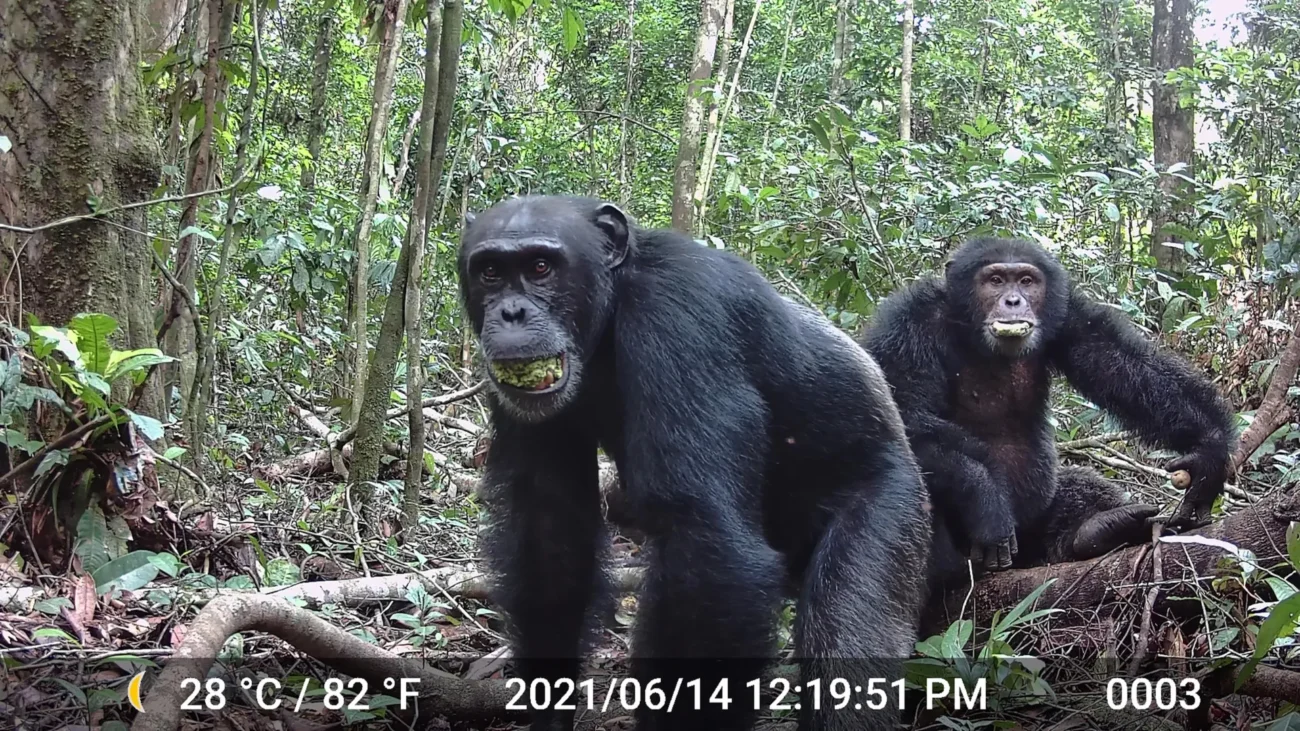
The first-ever measurements of the ethanol content of fruits available to chimpanzees in their native African habitat reveal that these primates regularly ingest a significant amount of alcohol, consuming the equivalent of more than two standard alcoholic drinks each day. This groundbreaking research, conducted by scientists at the University of California, Berkeley, suggests that alcohol has been a consistent component of primate diets, potentially dating back to our shared ancestors with chimpanzees. The findings challenge long-held assumptions about primate diets and offer compelling new insights into the evolutionary origins of human alcohol consumption.
The study, published in the prestigious journal Science Advances, meticulously analyzed the alcohol content of 21 different fruit species commonly consumed by chimpanzees at two long-term research sites: Ngogo in Uganda’s Kibale National Park and Taï in Ivory Coast. Researchers discovered that these fruits, on average, contained 0.26% alcohol by weight. When combined with estimates of chimpanzee fruit consumption – approximately 10 pounds (4.5 kilograms) per day, with fruit comprising about three-quarters of their total food intake – the daily ethanol intake for both male and female chimpanzees was calculated to be around 14 grams of pure ethanol. This quantity is equivalent to one standard American alcoholic drink. However, when adjusted for body mass, considering that chimpanzees weigh significantly less than humans, their consumption rises to nearly two standard drinks per day.
The "Drunken Monkey" Hypothesis Gains Traction
This research provides significant empirical support for the "drunken monkey" hypothesis, first proposed by UC Berkeley professor Robert Dudley over two decades ago. Dudley posited that humanity’s enduring attraction to alcohol has deep evolutionary roots, stemming from ancient foraging habits where fermenting fruits were a readily available source of ethanol. At the time of its initial proposal, the hypothesis faced considerable skepticism within the scientific community, particularly from primatologists who doubted the prevalence of fermented food consumption among wild primates. However, a growing body of observational and experimental evidence has steadily bolstered Dudley’s theory.
Recent field observations have confirmed that monkeys and apes do indeed consume fermented fruits. For instance, a recent study documented chimpanzees in Guinea-Bissau engaging in such behavior. Furthermore, captive animal studies have demonstrated a clear preference for alcoholic substances. A 2016 experiment by Dartmouth University researchers found that captive aye-ayes and slow lorises consistently chose nectar with higher alcohol concentrations and repeatedly returned to containers that had previously held such nectar. More recently, in 2022, Dudley and his collaborators observed wild spider monkeys in Panama consuming fermented fruits and subsequently excreting alcohol metabolites in their urine, providing direct physiological evidence of alcohol ingestion.
Methodology: A Rigorous Approach to Measuring Wild Alcohol Content
The current study’s robust findings are a testament to the rigorous methodology employed by lead researcher Aleksey Maro, a graduate student in UC Berkeley’s Department of Integrative Biology. Maro conducted two field seasons at Ngogo, Uganda, and one at Taï, Ivory Coast, between 2019 and 2021. At Ngogo, known for the largest chimpanzee community in Africa, researchers collected freshly fallen fruits from beneath trees where chimpanzees had recently fed. Similarly, at Taï, where chimps often consume fallen fruit, undamaged fruits were gathered from the ground below fruiting trees.
To ensure accuracy and reliability in the challenging field conditions, Maro employed three distinct techniques for measuring alcohol content: a semiconductor-based sensor, a portable gas chromatograph, and a chemical assay. Prior to deployment in the field, each method was meticulously validated in Professor Dudley’s Berkeley laboratory using standardized protocols. This meticulous preparation allowed for the processing of approximately 20 fruit samples per 12-hour day.
Two of the primary analytical methods involved thawing the fruit, processing the pulp, and allowing any generated alcohol to volatilize into the "headspace" of a sealed container, which was then analyzed. The third method involved extracting liquid from the pulp and using colorimetric chemical reactions to detect ethanol. The consistency of results across these diverse techniques lends significant credibility to the study’s conclusions.
Alcohol as a Routine Dietary Component for Chimpanzees
The research indicates that alcohol is not an occasional anomaly but a routine component of the chimpanzee diet. At both research sites, the fruits that chimps consume most frequently were also found to be the most alcohol-rich. At Ngogo, a fig species known as Ficus musuco emerged as a particular favorite, and at Taï, the plum-like fruit of the evergreen Parinari excelsa was similarly favored. Notably, male chimpanzee groups at Ngogo have been observed congregating in F. musuco trees before territorial patrols, and the P. excelsa fruits are also a known attractant for elephants, animals also known to be drawn to alcohol.
"The chimps are eating 5 to 10% of their body weight a day in ripe fruit, so even low concentrations yield a high daily total – a substantial dosage of alcohol," explained Professor Dudley. He further elaborated that if chimpanzees are randomly sampling ripe fruits, their consumption rate reflects an average intake. However, if they exhibit a preference for riper, more sugar-rich fruits, then the calculated intake represents a conservative lower limit, suggesting their actual alcohol consumption could be even higher.
Evolutionary Implications: A Shared Primate Heritage
The consistent, low-level exposure to ethanol suggests that the last common ancestor of humans and chimpanzees likely encountered alcohol daily through fermenting fruits. This dietary element, so integral to our closest living relatives, is notably absent from the diets of many captive chimpanzees and a significant portion of modern human diets, particularly those reliant on processed foods.
"Chimpanzees consume a similar amount of alcohol to what we might if we ate fermented food daily," stated Maro. "Human attraction to alcohol probably arose from this dietary heritage of our common ancestor with chimpanzees." This perspective suggests that our affinity for alcohol is not a modern indulgence but rather a deeply ingrained evolutionary predisposition.
Beyond Primates: Alcohol in the Wider Animal Kingdom
The presence of alcohol in the diet is not limited to primates. Earlier this year, Dudley and his colleagues analyzed feathers from 17 bird species and detected alcohol metabolites in 10 of them. This indicates that ethanol is a significant component of their diets, which include nectar, grains, insects, and even other vertebrates.
"The consumption of ethanol is not limited to primates," Dudley emphasized. "It’s more characteristic of all fruit-eating animals and, in some cases, nectar-feeding animals." He proposed several hypotheses for why animals might seek out ethanol. One theory suggests that the smell of alcohol acts as a beacon, helping animals locate energy-rich, sugary foods. Another possibility is that alcohol enhances the rewarding sensation of eating, akin to enjoying a glass of wine with a meal. Furthermore, the sharing of alcohol-containing fruits could play a role in fostering social bonding within primate groups and other animal species.
Future Research: Unraveling the Nuances of Alcohol Intake
The current research establishes a crucial baseline for future studies. Maro has already returned to Ngogo to collect chimpanzee urine samples, a challenging endeavor requiring an umbrella to collect from sleeping chimps, to test for alcohol metabolites using kits similar to those employed in workplace drug testing. Alongside Laura Clifton Byrne, an undergraduate at San Francisco State University, he also observed foraging chimpanzees, collecting freshly dislodged fruits to measure their alcohol content in real-time.
These ongoing investigations aim to determine the extent to which chimpanzees actively select fermented, alcohol-containing fruits over less fermented options. The research team is also exploring the physiological effects of this consistent alcohol consumption on chimpanzee behavior and health.
The implications of this research extend beyond understanding primate evolution. Dudley highlighted the need for increased federal funding for research into alcohol attraction and abuse in modern humans, suggesting that a deeper understanding of its evolutionary background could provide novel approaches to addressing alcohol-related health issues.
The study was made possible through the collaborative efforts of numerous researchers, including Aaron Sandel from the University of Texas, Austin; Bi Z. A. Blaiore and Roman Wittig from the Taï Chimpanzee Project; and John Mitani from the University of Michigan, Ann Arbor, a co-founder of the Ngogo Chimpanzee Project. Funding for this significant research was provided by UC Berkeley.

