


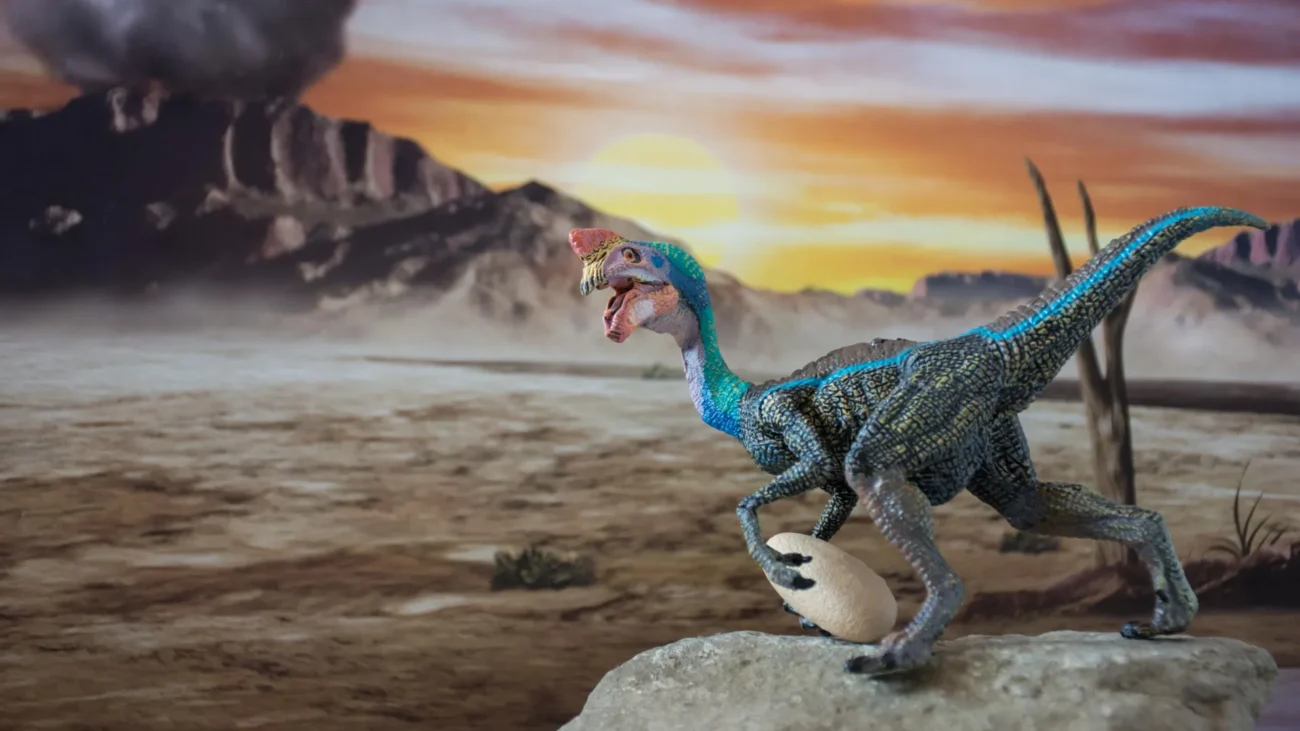
For decades, the enigmatic nesting habits of oviraptors, the bird-like but flightless dinosaurs that roamed the Earth millions of years ago, have been a subject of intense scientific debate. Did these fascinating creatures, known for their distinctive crests and often misunderstood name (which literally translates to "egg thief"), rely on the ambient heat of their environment, much like modern crocodiles and turtles, or did they possess the direct, attentive incubation strategies characteristic of today’s birds? A groundbreaking new study, published in the esteemed journal Frontiers in Ecology and Evolution, sheds significant light on this enduring paleontological puzzle, offering compelling insights into how oviraptors may have nurtured their young.
The research, spearheaded by a team of scientists in Taiwan, represents a significant leap forward in our understanding of dinosaur reproductive behavior. By ingeniously combining advanced heat transfer simulations with meticulous physical experiments, the researchers have managed to reconstruct a plausible scenario for oviraptor incubation. Their methodology not only delves into the physical mechanics of heat distribution within oviraptor nests but also draws crucial comparisons with the incubation practices of modern avian species, providing a vital link between the ancient past and the present.
Recreating the Oviraptor Nursery: A Life-Sized Endeavor
At the heart of this innovative study lies a remarkably detailed, life-sized model of an oviraptor and a highly realistic nest replica. This meticulously crafted diorama served as the experimental platform for testing how heat moved through the dinosaur’s eggs. The team’s efforts focused on a specific oviraptor species, Heyuannia huangi, which inhabited what is now China during the Late Cretaceous period, approximately 70 to 66 million years ago. This particular species, estimated to be around 1.5 meters in length and weighing approximately 20 kilograms, is known for constructing semi-open nests characterized by multiple rings of eggs.
The creation of the oviraptor model was a testament to the researchers’ dedication to accuracy. The torso was ingeniously constructed using a robust wooden frame enveloped in polystyrene foam, designed to mimic the skeletal structure. Soft tissues were then artfully simulated using layers of cotton, bubble paper, and fabric, aiming to replicate the general form and volume of the extinct animal. The eggs themselves were not overlooked; they were meticulously crafted from casting resin, a material chosen for its ability to approximate the density and thermal properties of real oviraptor eggs.
"Part of the difficulty lies in reconstructing oviraptor incubation realistically," explained Chun-Yu Su, the study’s first author. Su, who was a high school student at Washington High School in Taichung when the research was conducted, highlighted the unique challenges presented by oviraptor eggs. "For example, their eggs are unlike those of any living species, so we invented the resin eggs to approximate real oviraptor eggs as best as we could." This creative solution underscores the lengths to which the researchers went to bridge the gap between fossil evidence and the biological realities of incubation.
The Dynamics of Heat: Nest Design and Hatching Patterns Unveiled
The core of the experimental phase involved arranging these resin eggs in double rings, a configuration that faithfully mirrors the fossil evidence of oviraptor nests. This arrangement was crucial for understanding the spatial distribution of heat within the nest. The team then systematically tested how both the presence of the brooding adult and various environmental conditions influenced egg temperatures and, consequently, hatching outcomes.
The findings revealed a significant correlation between ambient temperature, adult presence, and the temperature gradients within the egg clutches. In colder environmental conditions, the presence of a brooding oviraptor had a discernible impact on egg temperatures, with variations of as much as 6 degrees Celsius observed between the outer rings of eggs. Such temperature disparities are significant, as they can lead to asynchronous hatching – a phenomenon where eggs within the same nest hatch at different times. This staggered hatching could have provided evolutionary advantages, allowing hatchlings to emerge when conditions were most favorable or ensuring that a stronger sibling could aid a weaker one.
Conversely, in warmer environments, the temperature variation within the clutches dropped dramatically to approximately 0.6 degrees Celsius. This suggests that in warmer climates, sunlight likely played a more dominant role in regulating egg temperatures, potentially acting as a supplementary heat source that helped to even out thermal gradients.
"It’s unlikely that large dinosaurs sat atop their clutches," stated Dr. Tzu-Ruei Yang, the senior author of the study and an associate curator of vertebrate paleontology at Taiwan’s National Museum of Natural Science. "Supposedly, they used the heat of the sun or soil to hatch their eggs, like turtles. Since oviraptor clutches are open to the air, heat from the sun likely mattered much more than heat from the soil." This hypothesis aligns with the observed differences in temperature variation across different environmental conditions, pointing towards a more passive incubation strategy heavily influenced by external factors.
Oviraptor Incubation: A Tale of Co-Incubation, Not Direct Contact
The study’s findings also offer a fascinating comparison between oviraptor incubation and the practices of modern birds. The majority of contemporary bird species employ what is known as thermoregulatory contact incubation (TCI). This method involves the adult bird sitting directly on its eggs, providing consistent warmth and acting as the primary heat source. For TCI to be effective, the adult must be able to maintain physical contact with all the eggs, ensuring uniform temperature distribution.
However, the research suggests that oviraptors, with their distinctive ring-shaped egg arrangements, would have struggled to achieve this level of direct contact. The spatial organization of their eggs made it physically impossible for an adult to cover and warm every single egg simultaneously.
"Oviraptors may not have been able to conduct TCI as modern birds do," Su explained. Instead, the study proposes a model of "co-incubation," where the oviraptor, external environmental heat (primarily solar radiation), and possibly even geothermal warmth from the soil, worked in concert to incubate the eggs. This collaborative approach, while likely less efficient in terms of precise temperature control compared to modern bird TCI, may have been perfectly suited to the oviraptors’ nesting style and their ecological niche.
"Modern birds aren’t ‘better’ at hatching eggs," Dr. Yang emphasized. "Instead, birds living today and oviraptors have a very different way of incubation or, more specifically, brooding. Nothing is better or worse. It just depends on the environment." This statement highlights a crucial evolutionary perspective: different strategies are not inherently superior but are rather adaptations to specific environmental pressures and available resources. The shift from potentially buried nests to the semi-open structures observed in some oviraptor species could have been driven by changes in climate or a need to better utilize solar energy for incubation.
Implications for Dinosaur Parenting and Future Research
The insights gained from this study have profound implications for our understanding of dinosaur parenting and reproductive strategies. It challenges the anthropocentric view that dinosaur parental care must mirror that of modern birds and instead suggests a more diverse spectrum of incubation behaviors. The concept of co-incubation opens new avenues for research into how extinct animals interacted with their environments to ensure the survival of their offspring.
However, the researchers are quick to acknowledge the limitations of their work. The study’s conclusions are based on a reconstructed nest and modern environmental conditions, which, while meticulously recreated, are not identical to those of the Late Cretaceous. Subtle differences in atmospheric composition, solar radiation intensity, and ambient temperatures could have influenced the actual incubation process. Furthermore, the team posits that oviraptors likely had significantly longer incubation periods than modern birds, a factor that would have required a sustained and stable incubation strategy.
Despite these caveats, the study represents a significant advancement, offering a tangible and data-driven approach to a previously intractable question. By merging physical modeling with sophisticated simulations, the research team has not only illuminated the potential incubation methods of oviraptors but has also pioneered a powerful new methodology for studying dinosaur reproduction.
"It also truly is an encouragement for all students, especially in Taiwan," concluded Dr. Yang. "There are no dinosaur fossils in Taiwan, but that does not mean that we cannot do dinosaur studies." This sentiment underscores the universal nature of scientific inquiry and the ability of dedicated researchers, regardless of geographical limitations, to contribute meaningfully to our understanding of Earth’s ancient past. The success of this study serves as a beacon, inspiring future generations of scientists to explore complex paleontological questions through innovative and interdisciplinary approaches. The secrets held within fossilized nests are slowly but surely being brought to light, offering us a richer, more nuanced picture of the lives and behaviors of these magnificent prehistoric creatures.

