


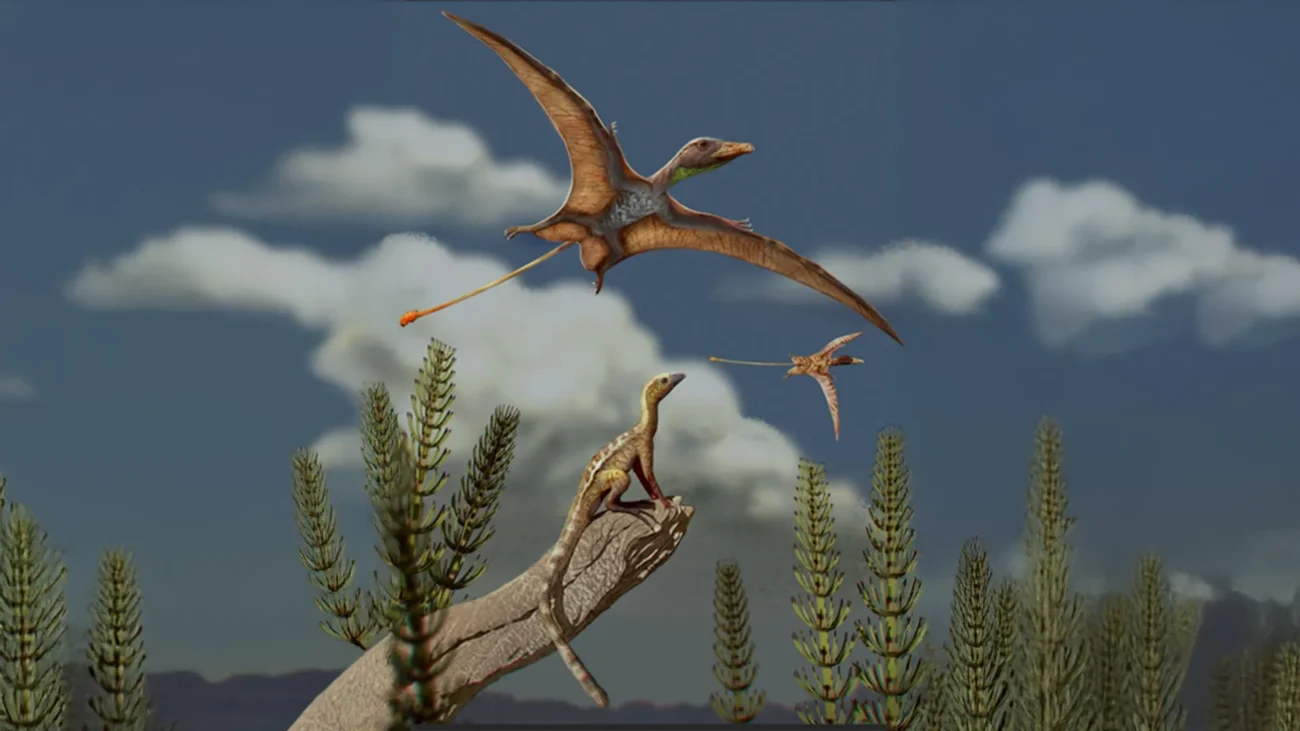
A groundbreaking study, led by an evolutionary biologist at Johns Hopkins Medicine, suggests that giant reptiles known as pterosaurs, which soared through the skies as far back as 220 million years ago, may have developed the remarkable ability of powered flight at the very dawn of their evolutionary journey. This finding starkly contrasts with the prevailing scientific understanding of how modern birds and their ancestors acquired flight, a process believed to have been more gradual and intrinsically linked to the development of larger, more complex brains. The research, which employed sophisticated imaging techniques to scrutinize the internal brain cavities of pterosaur fossils and received partial funding from the National Science Foundation, was published on November 26th in the esteemed journal Current Biology.
The implications of this research are far-reaching, potentially reshaping our understanding of vertebrate evolution and the diverse pathways that led to aerial locomotion. Dr. Matteo Fabbri, Ph.D., an assistant professor of functional anatomy and evolution at the Johns Hopkins University School of Medicine and the lead author of the study, articulated the significance of their findings. "Our study shows that pterosaurs evolved flight early on in their existence and that they did so with a smaller brain similar to true non-flying dinosaurs," Dr. Fabbri stated. This assertion challenges the long-held hypothesis that enlarged brains were a prerequisite for the evolution of flight, at least in the case of these ancient flying reptiles.
Giant Fliers with Surprising Brain Structure
Pterosaurs, often depicted as formidable airborne predators of the Mesozoic Era, were truly astonishing creatures. Some species reached weights of up to 500 pounds and boasted impressive wingspans stretching up to 30 feet, rivaling some of the largest modern birds of prey. They hold the distinction of being the earliest of the three major vertebrate lineages to independently achieve powered flight, with birds and bats following much later in evolutionary history.
The research team embarked on an in-depth investigation into the evolutionary trajectory of pterosaurs, seeking to unravel the mysteries of their aerial prowess and to ascertain if their path to flight differed significantly from that of birds and bats. A key focus of their examination was the shifts in the shape and size of the brain over evolutionary time, with particular attention paid to the optic lobe. This region of the brain, primarily responsible for processing visual information, has been strongly implicated in the development and refinement of flight capabilities across various volant species.
CT Scans Reveal Clues from Early Relatives
To achieve their objectives, the researchers utilized advanced computed tomography (CT) imaging techniques, coupled with specialized software that enabled them to create detailed digital models of fossilized nervous system structures. Their analytical gaze was directed towards the lagerpetids, a group of small, flightless, and arboreal reptiles identified in 2016 as the closest known relatives of pterosaurs. These ancient creatures inhabited the Earth during the Triassic period, roughly between 242 and 212 million years ago. A subsequent study in 2020 further solidified the close evolutionary connection between lagerpetids and pterosaurs, providing a crucial link for the current investigation.
"The lagerpetid’s brain already showed features linked to improved vision, including an enlarged optic lobe, an adaptation that may have later helped their pterosaur relatives take to the skies," explained corresponding author Mario Bronzati, a researcher at the University of Tübingen in Germany. This discovery suggests that the groundwork for enhanced visual processing, a vital component for aerial navigation, was laid in the lineage leading up to pterosaurs even before the advent of flight.
Dr. Fabbri further elaborated on the findings concerning pterosaur brains. While pterosaurs, like their lagerpetid ancestors, also exhibited enlarged optic lobes, their overall brain shape and size diverged considerably from those of the lagerpetid. "The few similarities suggest that flying pterosaurs, which appeared very soon after the lagerpetid, likely acquired flight in a burst at their origin," Dr. Fabbri noted. "Essentially, pterosaur brains quickly transformed, acquiring all they needed to take flight from the beginning." This suggests a rapid evolutionary leap, where flight capabilities were integrated relatively quickly into the pterosaur lineage, rather than being a slow, incremental development.
Comparing Pterosaur and Bird Flight Evolution
The evolutionary narrative for bird flight, in stark contrast, appears to be a more protracted and deliberate process. Modern birds are believed to have evolved flight through a more gradual accumulation of key traits inherited from earlier relatives. These inherited traits, including the expansion of the cerebrum, cerebellum, and optic lobes, were then further refined and adapted specifically for flight. Evidence supporting this gradual model comes from recent research conducted in 2024 by the laboratory of Dr. Amy Balanoff, an assistant professor of functional anatomy and evolution at Johns Hopkins Medicine. Her team’s work highlighted the pivotal role of cerebellum expansion in the origins of bird flight. The cerebellum, situated at the rear of the brain, is crucial for regulating motor coordination, balance, and other functions essential for agile movement, including flight.
"Any information that can fill in the gaps of what we don’t know about dinosaur and bird brains is important in understanding flight and neurosensory evolution within pterosaur and bird lineages," commented Dr. Balanoff, underscoring the interconnectedness of these fields of study. The comparative approach, examining both fossilized and extant brains, is proving invaluable in piecing together these complex evolutionary puzzles.
Insights from Fossilized Brains Across Species
To further contextualize their findings, the research team also analyzed brain cavities from crocodilians (ancestors of modern crocodiles) and early, extinct birds. These ancient reptilian and avian brains were then compared with those of pterosaurs. The analysis revealed that pterosaurs possessed moderately enlarged brain hemispheres, a characteristic that aligns them with other dinosaur groups. This includes the troodontids, bipedal, bird-like dinosaurs that roamed the Earth from approximately 163 to 66 million years ago, and Archaeopteryx lithographica, the oldest-known bird, which lived between 150.8 and 125.45 million years ago. Notably, these prehistoric species exhibit a distinct difference from modern birds, which are characterized by significantly larger brain cavities, further emphasizing the unique evolutionary trajectory of pterosaurs.
Timeline of Key Evolutionary Milestones
The study places the emergence of powered flight in pterosaurs at a remarkably early stage of their evolutionary history, potentially as far back as 220 million years ago during the Late Triassic period. This period was a critical time for the diversification of reptiles following the Permian-Triassic extinction event, which wiped out approximately 96% of marine species and 70% of terrestrial vertebrate species.
- ~242 to 212 Million Years Ago (Triassic Period): Existence of lagerpetids, the flightless, tree-climbing relatives of pterosaurs, exhibiting early adaptations for improved vision.
- ~220 Million Years Ago (Late Triassic Period): Emergence of pterosaurs, potentially acquiring powered flight early in their evolutionary history with relatively smaller brains.
- ~163 to 66 Million Years Ago (Late Jurassic to Late Cretaceous Periods): Existence of troodontids, dinosaur groups with moderately enlarged brain hemispheres.
- ~150.8 to 125.45 Million Years Ago (Late Jurassic to Early Cretaceous Periods): Existence of Archaeopteryx lithographica, the earliest known bird.
- Ongoing (Present Day): Modern birds exhibit significantly larger brain cavities, reflecting a more gradual evolutionary path to flight.
Broader Impact and Implications for Understanding Flight Evolution
The research’s findings have significant implications for our understanding of convergent evolution, the process by which unrelated organisms independently evolve similar traits. Both pterosaurs and birds achieved powered flight, yet their neuroanatomical pathways appear to have been distinct. This suggests that multiple evolutionary routes can lead to complex adaptations, driven by different selective pressures and utilizing varying biological resources.
The study also contributes to the ongoing debate about the relationship between brain size and cognitive complexity. While larger brains are often associated with advanced cognitive abilities, the pterosaur case demonstrates that efficient flight could be achieved with a brain structure that, by comparison to birds, was less developed in certain areas. This underscores the importance of brain organization and specialized adaptations over sheer size.
Looking Ahead to Future Research
Dr. Fabbri emphasized that future research will be crucial in delving deeper into the functional aspects of pterosaur brains. Understanding how the internal structure of the brain, beyond just its size and shape, facilitated their remarkable flight capabilities will be paramount. This deeper understanding is essential for uncovering the broader biological principles that govern the evolution of flight across diverse lineages. The study also highlights the ongoing importance of international collaboration and the reliance on funding from various scientific bodies to advance our knowledge of prehistoric life.
The research received significant funding from a consortium of organizations, including the Alexander von Humboldt Foundation, the Brazilian Federal Government, The Paleontological Society, Agencia Nacional de Promoción Científica y Técnica, Conselho Nacional de Desenvolvimento Científico e Tecnológico, the European Union NextGenerationEU/PRTR, the National Science Foundation (NSF DEB 1754596, NSF IOB-0517257, IOS-1050154, IOS-1456503), and the Swedish Research Council. This broad support underscores the global scientific interest and investment in unraveling the evolutionary history of life on Earth.
The collaborative nature of this research is also evident in the diverse team of scientists who contributed to the study. Alongside Dr. Fabbri and Dr. Bronzati, the paper lists a comprehensive list of researchers from institutions across the United States, Germany, Brazil, Spain, and Argentina. This global effort underscores the interdisciplinary and international nature of modern paleontological research.
In conclusion, this study on pterosaur brain evolution offers a compelling new perspective on the origins of flight. By meticulously examining fossil evidence and employing cutting-edge analytical tools, scientists are continuing to illuminate the intricate and diverse pathways that life has taken to conquer the skies, revealing that evolution often finds ingenious solutions through a variety of biological blueprints.

