


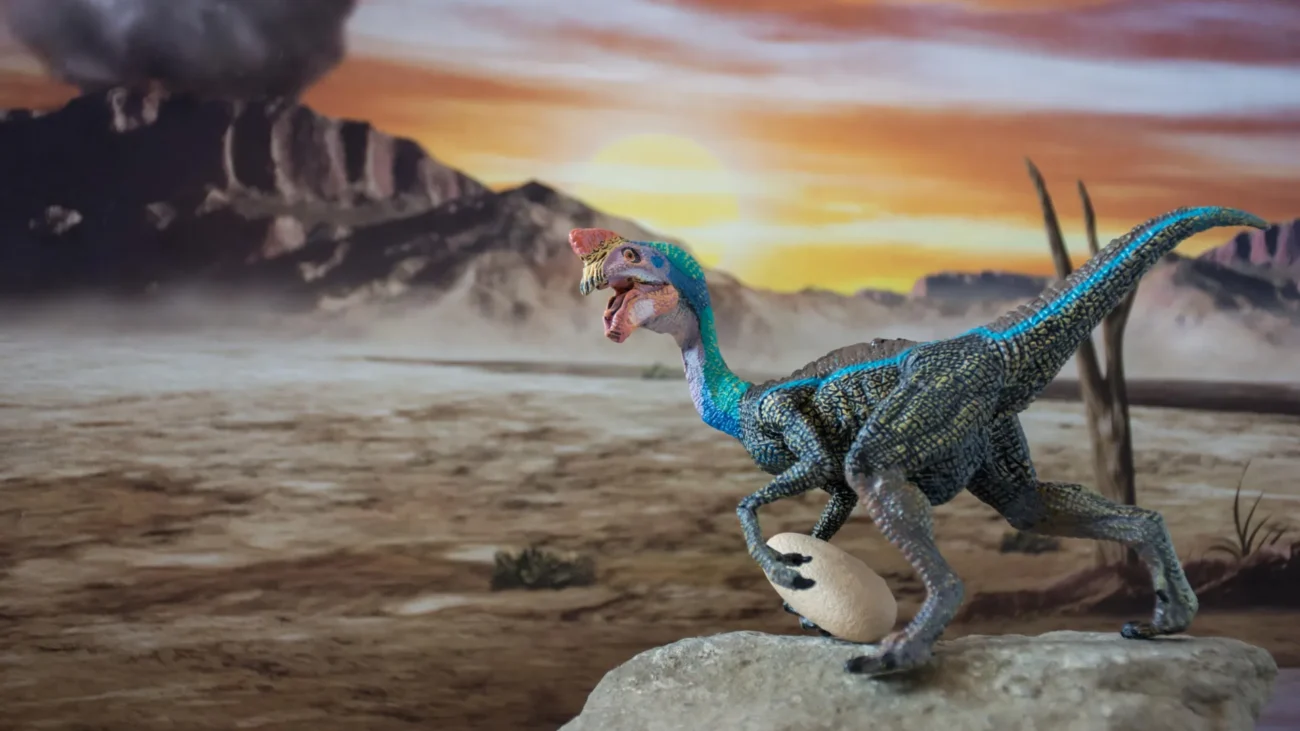
The intricate world of dinosaur reproduction, a realm long shrouded in speculation and scientific debate, has recently been illuminated by a groundbreaking study published in Frontiers in Ecology and Evolution. For decades, paleontologists have grappled with a fundamental question regarding oviraptors, a group of bird-like, flightless dinosaurs: how did they incubate their eggs? Did these ancient creatures rely on ambient environmental heat, akin to modern reptiles like crocodiles, or did they actively provide warmth to their offspring, mirroring the behavior of contemporary birds? This new research, spearheaded by a team of Taiwanese scientists, employs a multidisciplinary approach, combining sophisticated heat transfer simulations with hands-on physical experimentation, to reconstruct the incubation strategies of these fascinating dinosaurs.
The Oviraptor Enigma: A Question of Parental Care
Oviraptors, which roamed parts of Asia during the Late Cretaceous period (approximately 100 to 66 million years ago), have long captivated the scientific imagination. Their name, meaning "egg thief," stems from early fossil discoveries where oviraptors were found alongside dinosaur eggs, leading to the erroneous assumption that they preyed on the eggs of other species. However, subsequent research revealed that these eggs were, in fact, their own, and that oviraptors were dedicated parents, often found in brooding postures over their clutches. This revelation intensified the scientific curiosity about their incubation methods. Unlike many dinosaurs whose nests have been found in enclosed or buried structures, oviraptor nests, as evidenced by fossil discoveries, were often semi-open, arranged in intricate circular patterns. This distinctive nesting architecture presented a unique challenge for understanding how they regulated egg temperature.
The core of the scientific debate centered on two primary incubation models: ectothermy, where external heat sources like the sun or warm soil are utilized, and endothermy, where the parent’s body heat is the primary source of warmth. While some fossil evidence, such as the discovery of oviraptor skeletons positioned directly over their nests, suggested a brooding behavior similar to birds, the physical constraints of their nesting arrangements made direct, full-body contact with all eggs unlikely. This ambiguity necessitated a more empirical approach, moving beyond mere observation of fossilized postures to a quantitative understanding of heat transfer dynamics.
Reconstructing an Oviraptor Nest: A Hands-On Approach
To bridge the gap between fossil evidence and modern scientific understanding, researchers from Taiwan’s National Museum of Natural Science embarked on an ambitious project to recreate a life-sized oviraptor model and a realistic nest. The study focused on Heyuannia huangi, an oviraptor species that inhabited what is now China between 70 and 66 million years ago. This particular species was roughly 1.5 meters in length and weighed an estimated 20 kilograms, making it a medium-sized dinosaur. Its nesting behavior, characterized by semi-open nests with eggs arranged in multiple rings, served as the blueprint for the experimental setup.
The construction of the oviraptor model was a testament to the team’s dedication. The torso was meticulously crafted using a combination of polystyrene foam and a sturdy wooden frame, providing a skeletal foundation. To mimic the soft tissues and the insulating layer of feathers that many oviraptors are believed to have possessed, the model was padded with cotton, bubble paper, and fabric. The eggs themselves, a crucial component of the experiment, were fabricated from casting resin. This material was chosen for its ability to approximate the physical properties of real oviraptor eggs, which are unlike those of any currently living species. The researchers acknowledged the inherent difficulty in perfectly replicating these extinct eggs, stating, "Part of the difficulty lies in reconstructing oviraptor incubation realistically. For example, their eggs are unlike those of any living species, so we invented the resin eggs to approximate real oviraptor eggs as best as we could."
The experimental nests were designed to mirror fossil discoveries, with two clutches arranged in double rings. This arrangement was critical, as it directly influenced how heat could be distributed and received by the eggs. By carefully recreating the physical environment of an oviraptor nest, the researchers aimed to simulate the thermal dynamics that would have occurred during natural incubation.
Heat, Nest Design, and Hatching Patterns: A Tale of Two Environments
The core of the study involved testing how the presence of a brooding adult and varying environmental conditions impacted egg temperatures and, consequently, hatching outcomes. The team conducted experiments under both colder and warmer ambient temperature scenarios, meticulously recording the temperature fluctuations within the egg clutches.
In colder conditions, the presence of the brooding adult model had a significant effect. The temperature differential across the outer ring of eggs could reach as much as 6°C. Such a substantial temperature gradient is a key factor in asynchronous hatching, a phenomenon where eggs within the same clutch hatch at different times. This variability is crucial for survival, as it allows hatchlings to emerge during more favorable environmental conditions. In contrast, when the experiments were conducted in warmer environments, the temperature variation across the outer ring of eggs dropped dramatically to approximately 0.6°C. This finding strongly suggests that in warmer climates, the influence of solar radiation likely played a more significant role in evening out egg temperatures, thereby affecting hatching patterns.
Dr. Tzu-Ruei Yang, the senior author of the study and an associate curator of vertebrate paleontology at Taiwan’s National Museum of Natural Science, elaborated on this point: "It’s unlikely that large dinosaurs sat atop their clutches. Supposedly, they used the heat of the sun or soil to hatch their eggs, like turtles. Since oviraptor clutches are open to the air, heat from the sun likely mattered much more than heat from the soil." This observation shifts the paradigm from direct parental heat provision to a more cooperative model involving environmental heat sources, particularly solar energy.
The study’s findings indicate that the relative position of the incubating adult to the eggs was a primary driver of the observed hatching patterns. This suggests a sophisticated, albeit different, form of parental care compared to modern birds. The researchers also derived an estimate for the incubation efficiency of oviraptors, which was found to be considerably lower than that of modern birds. This lower efficiency, however, is not necessarily a sign of inferiority but rather an adaptation to their specific ecological niche and reproductive strategy.
Dinosaur vs. Bird Incubation Efficiency: A Comparative Analysis
The comparative analysis between oviraptor and modern bird incubation practices provided further crucial insights. Most modern birds employ what is known as thermoregulatory contact incubation (TCI). This method relies on the adult bird sitting directly on its eggs, providing a consistent and direct source of warmth. For TCI to be effective, the adult must be able to maintain physical contact with all eggs in the clutch, acting as the primary heat generator and ensuring uniform temperature distribution.
Oviraptors, however, faced a significant challenge in achieving TCI due to their unique nesting structure. The circular arrangement of their eggs meant that an adult, even if positioned centrally, could not simultaneously maintain consistent contact with every single egg. This physical limitation rendered direct TCI, as practiced by modern birds, impractical.
Chun-Yu Su, the first author of the study and a student at Washington High School in Taichung when the research was conducted, explained, "Oviraptors may not have been able to conduct TCI as modern birds do. Instead, these dinosaurs and environmental heat likely worked together, making them co-incubators." This concept of "co-incubation," where both parental presence and external environmental factors contribute to the incubation process, offers a novel perspective on dinosaur reproductive strategies. While this method might have been less efficient in terms of heat generation compared to direct brooding by modern birds, it was likely well-suited to the oviraptors’ nesting style, which appears to have evolved from more concealed nests to the semi-open structures observed in the fossil record.
Dr. Yang further emphasized the nuanced difference: "Modern birds aren’t ‘better’ at hatching eggs. Instead, birds living today and oviraptors have a very different way of incubation or, more specifically, brooding. Nothing is better or worse. It just depends on the environment." This statement underscores the principle that evolutionary adaptations are driven by environmental pressures and ecological opportunities, rather than a linear progression of "improvement." The oviraptor’s incubation strategy, while less efficient by modern bird standards, was an effective solution for its time and habitat.
Broader Implications for Dinosaur Parenting and Paleontological Research
The findings of this study carry significant implications for our understanding of dinosaur parenting behaviors and open new avenues for future paleontological research. While the researchers acknowledge certain limitations, such as the fact that their results are based on reconstructed models and modern environmental conditions that may differ from those of the Late Cretaceous, the study provides a robust framework for further investigation. The extended incubation periods, which are likely for dinosaurs compared to modern birds, would have necessitated a prolonged period of parental investment and protection.
The integration of physical models with heat transfer simulations represents a powerful methodological advancement. This approach allows paleontologists to move beyond descriptive interpretations of fossil evidence to quantitative analyses of biological processes. It offers a tangible way to test hypotheses about extinct animal behaviors and physiology, even in the absence of direct biological samples. This work, therefore, serves as a crucial stepping stone for future studies aiming to reconstruct other aspects of dinosaur reproduction, such as clutch size, nesting materials, and parental care strategies.
Moreover, the study holds a broader inspirational message. Dr. Yang concluded with a note of encouragement: "It also truly is an encouragement for all students, especially in Taiwan. There are no dinosaur fossils in Taiwan, but that does not mean that we cannot do dinosaur studies." This highlights the global nature of scientific inquiry and the power of innovative methodologies to overcome geographical limitations. By pushing the boundaries of scientific exploration, this research not only deepens our knowledge of prehistoric life but also inspires the next generation of scientists to tackle complex questions with creativity and determination. The oviraptor, once an enigma, is now a clearer window into the diverse and sophisticated world of dinosaur parental care.

