


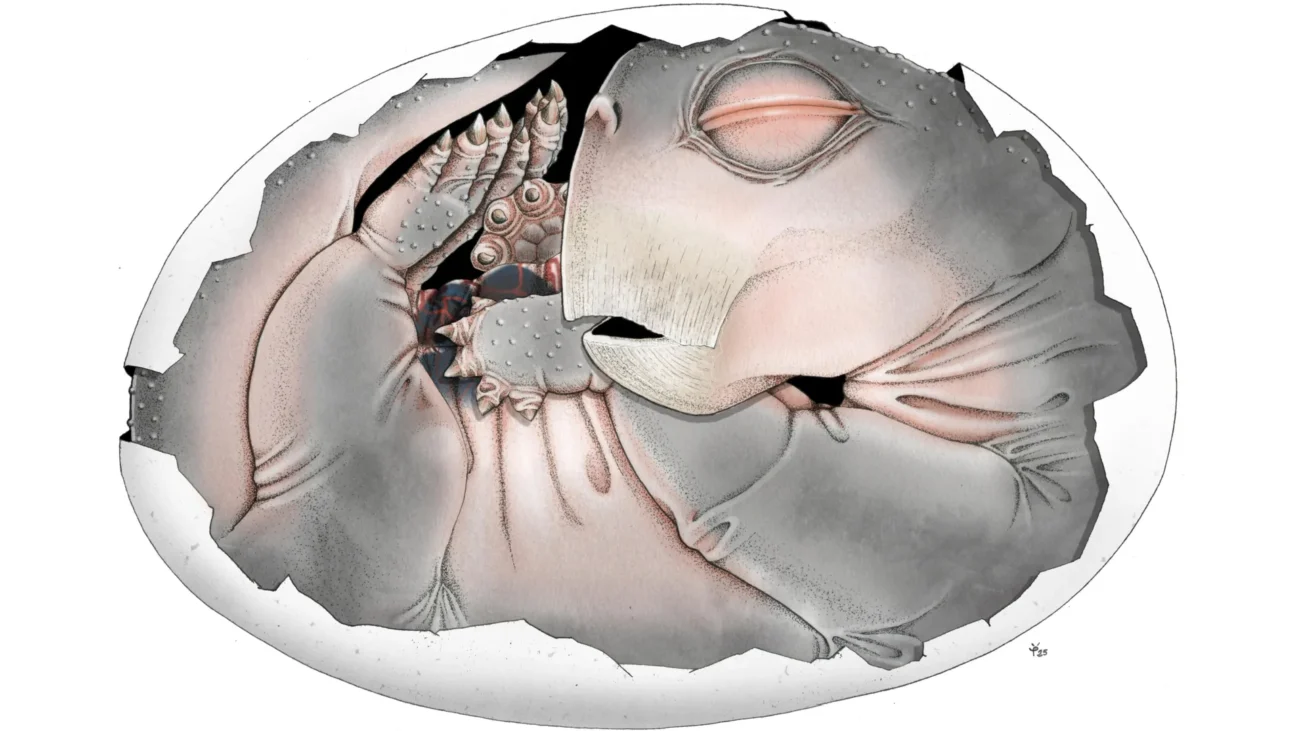
The discovery of a 250-million-year-old fossilized egg containing a Lystrosaurus embryo has unearthed profound insights into one of Earth’s most extraordinary survival sagas and definitively answered a question that has long eluded paleontologists: did the ancestors of mammals lay eggs? This groundbreaking find, published in the journal PLOS ONE, not only confirms the reproductive strategies of these ancient creatures but also sheds crucial light on how they managed to dominate the planet in the aftermath of the devastating End-Permian Mass Extinction.
The Great Dying and the Rise of an Unlikely Survivor
Around 252 million years ago, the Earth experienced its most catastrophic biological crisis, an event so profound it is known as the End-Permian Mass Extinction, or "The Great Dying." This cataclysmic period, driven by massive volcanic activity in the Siberian Traps and subsequent dramatic shifts in climate, oceans, and atmosphere, led to the demise of an estimated 96% of all marine species and 70% of terrestrial vertebrate species. The world that emerged from this devastation was a radically altered landscape, characterized by extreme heat, widespread droughts, and unstable environmental conditions.
Amidst this ecological wasteland, a peculiar, pig-sized creature named Lystrosaurus emerged as one of the planet’s most successful survivors. This hardy, herbivorous animal, a member of the synapsid lineage that would eventually lead to mammals, demonstrated an uncanny ability to not only endure but to thrive in this hostile new world. Its ubiquity in the fossil record of the Triassic period, immediately following the extinction event, has long marked it as a key player in the planet’s recovery. However, the precise reproductive strategies that facilitated this remarkable resilience remained a subject of intense scientific debate for decades.
Unveiling a Mammalian Ancestral Secret: The Egg Discovery
The breakthrough came from an international team of researchers, spearheaded by Professor Julien Benoit of the University of Burgundy, Professor Jennifer Botha from the Evolutionary Studies Institute at the University of the Witwatersrand in South Africa, and Dr. Vincent Fernandez from the ESRF – The European Synchrotron in France. Their meticulous analysis of a fossil specimen, initially discovered nearly 17 years ago, has provided the first conclusive evidence that mammal ancestors reproduced by laying eggs.
The fossil in question, a small nodule unearthed during a field excursion in 2008, initially presented only faint traces of bone. John Nyaphuli, a remarkably skilled preparator and fossil finder, meticulously worked on the specimen. As he painstakingly revealed more of the fossil, it became clear that it contained a perfectly curled-up Lystrosaurus hatchling. Professor Botha, who led the initial field work, suspected at the time that the creature had died within its egg, but the technology to confirm this definitively was not yet available.
Advanced Imaging: A Window into the Past
The advent of advanced synchrotron X-ray computed tomography (CT) scanning at the ESRF provided the crucial technological leap needed to unlock the secrets held within the ancient fossil. These powerful X-ray tools allowed researchers to peer inside the specimen with unprecedented detail, revealing the delicate skeletal structure of the embryo in its preserved state.
"This fossil was discovered during a field excursion I led in 2008, nearly 17 years ago," Professor Botha recounted. "My preparator and exceptional fossil finder, John Nyaphuli, identified a small nodule that at first revealed only tiny flecks of bone. As he carefully prepared the specimen, it became clear that it was a perfectly curled-up Lystrosaurus hatchling. I suspected even then that it had died within the egg, but at the time, we simply didn’t have the technology to confirm it."
Dr. Fernandez elaborated on the significance of the imaging process: "Understanding reproduction in mammal ancestors has been a long-lasting enigma, and this fossil provides a key piece to this puzzle. It was essential that we scanned the fossil just right to capture the level of detail needed to resolve such tiny, delicate bones."
The Crucial Mandibular Clue
The detailed scans revealed more than just the presence of an embryo within an egg; they offered vital clues about its developmental stage. Professor Benoit’s keen observation of an incomplete mandibular symphysis – the point where the two halves of the lower jaw fuse – proved to be a critical piece of evidence.
"When I saw the incomplete mandibular symphysis, I was genuinely excited," Professor Benoit stated. "The mandible, the lower jaw, is made up of two halves that must fuse before the animal can feed. The fact that this fusion had not yet occurred shows that the individual would have been incapable of feeding itself." This observation strongly suggests that the embryo died before hatching, confirming that it was indeed preserved within its egg.
The Riddle of Soft-Shelled Eggs
The rarity of finding such fossils can be largely attributed to the nature of the eggs themselves. Unlike the hard, calcified eggs of dinosaurs, which are readily preserved in the fossil record, researchers believe that Lystrosaurus eggs were soft-shelled. This characteristic, while beneficial in some ways, makes them far more susceptible to decay and disintegration before fossilization can occur. This extreme fragility explains why this is the first confirmed therapsid (mammal-ancestor) egg ever discovered, despite the widespread success of animals like Lystrosaurus.
Reproductive Strategies for Survival: Large Eggs and Precocial Young
Beyond confirming oviparous reproduction, the study offers significant insights into the specific reproductive strategies that enabled Lystrosaurus to flourish in a post-extinction world. The fossilized embryo indicates that Lystrosaurus produced relatively large eggs for its body size. In modern animals, larger eggs typically contain a greater proportion of yolk, providing ample nutrition for the developing embryo. This suggests that Lystrosaurus young were likely self-sufficient upon hatching, negating the need for extensive parental provisioning, such as milk feeding, which characterizes modern mammals.
The substantial yolk reserves would have been particularly advantageous in the arid and unstable climate that followed the End-Permian extinction. Larger eggs are inherently more resistant to desiccation, offering a crucial buffer against the drying conditions.
Furthermore, the developmental stage of the embryo, as indicated by the unfused jaw, points towards a precocial reproductive strategy. Precocial young are born or hatched at an advanced stage of development, capable of independent movement and feeding shortly after birth. This implies that Lystrosaurus hatchlings were well-equipped to forage for food, evade predators, and begin their journey to maturity rapidly. This strategy of rapid growth and early independence would have been a significant advantage in a world where resources were scarce and survival was a constant challenge.
Implications for Mammalian Evolution and Climate Resilience
This discovery has profound implications for our understanding of mammalian evolution. It firmly places egg-laying within the reproductive repertoire of the synapsid lineage, solidifying the evolutionary link between these ancient reptiles and modern mammals. The confirmation that mammal ancestors laid eggs is a pivotal moment, answering a question that has lingered for over a century of paleontological research.
"This research is important because it provides the first direct evidence that mammal ancestors, such as Lystrosaurus, laid eggs, resolving a long-standing question about the origins of mammalian reproduction," explained Professor Benoit. "Beyond this fundamental insight, it reveals how reproductive strategies can shape survival in extreme environments: by producing large, yolk-rich eggs and precocial young, Lystrosaurus was able to thrive in the harsh, unpredictable conditions following the End-Permian Mass Extinction."
The findings also offer a valuable deep-time perspective on resilience and adaptability in the face of environmental upheaval. The success of Lystrosaurus in the aftermath of the End-Permian extinction highlights the crucial role of flexible reproductive strategies and rapid development in surviving global crises.
Professor Botha emphasized the milestone nature of the find: "It is also thrilling because this discovery breaks entirely new ground. For over 150 years of South African paleontology, no fossil had ever been conclusively identified as a therapsid egg. This is the first time we can say, with confidence, that mammal ancestors like Lystrosaurus laid eggs, making it a true milestone in the field."
A Global Crisis and a Blueprint for Survival
The End-Permian Mass Extinction serves as a stark reminder of Earth’s vulnerability to rapid environmental change. The volcanic outgassing, likely triggered by the eruption of the Siberian Traps, released massive quantities of greenhouse gases, leading to a dramatic increase in global temperatures, ocean acidification, and widespread anoxia. This chain of events decimated ecosystems worldwide, leaving behind a planet struggling to recover.
The timeline of events leading to the Lystrosaurus discovery itself spans nearly two decades, underscoring the patience and technological advancement required in paleontology:
- 252 Million Years Ago: The End-Permian Mass Extinction event devastates global biodiversity.
- Early Triassic Period (following the extinction): Lystrosaurus emerges as a dominant species in the recovering ecosystems.
- 2008: Professor Jennifer Botha leads a field excursion where John Nyaphuli discovers the fossil nodule.
- Present Day: Advanced synchrotron X-ray CT scanning at the ESRF allows researchers to confirm the presence of a Lystrosaurus embryo within a fossilized egg.
- Publication in PLOS ONE: The findings are officially announced, resolving a long-standing scientific mystery.
Broader Implications for Modern Climate Challenges
In an era marked by accelerating climate change and increasing biodiversity loss, the study of ancient survival strategies offers invaluable lessons. The resilience of Lystrosaurus, born from its ability to adapt its reproductive and developmental strategies to harsh environmental conditions, provides a compelling historical parallel to the challenges faced by species today.
"In a modern context, this work is highly impactful because it offers a deep-time perspective on resilience and adaptability in the face of rapid climate change and ecological crisis," Professor Benoit noted. "Understanding how past organisms survived global upheaval helps scientists better predict how species today might respond to ongoing environmental stress, making this discovery not just a breakthrough in paleontology, but also highly relevant to current biodiversity and climate challenges."
The research highlights a fundamental principle of evolutionary success: adaptability is paramount, especially in the face of global environmental crises. The Lystrosaurus story, now illuminated by the discovery of its ancient egg, is a testament to the power of evolutionary innovation in ensuring survival, offering a vital perspective for understanding and addressing the ecological challenges of our own time. The ability to "see" inside this ancient specimen, as Dr. Fernandez described it, has not only solved a paleontological puzzle but has also provided a crucial historical lens through which to view the ongoing environmental struggles of life on Earth.

