


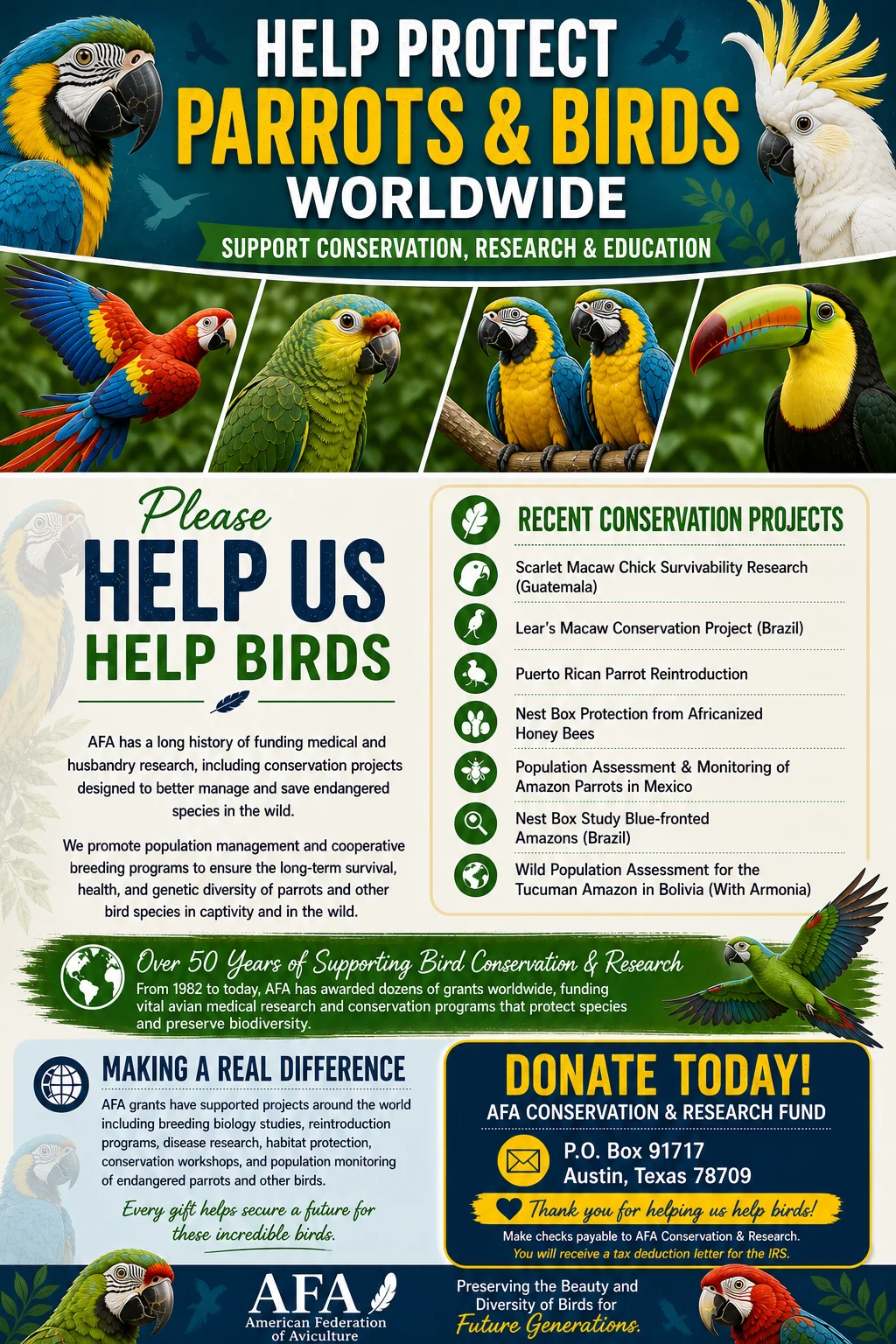
The American Federation of Aviculture (AFA), a leading global authority on the care and conservation of exotic birds, has officially announced its conservation agenda for the 2024-2025 period, bolstered by a significant financial partnership with Harrison’s Bird Foods. This collaboration aims to provide critical funding and resources to field biology projects and research initiatives targeting wild parrot populations in their native habitats. As part of this ongoing commitment, Harrison’s Bird Foods recently presented AFA Chief Financial Officer Janice Lang with a check for $25,000, underscoring the private sector’s role in supporting non-profit environmental stewardship.
This funding cycle is designed to support small-scale grants, typically ranging from $500 to larger sums in exceptional cases, for projects that align with the AFA’s mission to promote avian welfare, scientific research, and legislative awareness. By targeting high-impact, localized efforts, the AFA seeks to mitigate the effects of poaching, habitat loss, and environmental stressors on some of the world’s most vulnerable avian species.
Current Conservation Initiatives and Field Research
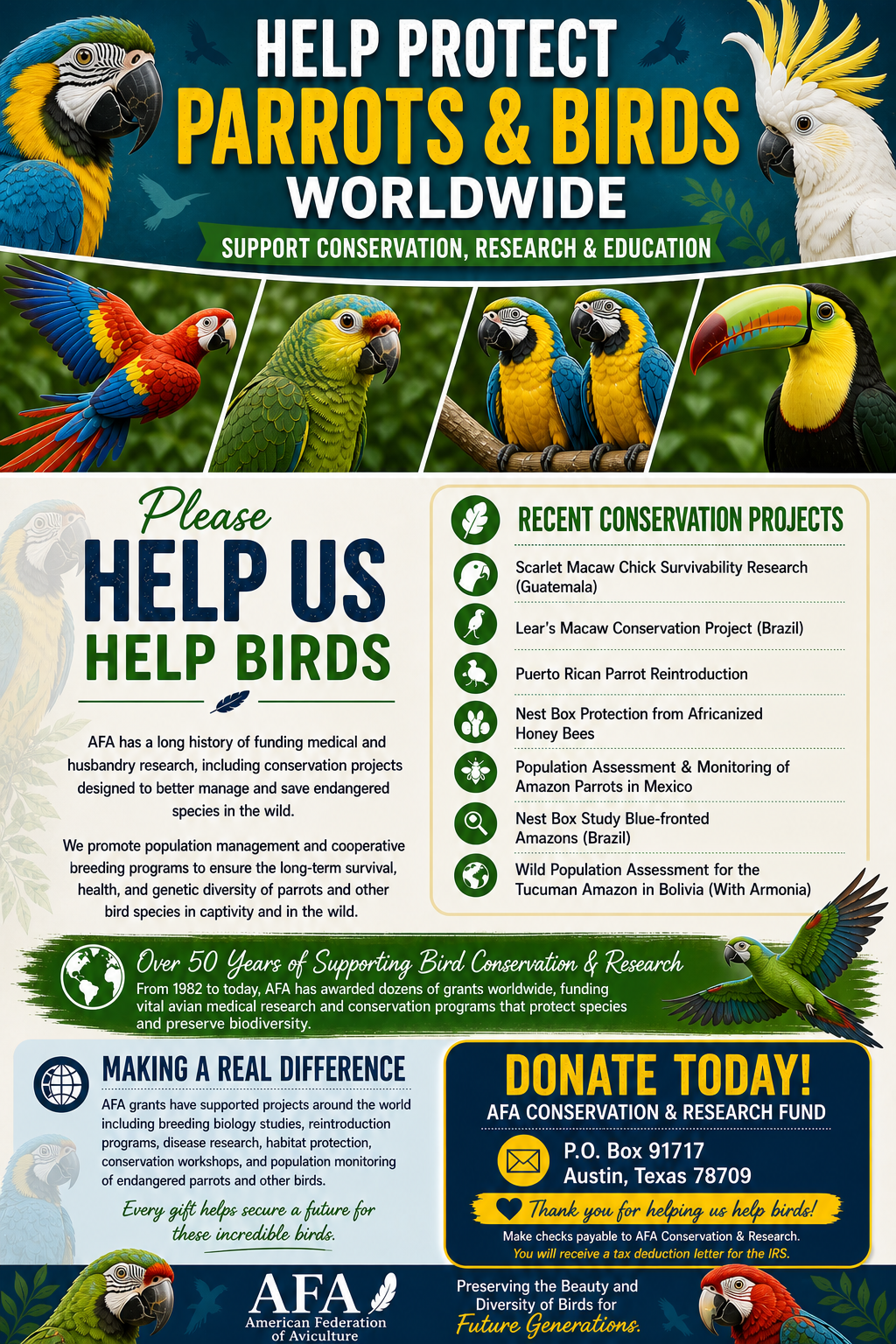
The 2024-2025 conservation portfolio includes several high-priority projects across Latin America, focusing on species such as the Scarlet Macaw (Ara macao) and the Lear’s Macaw (Anodorhynchus leari). These projects represent a blend of direct intervention, community-based subsidies, and advanced biological research.
Scarlet Macaw Recovery in Mexico and Guatemala
In the Lacandon rainforest of southern Mexico, the Chajul Biology Station, managed by Natura Mexicana, serves as the 2024 AFA Conservation Project centerpiece. The station addresses a critical crisis: without human intervention, the fledgling rate for wild Scarlet Macaws in the region often drops to zero percent due to systemic poaching for the illegal wildlife trade. Biologists at Chajul monitor wild nests, identify hatchlings, and, when necessary, rear and release wild-hatched macaws. To date, the program has successfully fledged over 150 Scarlet Macaws back into the wild. The AFA’s goal for the 2024 fundraising season is to secure $5,000 to provide the station with essential medical and husbandry equipment, including incubators, brooders, and precision gram scales.
Simultaneously, the Selva Maya Living Landscape Program, led by the Wildlife Conservation Society (WCS) in Guatemala, continues its long-term research into chick survivability within the Maya Biosphere Reserve. Since 2002, the WCS has implemented experimental interventions designed to increase population recruitment. The Scarlet Macaw remains one of the top five landscape species for the WCS in this region, where habitat fragmentation and climate-driven nest failures pose ongoing threats.
Human-Wildlife Conflict Resolution in Brazil
In Brazil, the Lear’s Macaw Corn Subsidy Program addresses a unique challenge at the intersection of agriculture and conservation. Wild Lear’s Macaws often forage in local cornfields, leading to significant crop losses for subsistence farmers. Historically, this led to retaliatory killings of the birds. The subsidy program, supported by the AFA and its partners, provides corn to these farmers to offset their losses, transforming potential antagonists into conservation allies. This "human-wildlife conflict" model is increasingly viewed as a gold standard for protecting endangered species that live in proximity to human settlements.
Advanced Physiological Research in Peru
The Tambopata Macaw Project in Peru continues to provide the scientific community with invaluable baseline data. Led by investigators J. Jill Heatley, Lizzie Ortiz-cam, and Donald Brightsmith, the project utilizes i-STAT analyzers to determine electrolytes, venous blood gases, and lactate levels in both nestlings and free-flighted adults. This data is essential for understanding the physiological needs of parrots and evaluating the health of populations in the wild. A secondary focus involves investigating the use of clay licks; while several theories suggest birds visit these sites for sodium or toxin neutralization, the current research aims to confirm these hypotheses through serum electrolyte determination.
Innovative Solutions to Biological Threats
Beyond direct population management, the AFA supports research into environmental threats that compromise nesting success. One such project, led by Principal Investigator Caroline A. Efstathion, focuses on the prevention of Africanized honey bee colonization in parrot nest boxes. Using a "push-pull" protocol, researchers apply permethrin—a bird-safe insecticide—to repel bees from bird boxes while simultaneously using pheromone-baited traps to draw them to alternative nesting sites. This methodology ensures that parrots have safe, bee-free environments to rear their young, addressing a significant cause of nest abandonment in tropical regions.
A Legacy of Avicultural Advocacy: The History of the AFA
The American Federation of Aviculture was not born solely out of a desire for conservation, but from a need for protection against legislative overreach. In the early 1970s, an outbreak of Exotic Newcastle Disease in California led to the mass euthanasia of healthy exotic birds by the United States Department of Agriculture (USDA). This event, coupled with proposed state legislation that threatened to ban the private ownership of exotic birds, served as the catalyst for the formation of the AFA in March 1974.
Since its incorporation as a 501(c)3 non-profit, the AFA has evolved into a global umbrella organization representing thousands of aviculturists and numerous bird clubs. Its mission is multifaceted: promoting breeding and husbandry practices, supporting research, and ensuring that the interests of bird owners are represented at the highest levels of government, including the Convention on the International Trade in Endangered Species (CITES).
The Regulatory Framework: CITES, WBCA, and the ESA
Understanding the landscape of avian conservation requires a deep dive into the legal structures that govern the trade and movement of birds. The AFA plays a pivotal role in navigating these regulations, which include:

The Convention on the International Trade in Endangered Species (CITES)
CITES is an international treaty designed to ensure that the trade of wild animals and plants does not threaten their survival. Species are categorized into three appendices based on their level of endangerment. The AFA holds official Non-Governmental Observer (NGO) status at CITES meetings, providing a voice for the avicultural community and offering practical expertise on the captive breeding of psittacines.
The Wild Bird Conservation Act (WBCA) of 1992
The WBCA effectively halted the mass importation of wild-caught birds into the United States. While the law was intended to protect wild populations, it created significant hurdles for aviculturists seeking to diversify genetic pools. However, the act allows for exceptions, such as "Cooperative Breeding Programs" (CBPs) and a "Clean List" of species that are well-established in captivity and not exploited in the wild.
The Endangered Species Act (ESA) of 1973
The ESA is a domestic U.S. law that protects species deemed to be at risk of extinction. While the ESA and CITES often overlap, they are distinct. For example, some species listed on CITES Appendix I may not be listed under the ESA. The AFA monitors the Federal Register for any changes to the ESA that might affect the interstate commerce or ownership of birds, such as the recent additions of the Military Macaw and various cockatoo species to the act.
Cooperative Breeding Programs: Ensuring Genetic Diversity
To combat the limitations imposed by the WBCA, the AFA oversees several Cooperative Breeding Programs. These programs allow for the limited importation of specific species to serve as breeding stock, ensuring that populations within the U.S. remain genetically healthy and sustainable.

Current programs include the Blue-eyed Cockatoo CBP, which has recently been extended to include various Black Cockatoo species, such as the Gang-gang and the Red-tailed Black Cockatoo. These initiatives require rigorous reporting to the U.S. Fish and Wildlife Service (USFWS) and are managed by dedicated program leaders like Mary Ellen LePage. By importing birds from countries where they are domestically raised, these programs avoid depleting wild populations while enriching the domestic avicultural landscape.
Broader Impact and Future Outlook
The work of the AFA and its partners like Harrison’s Bird Foods represents a holistic approach to conservation. By combining field research, legislative monitoring, and sustainable captive breeding, the organization ensures a future where exotic birds can thrive both in their natural habitats and under human care.
The implications of this work extend beyond individual species. Avian health research often provides early warning signs for broader environmental degradation, and the human-wildlife conflict models developed for parrots can be adapted for other endangered fauna. As the 2024-2025 cycle progresses, the AFA continues to invite researchers and conservationists to apply for grants, fostering a new generation of scientists dedicated to the preservation of the world’s avian wildlife.
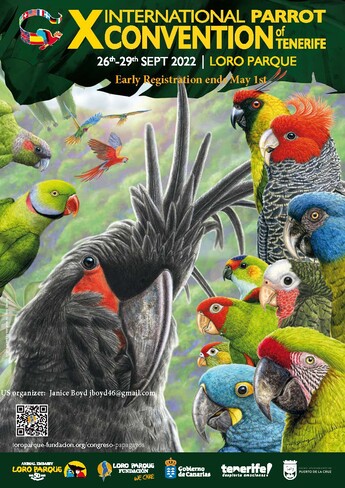
The organization also encourages public participation through donations and attendance at international forums, such as the upcoming International Parrot Conference in the Canary Islands. Through these collective efforts, the AFA remains at the forefront of global avian stewardship, bridging the gap between private aviculture and international conservation science.

