



The Belfast Photo Festival, a premier event in the international photography calendar, has found itself at the center of a heated global debate ahead of its June 4 opening in Northern Ireland. The controversy stems from a planned interactive installation titled "Camera Obsolete?" which invites members of the public to participate in the physical destruction of analog and digital cameras. While organizers frame the event as a profound exploration of the transition from the mechanical to the algorithmic era of image-making, a significant portion of the photographic community has decried the project as wasteful, environmentally hazardous, and disrespectful to the history of the medium.
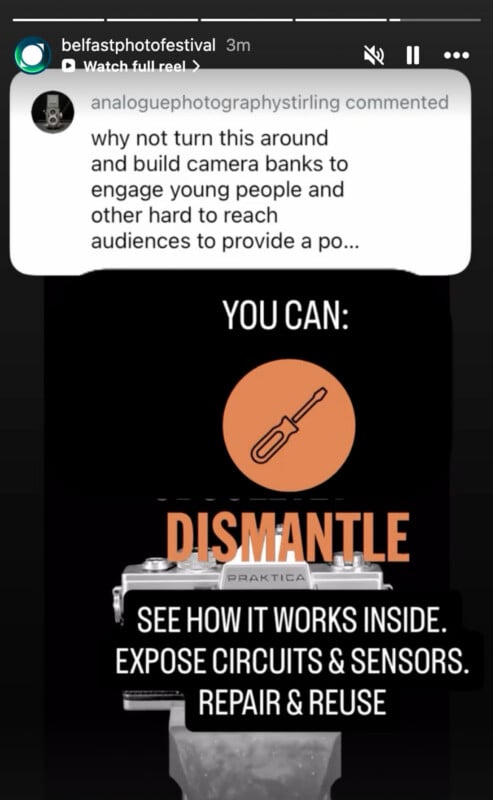
As part of the festival’s major public exhibition, the "Camera Obsolete?" installation features a dedicated space colloquially referred to as "The Destroy Room." Here, visitors aged 18 and older are provided with hammers and safety gear to smash cameras deemed "obsolete." For those seeking a less violent engagement, the exhibit offers tools for the meticulous dismantling of hardware, allowing participants to examine the internal circuitry, sensors, and mechanical gears that once facilitated the capture of light on film or silicon. The ultimate goal of the project is a "material transformation," where the resulting debris is collected and collaboratively reconfigured into new sculptural forms. These sculptures are intended to remain on display throughout the festival before being cast into a permanent public monument at the Belfast Botanical Gardens.
The Philosophy of Creative Destruction
The installation was conceived and produced by the Belfast Photo Festival as a direct response to the shifting landscape of contemporary photography. In an era increasingly dominated by artificial intelligence and "prompt-based" imagery, the physical camera is becoming, for many, a secondary or even redundant tool. Toby Smith, the Belfast Photo Festival’s Director of Development, explained that the exhibit is designed to confront audiences with the "pleasure, discomfort, and contradiction" inherent in the destruction of physical hardware.

According to Smith, many modern creators are already making a silent choice to abandon traditional photography in favor of generative AI. By bringing this act of abandonment into the public sphere through physical destruction, the festival aims to raise critical questions regarding authorship, the nature of truth in imagery, and the loss of the tangible medium. The organizers argue that the project is not merely about destruction but about "recasting" the past into a new artistic narrative, thereby facilitating a dialogue between the mechanical history of the 19th and 20th centuries and the digital frontier of the 21st.
A Timeline of the Controversy
The backlash began shortly after the festival’s initial promotional materials were released in mid-May. When PetaPixel and other industry outlets reported on the specifics of "The Destroy Room," social media platforms became a focal point for dissent. By late May, the festival’s Instagram and Facebook pages were flooded with comments from photographers, collectors, and conservationists.
On May 20, the rhetoric intensified when prominent voices in the film photography community began sharing the news. Within 48 hours, the "Camera Obsolete?" project had become a viral topic, prompting the festival to issue a series of clarifications via Instagram Stories. By the final week of May, the debate had evolved from a local arts news story into a broader discussion on the ethics of "auto-destructive art" in the context of the global climate crisis and the burgeoning "analog renaissance."
Critical Responses and Environmental Concerns
The most vocal opposition has come from the analog photography sector, a community that has seen a massive resurgence in recent years. Retailers and repair technicians have pointed out that the supply of vintage film cameras is finite. Unlike modern electronics, mechanical cameras from the mid-20th century are no longer in production, and the availability of spare parts is dwindling.

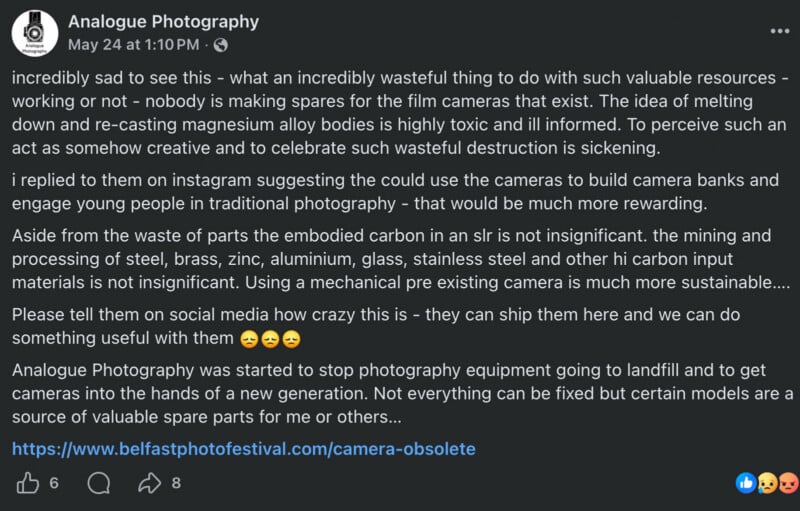
Analogue Photography, a specialized online retailer, expressed profound disappointment in the project, labeling it "sickening" and "wasteful." The organization emphasized that even cameras that are no longer functional serve as vital "organ donors" for the repair of other units. By smashing these devices, the festival is effectively removing irreplaceable resources from a community that struggles to keep historical hardware operational.
Beyond the loss of historical artifacts, critics have raised significant environmental and health concerns. Modern and vintage cameras contain a variety of materials that can be hazardous when broken or melted. Magnesium alloy bodies, frequently used in professional-grade cameras for their strength and light weight, can be highly toxic if handled improperly during a "recasting" process. Furthermore, the glass in lenses often contains coatings or chemical compositions that require specialized disposal. In an age where the arts are increasingly pressured to adopt sustainable practices, critics like photographer Adam Bradley have argued that an exhibit centered on creating "obscene levels of waste" is tone-deaf and irresponsible.
Supporting Data: The Value of "Obsolete" Hardware
The term "obsolete" used by the festival is a point of contention. Data from the used camera market suggests that the demand for vintage hardware is at an all-time high. According to industry reports, the market for film cameras has seen a steady annual growth rate of approximately 5% to 10% over the last decade, driven by Gen Z and Millennial photographers seeking a tactile alternative to digital perfection.
For example, the Praktica MTL 5, a vintage camera featured in the festival’s promotional imagery, remains a popular entry-level SLR for students. While individual units may only retail for $50 to $100, their value as educational tools is significant. The destruction of "hundreds" of such units represents a notable loss of accessible technology for aspiring photographers who may not be able to afford high-end digital equipment.
Furthermore, the global e-waste crisis provides a sobering backdrop to the exhibit. According to the Global E-waste Monitor, the world generated 62 million tonnes of e-waste in 2022, a figure that is projected to rise by 33% by 2030. Critics argue that an art festival should be leading the way in "circular economy" practices—such as repair and reuse—rather than encouraging the physical pulverization of electronic and mechanical goods.
The Festival’s Defense and the "Resist" Option
In response to the overwhelming criticism, the Belfast Photo Festival has attempted to highlight the more constructive elements of the installation. Organizers pointed out that the exhibit is divided into four pillars: Destroy, Dismantle, Recast, and Resist.
The "Resist" component is a direct concession to those who wish to preserve the hardware. For a fee of £10 (approximately $13), visitors can "adopt" a camera from the display, effectively rescuing it from the hammer. The festival also provides film for sale to encourage participants to actually use the rescued cameras. Additionally, the "Dismantle" section is framed as an educational opportunity, allowing children and adults to learn about optics and mechanics in a hands-on environment.
The festival maintains that the project is a form of "material transformation" rather than simple vandalism. They argue that by turning the debris into a permanent sculpture, they are giving the "obsolete" technology a second life as a public landmark. This defense, however, has done little to appease critics who believe that a functional camera is inherently more valuable than a pile of scrap metal shaped into an abstract form.
Broader Impact and the Role of Provocative Art
The controversy surrounding the Belfast Photo Festival highlights a fundamental tension in the contemporary art world: the balance between the artist’s right to provoke and the community’s expectation of stewardship. Auto-destructive art has a long history, dating back to figures like Gustav Metzger, who used destruction to protest the nuclear arms race and the consumerist nature of society. In this tradition, the "Camera Obsolete?" exhibit could be seen as a legitimate critique of the ephemeral nature of modern technology.
However, the specific choice of the camera—a tool of preservation and truth—as the object of destruction adds a layer of irony that many find difficult to swallow. For photographers, the camera is not just a tool but a partner in the creative process. Smashing it is viewed by some as an act of symbolic violence against the craft itself.
As the June 4 opening approaches, the Belfast Photo Festival remains committed to the installation. The event will serve as a litmus test for how public institutions navigate the complexities of "creative destruction" in a world increasingly sensitive to waste and historical preservation. Whether the resulting sculpture will be viewed as a profound monument to a bygone era or a permanent reminder of a controversial decision remains to be seen. What is certain is that the "Camera Obsolete?" exhibit has succeeded in one of its primary goals: it has forced a global conversation about the value of the physical object in an increasingly digital world.

