


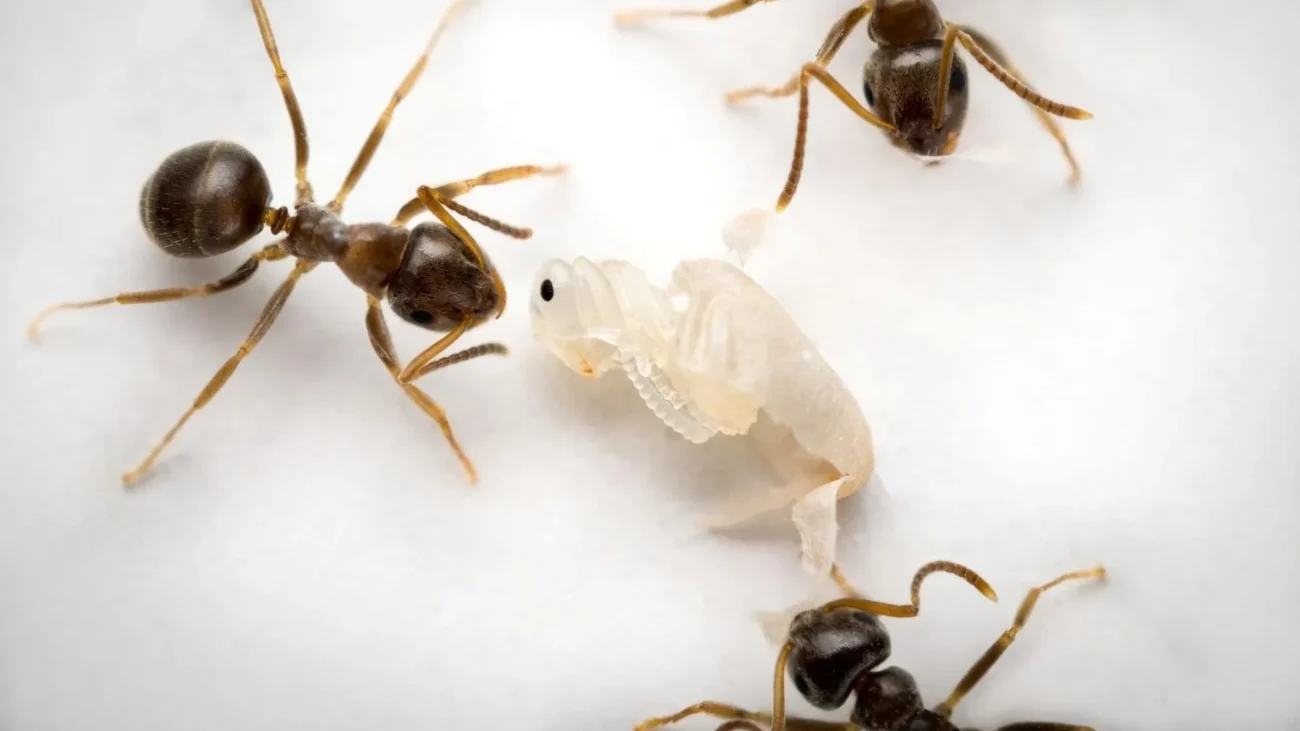
Ant societies, renowned for their intricate social structures and collective efficiency, have revealed another layer of their sophisticated "superorganism" existence. Researchers at the Institute of Science and Technology Austria (ISTA) have uncovered a remarkable form of altruistic communication: terminally ill ant pupae emit a distinctive odor that acts as an urgent distress signal, prompting their healthy nestmates to swiftly detect and eliminate potential infections before they can ravage the colony. This groundbreaking discovery, published in the prestigious journal Nature Communications, offers profound insights into the evolutionary strategies underpinning social immunity and the remarkable parallels between insect colonies and multicellular organisms.
A Chemical SOS from the Nursery
Unlike many social animals, where individuals might conceal signs of illness to avoid ostracization or abandonment, ant pupae facing an untreatable infection adopt a radically different approach. Instead of succumbing silently, they proactively release a potent chemical alarm. This olfactory beacon serves as an early warning system, alerting worker ants to the presence of a dangerous contagion within the nursery. This phenomenon challenges conventional understanding, suggesting that in the hyper-cooperative world of ants, individual sacrifice can serve the greater good of the collective, a concept deeply rooted in kin selection and the preservation of the colony’s genetic lineage.
The study, led by Erika Dawson, a former postdoctoral researcher in the Social Immunity group at ISTA, headed by Professor Sylvia Cremer, details how worker ants are remarkably attuned to these subtle shifts in scent. Upon detecting this specific alarm signal, the workers mobilize with remarkable speed and precision. Their immediate response involves opening the cocoon of the infected pupa, making minute incisions in its outer surface, and then meticulously applying formic acid. This potent antimicrobial compound, naturally produced by the worker ants themselves, serves a dual purpose: it effectively eradicates the pathogens multiplying within the pupa, but tragically, it also hastens the pupa’s demise.
"What appears to be self-sacrifice at first glance is, in fact, also beneficial to the signaler," explains Dawson. "It safeguards its nestmates, with whom it shares many genes. By warning the colony of their deadly infection, terminally ill ants help the colony remain healthy and produce daughter colonies, which indirectly pass on the signaler’s genes to the next generation." This intricate interplay of individual fate and collective survival underscores the profound evolutionary pressures that have shaped ant societies into highly resilient and adaptable entities.
The Symphony of Social Immunity
This newly documented form of altruistic disease signaling in social insects marks the first time such a sophisticated mechanism has been scientifically elucidated. The research, conducted in collaboration with chemical ecologist Professor Thomas Schmitt from the University of Würzburg in Germany, sheds light on a critical component of ant colony health. Without this proactive warning system, a dying pupa could easily become a highly infectious agent, posing an existential threat to the entire colony. By broadcasting their condition early, these incurably ill individuals enable the colony to neutralize the threat before it escalates into a widespread epidemic.
The concept of the ant colony as a "superorganism" is central to understanding this behavior. In this model, individual ants function much like specialized cells within a larger biological entity. Queens are analogous to reproductive organs, solely focused on generating future generations, while worker ants perform a diverse array of tasks—from foraging and nest construction to meticulous healthcare—essential for the colony’s survival and prosperity. This mirrors the division of labor seen in the human body, where distinct cell types are dedicated to specific functions, all contributing to the overall health and continuity of the organism.
Both biological organisms and superorganisms rely on the seamless cooperation of their reproductive and non-reproductive components. In ant colonies, this cooperation is so profound that it extends to behaviors that, while detrimental to an individual, are crucial for the survival of the collective. The sacrifice of fatally infected brood is a prime example of this extreme form of cooperative altruism.
The Need for an Early-Warning System
A pertinent question arises: why would such an elaborate alarm system evolve if sick individuals could simply isolate themselves? Professor Cremer offers a compelling explanation. "Adult ants that approach death leave the nest to die outside the colony. Similarly, workers that have been exposed to fungal spores practice social distancing," she notes. However, this option is fundamentally unavailable to brood, which are immobile and entirely dependent on the care of adult workers. Like infected cells within a multicellular organism, these vulnerable pupae require external intervention.
The parallels between developing pupae and infected body cells are striking. Both are incapable of independent action and rely on chemical cues to solicit help. Infected body cells release signals that attract immune cells, the body’s internal defense force, to identify and eliminate the source of infection. Similarly, the terminally ill ant pupae emit chemical signals that draw worker ants, the colony’s external sanitation crew, to them. Immunologists often refer to these cues as "find-me and eat-me" signals, and the ant pupal alarm appears to fit this description perfectly.
"The signal must be both sensitive and specific," emphasizes Cremer. "It should help to identify all terminally-sick ant pupae but be precise enough to avoid triggering the unpacking of healthy pupae or those capable of overcoming the infection with their own immune system." This raises a critical question: how do ants achieve such a high degree of specificity in their disease signaling?
Decoding the Scent of Sickness
Professor Schmitt, whose research extensively explores chemical communication in social insects, highlights the remarkable ability of worker ants to pinpoint a single infected pupa amidst a densely populated brood chamber. "This means the scent cannot simply diffuse through the nest chamber but must be directly associated with the diseased pupa," he observes. Consequently, the signal is not composed of volatile compounds that disperse easily, but rather of non-volatile compounds adhering to the pupal body surface.
The research indicates that when a pupa becomes fatally infected, two specific components of its natural scent profile become significantly more pronounced. To rigorously test whether this alteration in odor alone was sufficient to trigger the disinfection response, the ISTA team conducted a series of controlled experiments. They meticulously extracted the altered scent from signaling pupae and applied it to healthy pupae. The results were unequivocal: the treated healthy pupae were subsequently unpacked by the worker ants, demonstrating that the modified odor of terminally infected brood functions precisely as the "find-me and eat-me" signal observed in infected body cells.
The Selectivity of the Signal
A crucial aspect of this altruistic signaling system is its selectivity. Not all brood emit this alarm signal, a fact elucidated by Dawson. "Queen pupae, which possess more robust immune defenses than worker pupae and are capable of containing infections independently, were not observed to emit this warning signal to the colony," she explains. In contrast, worker pupae, lacking this inherent resilience, readily signaled for assistance.
This selective signaling ensures that the colony’s valuable resources are not squandered on unnecessary interventions. By only broadcasting an alarm when an infection proves insurmountable, the brood conserves the colony’s energy and prevents the premature removal of individuals that might still recover. Professor Cremer concludes, "This precise coordination between the individual and colony level is what makes this altruistic disease signaling so effective."
Implications for Understanding Social Behavior and Immunity
The implications of this discovery extend far beyond the realm of entomology. It provides a compelling real-world model for understanding the evolution of altruism and cooperation, concepts that have long fascinated biologists and philosophers. The ant’s "find-me and eat-me" signal offers a concrete example of how individual sacrifice can be genetically and behaviorally advantageous within a highly integrated social structure.
Furthermore, the parallels drawn between ant colonies and multicellular organisms highlight the convergent evolution of biological strategies for maintaining health and combating disease. The study reinforces the idea that fundamental principles of immunology and social organization can manifest across vastly different biological scales.
Background and Context
The research builds upon decades of work investigating the complex social lives of ants and their sophisticated immune systems. Previous studies have documented various forms of "social immunity," where colonies collectively defend themselves against pathogens through behaviors such as grooming, waste disposal, and the use of antimicrobial substances. The identification of this specific olfactory alarm signal adds a critical new dimension to our understanding of how ants manage disease at the individual and colony level.
The work by ISTA researchers, particularly the Social Immunity group, has been instrumental in uncovering the intricate mechanisms by which ant colonies maintain health. Their investigations have explored everything from the genetic basis of disease resistance to the chemical communication that underpins colony-wide defense strategies. This latest finding represents a significant advancement, demonstrating a level of sophistication in disease signaling that was previously unrecognized.
Chronology of Discovery (Inferred)
While a precise timeline is not provided, the research likely progressed through several stages:
- Initial Observation: Researchers may have observed unusual worker behavior around certain pupae, prompting further investigation.
- Chemical Analysis: Advanced techniques would have been employed to identify and analyze the chemical compounds present on the surface of healthy and infected pupae.
- Behavioral Experiments: Controlled experiments, such as scent transfer to healthy pupae, would have been crucial to establish causality.
- Comparative Studies: Drawing parallels with known "find-me and eat-me" signals in other biological systems, including mammalian immunology.
- Publication: The culmination of rigorous research and peer review, leading to the publication in Nature Communications.
Supporting Data and Analytical Insights
The effectiveness of this signaling system can be quantified by considering the potential impact of an unchecked infection. A single infected pupa, if left untreated, could harbor millions of pathogens. In a densely populated brood chamber, these pathogens could spread exponentially, potentially decimating a significant portion of the colony’s future workforce and reproductive individuals. The rapid detection and elimination of infected brood, facilitated by the olfactory alarm, drastically reduces this risk, ensuring colony survival and reproductive success.
The specificity of the signal, distinguishing between fatally infected and recoverable pupae, is also a critical data point. This prevents the unnecessary sacrifice of healthy or recovering individuals, optimizing the allocation of the colony’s resources. The observation that queen pupae, with their enhanced immune capabilities, do not emit the signal further supports this selective strategy.
Broader Impact and Implications
The findings have significant implications for:
- Evolutionary Biology: Understanding the evolution of altruism, cooperation, and social immunity in complex societies.
- Immunology: Providing novel insights into disease detection and signaling mechanisms, with potential applications in human medicine.
- Ecology: Informing our understanding of disease dynamics within insect populations and their ecological roles.
- Biomimetics: Inspiring the development of novel sensor technologies or disease detection systems based on chemical signaling.
The research underscores the importance of continued investment in fundamental biological research. Understanding the intricate workings of even seemingly simple organisms like ants can unlock profound insights into complex biological processes that have relevance across the tree of life.
Information on Animal Studies
All animal studies conducted as part of this research adhered to strict ethical guidelines and legal regulations. The collection, rearing, and handling of ants were performed in accordance with established protocols designed to minimize any potential distress or harm to the animals. These studies are deemed essential for understanding fundamental biological processes that cannot be replicated through in silico or other non-animal methodologies.
In conclusion, the discovery of the olfactory alarm system in terminally ill ant pupae represents a significant leap in our comprehension of social insect behavior and the intricate mechanisms that ensure colony survival. It highlights a remarkable convergence of strategies for disease management, bridging the gap between the microscopic world of cells and the macroscopic world of superorganisms.

