


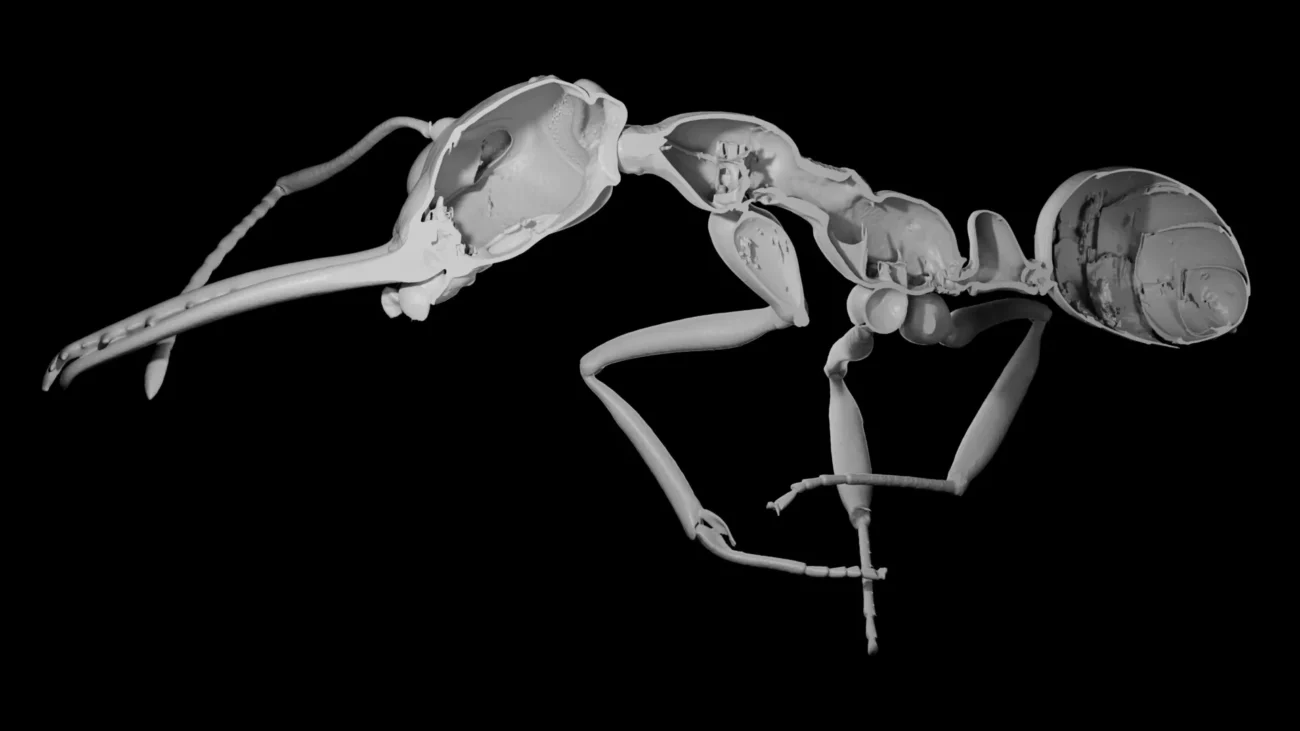
A groundbreaking study published on December 19, 2025, in the esteemed journal Science Advances reveals a fundamental evolutionary strategy that has underpinned the success of complex animal societies, particularly the remarkable rise of ants. The research, a comprehensive analysis of over 500 ant species, suggests that these social insects have consistently prioritized quantity over individual quality, a tradeoff that has profoundly shaped their evolutionary trajectory, leading to larger colonies and an explosion of species diversity.
The core of the discovery lies in understanding how ants allocate their limited resources. Rather than investing heavily in the robust physical defenses of each individual worker, many ant species have evolved to produce a greater number of less-armored individuals. This strategy hinges on reducing the investment in the cuticle, the hard outer layer of the exoskeleton that provides protection against predators, desiccation, and disease, as well as structural support for muscles. While a thicker cuticle offers superior individual resilience, it is metabolically expensive, demanding significant amounts of critical nutrients like nitrogen and minerals. By opting for a thinner cuticle, ant species free up these valuable resources, enabling them to produce a larger workforce.
The Quantity-Quality Tradeoff in Biological Evolution
The concept of a tradeoff between quantity and quality is a recurring theme in biological and evolutionary sciences. It poses a fundamental question: is it more advantageous to have a few highly robust and capable individuals, or a multitude of less specialized but numerous ones? This dilemma has been observed across various life forms, from the reproductive strategies of organisms that produce few, well-developed offspring to those that release vast numbers of less protected eggs. However, the scale and depth of this research on ants provide compelling empirical evidence for how this principle has driven the evolution of complex social structures.
Dr. Evan Economo, senior author of the study and chair of the Department of Entomology at the University of Maryland, explains the broader biological context: "There’s this question in biology of what happens to individuals as societies they are in get more complex. For example, the individuals may themselves become simpler because tasks that a solitary organism would need to complete can be handled by a collective." This simplification of the individual, often described as becoming "cheaper" in terms of resource requirements, allows for greater numbers and, consequently, the development of more elaborate social systems. Until this research, this hypothesis had not been rigorously tested with large-scale analyses of social insects.
Ants: A Model System for Social Evolution
Ants, with their astonishing range of colony sizes – from a few dozen individuals to tens of millions – and their ubiquitous presence across nearly every terrestrial ecosystem, offer an unparalleled system for studying the evolution of social complexity. Their success in colonizing diverse habitats and their remarkable diversification into thousands of distinct species make them ideal subjects for understanding the fundamental biological strategies that enable such achievements.
Arthur Matte, lead author of the study and a Ph.D. student in zoology at the University of Cambridge, highlights the enduring mystery: "Ants are everywhere. Yet the fundamental biological strategies which enabled their massive colonies and extraordinary diversification remain unclear." The research team’s proposal that colony size might be intrinsically linked to the investment in the ant’s cuticle provided a crucial avenue for investigation.
The Metabolic Cost of Body Armor
The cuticle, while vital for survival, represents a significant metabolic burden. It requires substantial inputs of nitrogen and various minerals, which are often limiting resources in many environments. The thickness of this protective layer directly correlates with the amount of these nutrients it consumes. Consequently, species that invest heavily in thicker cuticles are inherently limited in the number of individuals they can support within a colony, as the available resources must be divided among fewer, more resource-intensive bodies. This creates a direct constraint on colony size and, by extension, the potential for social complexity.
Unveiling the Evolutionary Pattern: Data and Models
To empirically test their hypothesis, the researchers embarked on an extensive data collection and analysis. They amassed a substantial dataset comprising 3D X-ray scans of over 500 ant species, meticulously measuring both their total body volume and the volume of their cuticle. These measurements revealed a remarkable variation in cuticle investment across the ant phylogeny, ranging from a mere 6% of an ant’s body mass dedicated to its exoskeleton to a substantial 35%.
The collected data was then integrated into sophisticated evolutionary models. These models allowed the researchers to simulate the evolutionary pressures and outcomes associated with different levels of cuticle investment. The results were striking and consistent: ant species that devoted a smaller proportion of their body mass to cuticle consistently demonstrated a propensity to form significantly larger colonies. This correlation provided strong statistical evidence supporting the central thesis of the study.
Collective Strength and Societal Growth
The implications of this reduced individual armor extend far beyond mere numerical advantage. The authors propose that this evolutionary path, characterized by less individually robust ants, may have actively fostered the development of large, cooperative societies. A reduced reliance on heavy individual armor could have been coupled with the emergence and refinement of other advantageous social traits. These include highly efficient cooperative foraging strategies, sophisticated shared nest defense mechanisms, and a more pronounced division of labor, all of which become increasingly critical and beneficial as colony size and complexity escalate.
Matte elaborates on this symbiotic relationship between individual cost and collective benefit: "Ants reduce per-worker investment in one of the most nutritionally expensive tissues for the good of the collective. They’re shifting from self-investment toward a distributed workforce, resulting in more complex societies." He further draws a compelling parallel to the evolution of multicellularity, where individual cells, though simpler, collectively achieve a level of complexity unattainable by solitary cells.
Diversification: A Consequence of Reduced Investment
Perhaps one of the most significant and surprising findings of the research is the link between lower cuticle investment and accelerated diversification rates. Diversification, a key metric for evolutionary success, reflects the rate at which new species emerge from existing ones. Biologists often consider traits that are strongly correlated with diversification to be of exceptional evolutionary importance.
Dr. Economo notes the rarity of such strong connections: "Very few traits have been connected to diversification in ants, making this result especially striking." The observation that reduced investment in the cuticle directly correlates with a higher propensity for speciation suggests that this fundamental tradeoff has not only driven the growth of ant societies but also fueled their remarkable evolutionary radiation.
Explaining Accelerated Speciation
The precise mechanisms by which reduced cuticle investment promotes speciation are still a subject of ongoing investigation, but leading hypotheses offer compelling explanations. One prominent theory suggests that ant species with lower nutritional demands, facilitated by their less resource-intensive cuticles, are better equipped to expand into environments where resources are scarce. This increased adaptability allows them to exploit ecological niches that might be inaccessible to more resource-demanding species.
"Requiring less nitrogen could make them more versatile and able to conquer new environments," Matte explains, tracing the origins of his involvement in the research back to an internship at the Okinawa Institute of Science and Technology.
Furthermore, as ant societies evolved greater complexity, the need for individual heavy armor may have diminished due to the increasing efficacy of group-level defenses. Collective nest protection, sophisticated disease control mechanisms within the colony, and coordinated foraging efforts all contribute to the overall survival and success of the group, thereby reducing the selective pressure for each individual ant to be heavily armed. This creates a self-reinforcing cycle: lower cuticle investment enables larger colonies, and larger, more complex colonies, in turn, further reduce the individual need for robust protection.
Dr. Economo humorously encapsulates this evolutionary shift: "I think of this as the evolution of squishability. Many kids have discovered that insects aren’t all equally robust." This lighthearted analogy underscores the profound transformation in individual ant characteristics driven by the evolution of their social systems.
The study also speculates that similar evolutionary pathways might be observed in other social organisms, such as termites, although further research is needed to confirm these parallels.
Broader Implications: Lessons for Human Societies
The implications of this research extend far beyond the realm of entomology, offering intriguing parallels to the evolution of human societies and military history. The study draws a connection to historical shifts in warfare, such as the eventual replacement of heavily armored knights by more specialized and numerous soldiers like archers and crossbowmen. This historical transition mirrors the ant’s evolutionary strategy of prioritizing numbers and specialized roles over individual, heavily fortified units.
Dr. Economo also points to Lanchester’s Laws, a set of mathematical equations developed during World War I to model the outcome of battles. These laws demonstrate how numerical superiority, even with weaker individual combatants, can overcome a smaller force of stronger ones under certain conditions. This mathematical framework provides a quantitative basis for understanding the strategic advantage of mass over individual might, a principle that appears to have been a cornerstone of ant evolution.
Matte emphasizes the universality of this tradeoff: "The tradeoff between quantity and quality is all around. It’s in the food you eat, the books you read, the offspring you want to raise. It was fascinating to retrace how ants handled it through their long evolution. We could see lineages taking different directions, being shaped by different constraints and environments, and ultimately giving rise to the extraordinary diversity we observe today."
This research, supported by grants from the Okinawa Institute of Science and Technology, the Japan Society for the Promotion of Science KAKENHI, the University of Cambridge, and the Research Grant Council of Hong Kong, not only deepens our understanding of ant evolution but also provides a compelling case study for the fundamental principles that govern the development of complex societies across the biological world. The study, "The evolution of cheaper workers facilitated larger societies and accelerated diversification in ants," is a significant contribution to evolutionary biology, offering insights that resonate from the smallest insect colonies to the grandest human endeavors.

