


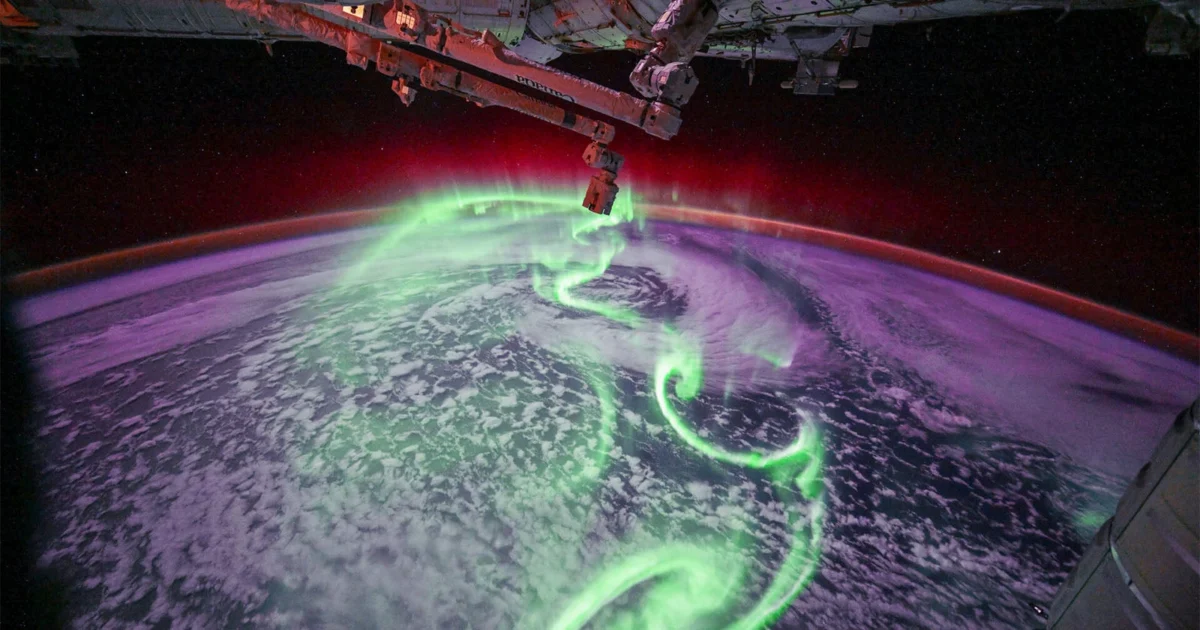
Sophie Adenot, a Colonel in the French Air and Space Force and a distinguished member of the European Space Agency (ESA) astronaut corps, has provided the world with a mesmerizing glimpse of the Southern Lights from her unique vantage point aboard the International Space Station (ISS). Currently serving on the Epsilon mission, Adenot has utilized the station’s advanced photographic equipment to document some of the most intense auroral activity recorded during the current solar cycle. On day 127 of her maiden spaceflight, which commenced in February 2026, Adenot captured a series of eight high-resolution images and a subsequent timelapse video that have since captivated the scientific community and the general public alike. The visuals depict a vivid, shimmering ribbon of green light dancing across the Earth’s horizon, an atmospheric phenomenon so powerful that it physically illuminated the exterior structures of the ISS in a ghostly emerald hue.
The Epsilon Mission and the Observation of Orbit 1968
The Epsilon mission marks a significant milestone for European space exploration, with Sophie Adenot at the helm of several key scientific experiments. However, it is her secondary role as a chronicler of Earth’s orbital beauty that has garnered recent international headlines. According to Adenot’s mission logs, the most spectacular display occurred during orbit 1968. At an altitude of approximately 400 kilometers (250 miles), the ISS passed through a region of intense geomagnetic activity, allowing the astronaut to witness an aurora australis of unprecedented scale.
In her official communications, Adenot described the experience as transformative, noting that the "shimmering and dancing" lights stretched as far as the eye could see. The intensity of the light was a result of a surge in solar activity, which has been a recurring theme throughout 2025 and 2026. This period coincides with the peak of Solar Cycle 25, a cycle that has proven to be significantly more active than initial forecasts by NASA and the National Oceanic and Atmospheric Administration (NOAA) had predicted. For astronauts aboard the ISS, this translates to more frequent and more luminous auroral displays as solar winds buffet the Earth’s magnetosphere.
Scientific Foundations: The Mechanics of the Aurora
The imagery captured by Adenot is more than just aesthetically pleasing; it serves as a visual record of the complex interaction between the Sun and Earth. Auroras are created when charged particles—primarily electrons and protons—are ejected from the Sun’s corona during solar flares or coronal mass ejections (CMEs). These particles travel through space via the solar wind and are funneled toward Earth’s poles by the planet’s magnetic field.
When these high-energy particles collide with gases in the Earth’s upper atmosphere, they transfer energy to the gas atoms, "exciting" them. As these atoms return to their ground state, they release photons of light. The specific colors observed by Adenot—predominantly green—are the result of collisions with oxygen molecules at altitudes between 100 and 300 kilometers. The rarer red hues, occasionally seen at the higher fringes of the display, occur when particles interact with oxygen at even higher altitudes, while nitrogen produces blue or purplish-red lights. From the ISS, astronauts view these displays from the side or from above, providing a three-dimensional perspective that is impossible to achieve from the ground.
Professional Background of Colonel Sophie Adenot
Sophie Adenot’s journey to the ISS is the culmination of a stellar career in aviation and engineering. Born in 1982, Adenot joined the French Air and Space Force in 2005, eventually rising to the rank of Colonel. She made history as France’s first female helicopter test pilot, accumulating over 3,000 flight hours on 22 different types of aircraft. Her academic credentials include an engineering degree from ISAE-SUPAERO and a Master of Science from the Massachusetts Institute of Technology (MIT).
Selected for the European Astronaut Corps in 2022, Adenot underwent rigorous training at the European Astronaut Centre (EAC) in Cologne, Germany, before being assigned to the Epsilon mission. Her arrival at the ISS in early 2026 was met with great anticipation, as she represents a new generation of European explorers tasked with preparing for future lunar missions under the Artemis program. Her 44th birthday, celebrated aboard the station, serves as a testament to her dedication to the field of aerospace.
A Chronology of Orbital Photography
Adenot’s recent aurora video is part of a broader effort by ISS residents to document the planet using timelapse photography. This technique involves taking a series of still images at set intervals and stitching them together to create a fluid motion video. This method is particularly effective in space, where the ISS travels at a staggering 17,500 miles per hour, completing a full orbit of the Earth every 90 minutes.
- February 2026: Launch of the Epsilon mission. Adenot begins her first long-duration stay on the ISS.
- May 2026: Adenot captures a stunning timelapse of the Lyrids meteor shower. The footage shows "falling stars" burning up in the atmosphere beneath the station, interspersed with lightning strikes from terrestrial thunderstorms.
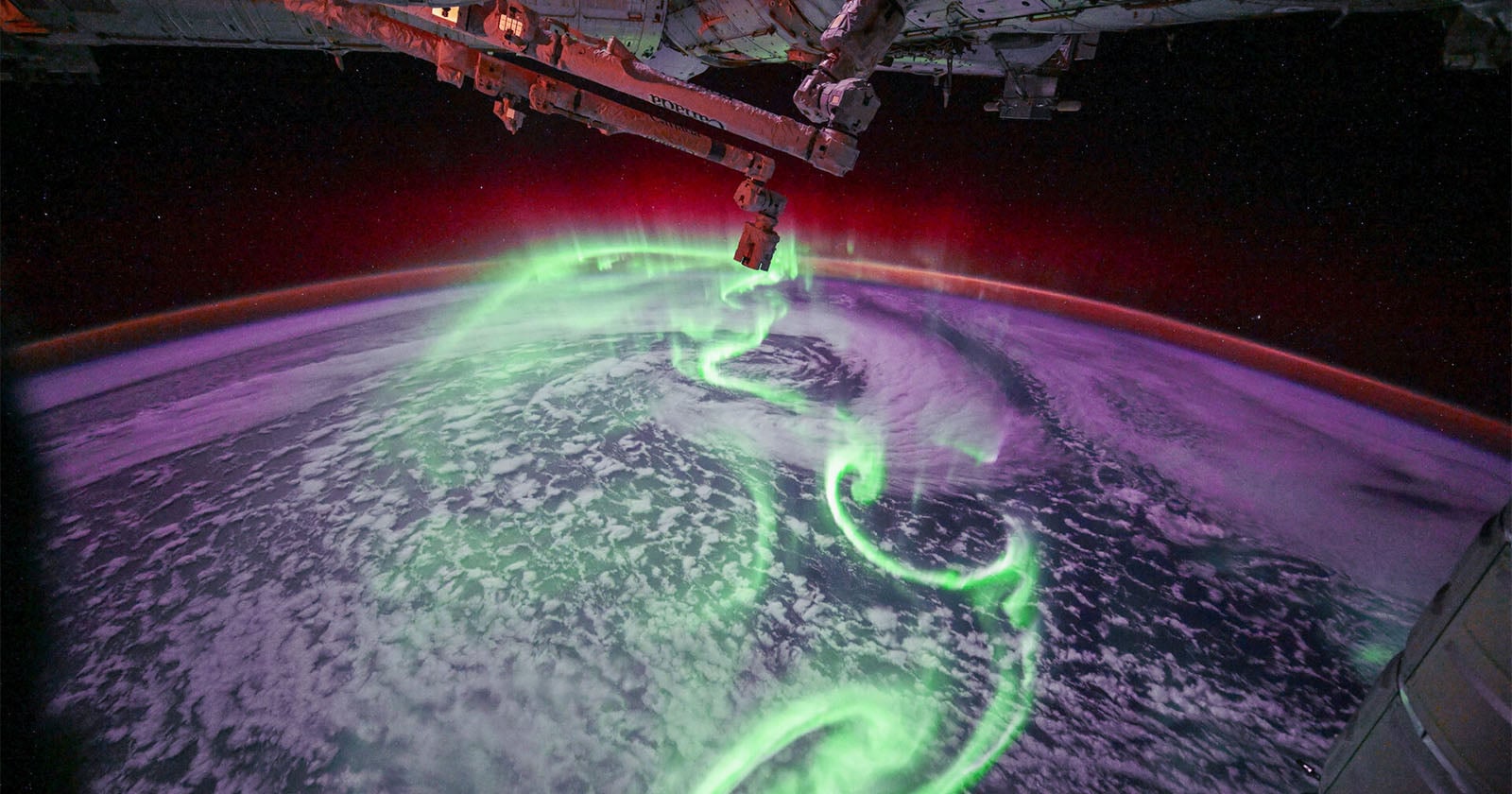
- June 2026 (Day 127): During orbit 1968, the "most spectacular aurora of the mission" is recorded. Adenot shares eight still images documenting the progression of the light pillars.
- July 2026: Adenot releases a comprehensive timelapse video of the aurora, gaining millions of views on social media platforms and sparking renewed interest in space weather.
Adenot follows in the footsteps of other prolific space photographers. In late 2025 and early 2026, Russian cosmonaut Sergey Kud-Sverchkov and NASA astronaut Zena Cardman shared similar high-definition footage. Furthermore, veteran astronaut Don Pettit, known for his "space-hacks" and technical mastery of orbital photography, set a high standard for aurora documentation during his previous missions, which Adenot has continued to uphold with modern digital sensors capable of capturing low-light environments with minimal noise.
Technical Challenges of Space-Based Imaging
Capturing the aurora from the ISS presents unique technical hurdles. The station is a vibratory environment; the constant hum of life-support systems and the movement of gyroscopes can introduce blur into long-exposure shots. To combat this, astronauts use specialized mounts and fast lenses with wide apertures (often f/1.4 or f/2.8) to allow as much light as possible onto the camera sensor in a short period.
The transition from DSLR to mirrorless technology has also aided astronauts. Cameras like the Nikon Z9, which are currently in use on the station, offer superior low-light performance and electronic shutters that eliminate mechanical vibration. When creating a timelapse like Adenot’s, the astronaut must calculate the interval between shots to ensure the "dancing" motion of the aurora appears smooth rather than jittery. The resulting videos provide scientists with data on the altitude and velocity of auroral curtains, which can be cross-referenced with ground-based magnetometer data to better understand geomagnetic storms.
Broader Implications and Public Engagement
The release of these images serves a dual purpose. Beyond the scientific data, they are powerful tools for public diplomacy and educational outreach. The European Space Agency has emphasized that Adenot’s ability to communicate the "magic of the moment" helps to humanize the rigors of spaceflight. In an era where space exploration is becoming increasingly commercialized, the raw, natural beauty captured by state-sponsored astronauts reinforces the value of international cooperation in the peaceful study of the cosmos.
The "Epsilon" mission, while focused on human physiology and materials science in microgravity, has arguably reached its widest audience through these visual dispatches. Analysis of social media engagement shows that orbital photography remains the most effective way to maintain public interest in the ISS, especially as the station nears its planned decommissioning in the early 2030s.
Conclusion and Future Outlook
As Sophie Adenot continues her mission, which has now exceeded 137 days, the scientific community eagerly awaits further data from the Epsilon mission. The high level of solar activity expected to continue through the remainder of 2026 suggests that more spectacular displays are likely. These observations are critical as NASA and ESA prepare for the Gateway station, which will orbit the Moon and sit outside the protective shield of Earth’s magnetosphere. Understanding the intensity and frequency of solar events—as visualized through the aurora—is essential for the safety of future deep-space travelers.
For now, Colonel Adenot remains a watchful guardian in the "cupola" of the ISS, her camera pointed toward the horizon, capturing the ephemeral beauty of a planet protected by a thin, glowing atmosphere. Her work ensures that while only a handful of humans may ever witness an aurora from space in person, the rest of humanity can share in the wonder of the "glowing green ribbons" that define the boundary between our world and the vacuum of space.

