


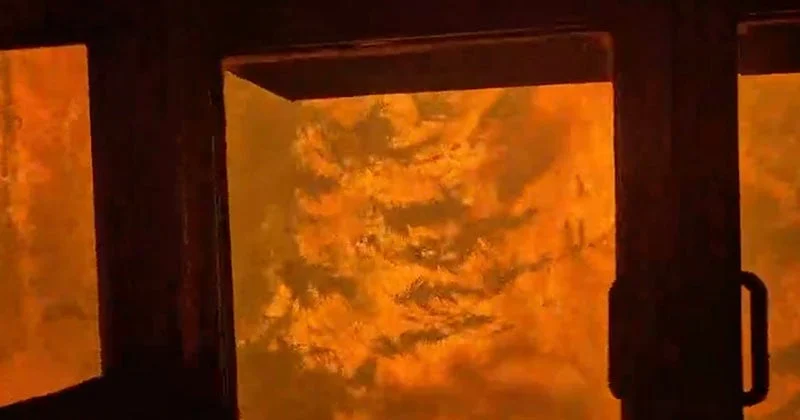
A harrowing video captured from the interior of a Canadian National (CN) Rail train has surfaced, depicting the intense and life-threatening conditions faced by rail workers as wildfires ravage Northern Ontario. The footage, which began circulating widely on social media on July 14, 2026, shows a freight train surrounded by a violent inferno near the community of Armstrong. As massive walls of fire flank the tracks, the interior of the train car is bathed in a thick, monochromatic orange glow, with smoke obscuring the horizon. While CN Rail has confirmed that all personnel involved were safely evacuated, the incident has ignited a significant public debate regarding the safety protocols governing rail operations during extreme weather events and the transparency of corporate responses to environmental crises.
The Incident Near Armstrong: A Close Encounter with Disaster
The video, shared by Sol Mamakwa, the Member of Provincial Parliament (MPP) for Kiiwetinoong and Deputy Leader of the Ontario NDP, provides a rare and terrifying first-person perspective of a wildfire’s power. In the recording, the voices of CN Rail employees can be heard expressing the gravity of their situation. One individual is heard stating, “This could potentially overtake us here,” followed by the admission, “This is getting a little scary.”
The train was operating near Armstrong, a critical junction in Ontario’s northern rail corridor, when it became stalled due to the encroaching fire. The visual evidence suggests that the fire was not merely nearby but had effectively reached the rail line, with flames visible just inches from the window glass. The heat generated by such forest fires can exceed 800 degrees Celsius (1,472 degrees Fahrenheit), posing a risk not only to the occupants but to the structural integrity of the rail equipment and the tracks themselves.
CN Rail, Canada’s largest freight transporter, confirmed that the train in question was carrying only company employees at the time. Following the recording of the video, emergency evacuation procedures were triggered. The company later reported that these employees, along with residents of the Town of Armstrong, were moved to safety during an overnight operation as the wildfire situation deteriorated.
Chronology of the Crisis
The events leading up to the viral video were marked by a rapid escalation in wildfire activity across the Nipigon and Sioux Lookout districts.
Sunday, July 12, 2026: Meteorological conditions in Northern Ontario reach a critical "red flag" state. High temperatures, low humidity, and shifting wind patterns cause several existing blazes to merge and expand. The Ministry of Natural Resources and Forestry (MNRF) reports a surge in lightning strikes, sparking new fires near the CN Rail main line.
Monday, July 13, 2026: The train in the video is operating on the transcontinental corridor near Armstrong. As the fire moves faster than predicted, the train is forced to stop. During this period of entrapment, the viral footage is recorded. By late evening, the fire threatens the townsite of Armstrong and the adjacent Whitesand First Nation.
Tuesday, July 14, 2026 (Early Morning): CN Rail and local authorities coordinate an emergency evacuation. Residents and rail workers are transported out of the danger zone. CN Rail officially suspends all operations on the affected segment of the track.
Tuesday, July 14, 2026 (Afternoon): The video is posted to social media by Sol Mamakwa, drawing international attention to the incident and prompting demands for a formal statement from the railway company.
Supporting Data: The Scale of the Northern Ontario Wildfires
The 2026 wildfire season has proven to be one of the most volatile in recent history for Ontario. Data provided by the Aviation, Forest Fire and Emergency Services (AFFES) indicates that as of mid-July, there are over 75 active fires in the Northwest Region alone. Of these, approximately 28 are classified as "not under control."
The fire near Armstrong is part of a larger complex of blazes that has consumed an estimated 45,000 hectares of forest in less than two weeks. The intensity of these fires is driven by a multi-year drought affecting the Canadian Shield, which has left the boreal forest floor—comprised of peat and dry timber—highly flammable.
The impact of these fires extends far beyond the immediate flames. Smoke from the Northern Ontario blazes has triggered air quality alerts across the province and into the United States. In cities as far south as Minneapolis and Chicago, PM2.5 levels (fine particulate matter) have reached "unhealthy" categories, leading to health warnings for vulnerable populations. The smoke plume from the Armstrong fire was visible from satellite imagery, stretching across the Great Lakes basin.
Official Responses and Corporate Accountability
The release of the video prompted an immediate reaction from political leaders and the public. Sol Mamakwa, who has been a vocal advocate for Northern Ontario and Indigenous communities, questioned the timing and nature of the railway’s communications. "When will the Canadian National Railway Company make a statement about this incident?" Mamakwa asked, highlighting a perceived delay in the company’s public acknowledgement of the danger its workers faced.
In a statement provided to news outlets following the video’s surge in views, CN Rail defended its actions. “CN has temporarily suspended rail operations near Armstrong, ON as a precaution due to wildfire activity in the area," the statement read. "As a safety measure, CN employees in the area and residents of the Town of Armstrong were evacuated overnight. The safety of our employees, the community, and emergency responders remains our top priority.”
The company further noted that it is maintaining constant communication with the Ontario Ministry of Natural Resources and local emergency management agencies. However, the statement did not address specific questions regarding why the train was permitted to enter a zone where fire activity was known to be high, or what technical failures, if any, led to the train stalling in the path of the inferno.
Technical Analysis: Rail Safety in Fire Zones
The incident raises critical technical questions regarding the resilience of rail infrastructure. Rail transportation is particularly vulnerable to wildfires for several reasons:
- Track Buckling (Sun Kinks): The extreme heat from a nearby wildfire can cause steel rails to expand beyond their design limits. This leads to "track buckling" or "sun kinks," where the rail warps into a curve. If a train attempts to pass over buckled tracks, the risk of derailment is nearly certain.
- Signal and Communication Failure: Wildfires often destroy the electrical cabling and signaling bungalows located alongside tracks. Without these systems, train dispatchers lose the ability to track train locations or control movements safely, necessitating a full "dark territory" stoppage.
- Brake System Risks: Modern freight trains use air brake systems. Extreme heat can damage the rubber seals and hoses, potentially leading to a loss of braking pressure, which is a catastrophic scenario on the undulating terrain of Northern Ontario.
- Combustible Cargo: While the train in the video was reportedly carrying employees, CN Rail frequently transports hazardous materials, including oil and chemicals. A fire overtaking a train carrying such cargo would escalate a localized wildfire into a major environmental and chemical disaster.
Industry analysts suggest that the "near-miss" in Armstrong may lead to calls for stricter "slow orders" or mandatory corridor closures based on real-time fire proximity data, similar to protocols used for high-wind or extreme-cold events.
Broader Impact on First Nations and Remote Communities
The wildfire crisis near Armstrong disproportionately affects Indigenous communities. The Whitesand First Nation, located near Armstrong, has faced repeated threats from wildfires and smoke inhalation. For these communities, the rail line is more than just a commercial artery; it is a vital link for the delivery of food, fuel, and medical supplies.
The suspension of CN Rail operations, while necessary for safety, creates a secondary crisis of supply chain disruption. Northern Ontario’s "Ring of Fire" region and various remote settlements rely on the rail network to sustain daily life. When the tracks are closed, the cost of living in these areas often spikes as goods must be diverted to expensive air freight.
Furthermore, the environmental impact on traditional lands is profound. The loss of vast swaths of forest affects hunting, fishing, and the overall ecological balance that Indigenous communities have maintained for generations. The psychological toll of witnessing such "terrifying" events, as seen in the video, adds to the cumulative trauma of climate-related displacement.
Conclusion and Future Outlook
The viral video of the CN Rail train in Armstrong serves as a stark reminder of the increasing intersection between industrial operations and the escalating intensity of climate-driven wildfires. While the safe evacuation of the crew is a testament to emergency response coordination, the fact that a train found itself in the heart of an inferno suggests a need for a comprehensive review of rail safety during the fire season.
As of July 15, 2026, the fires in Northern Ontario remain largely uncontained. Firefighting crews from across Canada and international partners are being deployed to the region to assist local efforts. For CN Rail, the focus will likely shift from immediate crisis management to an investigation of the incident and the eventual repair of any fire-damaged infrastructure.
For the public and policymakers, the incident underscores the urgency of adapting to a "new normal" where wildfires are not just seasonal inconveniences but significant threats to national infrastructure and the safety of the workforce. The questions raised by Sol Mamakwa and the haunting images of the orange-tinted train car will likely remain at the forefront of the conversation regarding corporate accountability and environmental safety in Canada’s North.

