


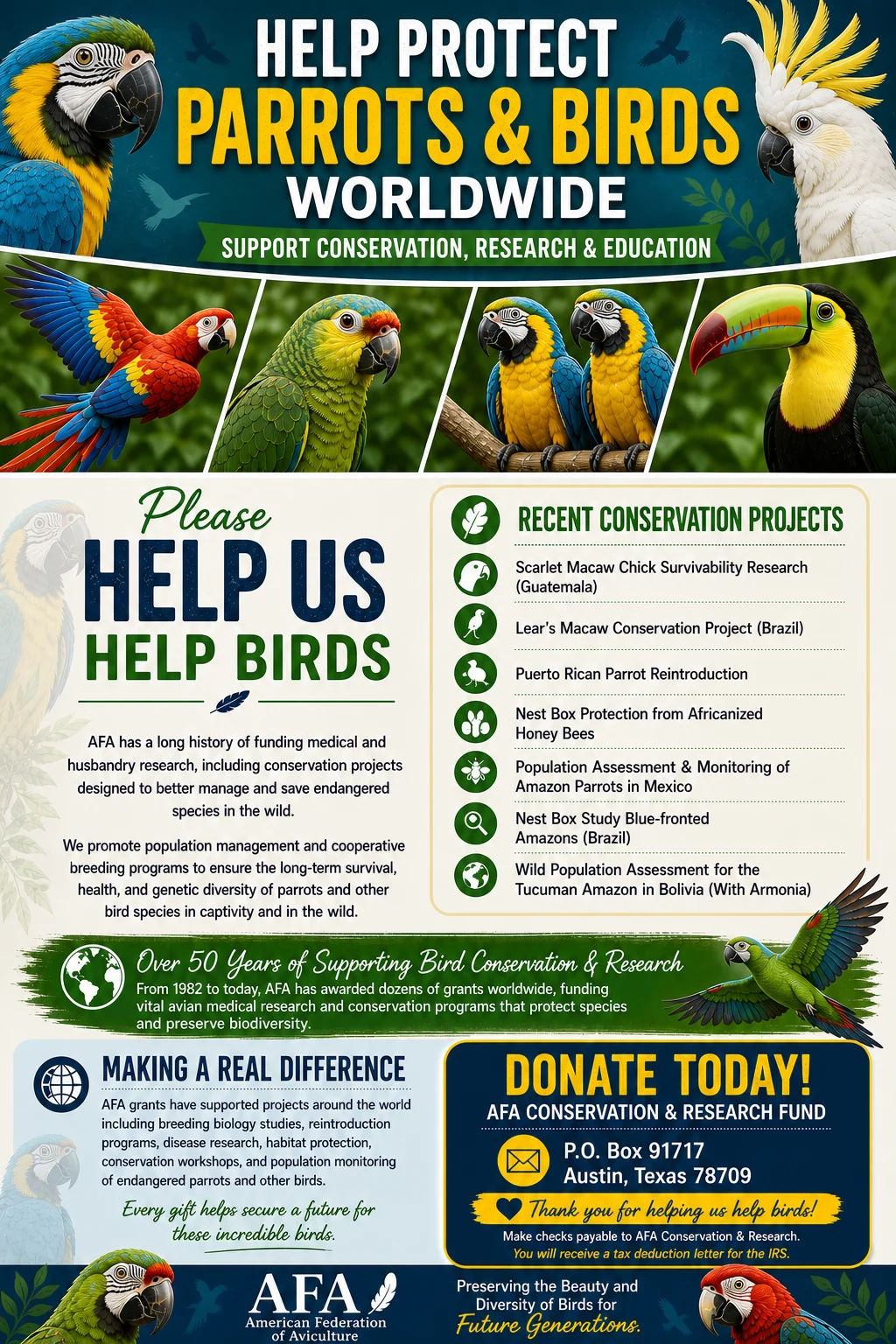
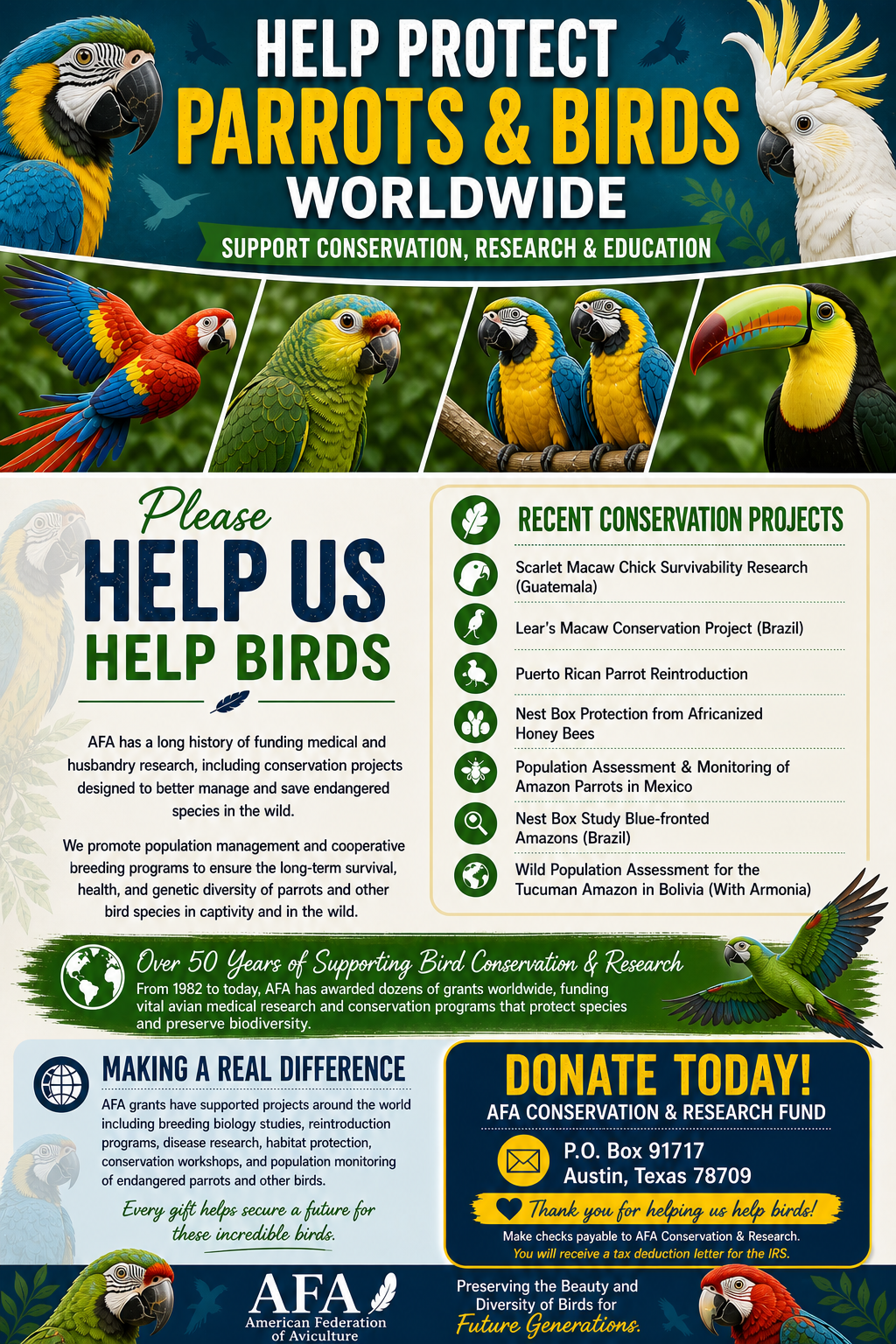
The American Federation of Aviculture (AFA) has officially launched its conservation and research agenda for the 2024-2025 cycle, marking a significant expansion of its efforts to protect wild parrot populations and their native habitats. Central to this year’s initiative is a reinforced partnership with Harrison’s Bird Foods, which recently demonstrated its commitment to the cause with a substantial $25,000 donation. This funding, presented to AFA Chief Financial Officer Janice Lang, serves as a cornerstone for the organization’s small-grant program, designed to catalyze field research and direct conservation interventions across Latin America and beyond.
As a non-profit 501(c)(3) educational organization, the AFA has evolved from a defensive legislative body into a proactive force in global avian biology. The 2024-2025 roadmap emphasizes a multi-pronged approach: providing financial lifelines to grassroots field projects, fostering scientific innovation in nest protection, and navigating the complex international legal frameworks that govern the movement and breeding of endangered species.
Strategic Field Interventions: From Mexico to Peru
The AFA’s conservation committee has identified several high-priority projects for the current funding cycle, each addressing specific ecological threats to psittacine species.
In the Lacandon rainforest of southern Mexico, the AFA continues its long-standing support for the Chajul Biology Station and Natura Mexicana. This project focuses on the critically endangered Scarlet Macaw, a species plagued by rampant poaching for the illegal wildlife trade. In this region, biological data indicates that without human intervention, the fledgling rate for wild nests often drops to near zero percent due to nest raiding.
Since its inception, the Chajul program has successfully fledged over 150 Scarlet Macaws back into the wild. The strategy involves rigorous nest monitoring, veterinary intervention for hatchlings, and a controlled rear-and-release program. For the 2024 season, the AFA has set a fundraising target of $5,000 to provide the station with essential medical and husbandry equipment, including portable incubators, gram scales, and brooders.
Further south, in the Maya Biosphere Reserve of Guatemala, the AFA is collaborating with the Wildlife Conservation Society (WCS) under the Selva Maya Living Landscape Program. This initiative utilizes experimental interventions to increase the survivability of Scarlet Macaw chicks. By addressing both environmental threats and direct population recruitment, the WCS aims to stabilize one of the most significant landscape species in Central America.
Scientific Innovation: The Push-Pull Protocol and Health Baselines
Beyond direct habitat management, the AFA is championing innovative scientific research to solve specific biological hurdles. One such project, led by Principal Investigator Caroline A. Efstathion, addresses the colonization of parrot nest boxes by Africanized honey bees—a major cause of nest failure and adult mortality in certain regions.
The research has yielded a "push-pull" prevention protocol. This method utilizes permethrin, a bird-safe insecticide, to repel scout bees from avian nest boxes (the "push"), while simultaneously using pheromone-baited traps to draw them to more attractive nesting sites (the "pull"). This dual-action strategy ensures that parrot nesting sites remain viable throughout the breeding season.
In the Tambopata region of Peru, the AFA is supporting a sophisticated physiological study led by Dr. J. Jill Heatley, Lizzie Ortiz-cam, and Donald Brightsmith. This research utilizes i-STAT analyzers to determine electrolytes, venous blood gases, and lactate levels in wild macaws directly in the field. These data points provide an invaluable physiological baseline for both growing nestlings and free-flighted adults.
Furthermore, the study investigates the long-standing mystery of "clay lick" usage. By analyzing serum electrolytes in relation to crop contents and reproductive status, researchers hope to confirm whether birds visit these sites for necessary mineral supplementation or toxin neutralization. The findings are expected to have a dual impact: informing conservation strategies for wild populations and refining nutritional formulations for companion birds in domestic settings.
The Role of Small Grants and Community Partnership
The AFA’s Avian Conservation Grants program is a vital mechanism for supporting researchers who may not have access to large-scale institutional funding. While the AFA generally provides modest grants—often $500 or less—these funds are frequently used to bridge gaps in equipment procurement or to fund student workers for labor-intensive tasks, such as the determination of white blood cell counts from field samples.

The application process for these grants is rigorous. Proposals are reviewed based on their alignment with the AFA mission: the promotion of breeding practices, husbandry, research, and legislative awareness. The deadline for the next funding cycle is September 15, ensuring that projects are vetted and ready for implementation by the following calendar year.
Legislative Advocacy and International Trade Standards
A significant portion of the AFA’s mandate involves navigating and influencing the laws that govern aviculture. The organization maintains a permanent presence in discussions regarding the Convention on the International Trade in Endangered Species of Wild Fauna and Flora (CITES). As an official Non-Governmental Observer (NGO), the AFA provides "ground-level" expertise to the U.S. Fish and Wildlife Service (USFWS) and the CITES Animals Committee.
This involvement is crucial for ensuring that international trade regulations are based on sound biological data rather than political pressure. The AFA monitors the Federal Register for any pending legislation that could affect bird ownership in the United States, particularly regarding the Wild Bird Conservation Act (WBCA) of 1992 and the Endangered Species Act (ESA) of 1973.
The WBCA, while designed to stop the mass importation of wild-caught birds, created significant hurdles for legitimate avicultural exchange. The AFA works within these constraints by managing Cooperative Breeding Programs (CBPs). These programs allow for the limited importation of species that are underrepresented in the U.S., ensuring genetic diversity without depleting wild populations.

Current CBP efforts, led by Mary Ellen LePage, focus on the Blue-eyed Cockatoo and various species of Black Cockatoos, including the Gang-gang and the Red-tailed Black Cockatoo. These programs are strictly regulated by the USFWS, requiring biannual updates and ensuring that imported birds remain within the breeding community rather than entering the commercial pet market.
Historical Context: A Legacy of Protection
The AFA’s commitment to conservation is rooted in its origin story. Founded in March 1974, the organization was born out of a crisis. During an outbreak of Exotic Newcastle Disease in California in the early 1970s, federal authorities euthanized thousands of healthy exotic birds in private collections to prevent the spread of the disease to the poultry industry.
This event, coupled with proposed state legislation to ban the private ownership of exotic birds, catalyzed Southern California bird owners to form a unified front. Over the past five decades, the AFA has transformed from a reactionary legislative group into a global leader in avian education and conservation. Since 1982, the organization has awarded more than 40 separate grants specifically for avian research, building a foundation of knowledge that benefits both wild and captive birds.
Analysis of Broader Implications
The AFA’s 2024-2025 agenda reflects a modern shift in conservation philosophy: the "One Plan" approach, which integrates captive breeding (ex situ) and wild habitat management (in situ). By funding nutritional studies in Peru while simultaneously advocating for corn subsidies for farmers in Brazil to protect Lear’s Macaws, the AFA recognizes that conservation is as much about human-wildlife conflict as it is about biology.
The corn subsidy program in Brazil is a prime example of this holistic strategy. By compensating local farmers for crops lost to wild macaws, the program reduces the incentive for farmers to retaliate against the birds, thereby securing the habitat of one of the world’s rarest parrots.
As the AFA looks toward the future, the integration of technology, such as the "push-pull" bee protocol and advanced blood chemistry analysis, suggests a new era of "precision conservation." The organization’s ability to mobilize private funding from partners like Harrison’s Bird Foods and distribute it to targeted, high-impact projects remains its greatest strength.
Through education, research, and legislative vigilance, the American Federation of Aviculture continues to serve as a bridge between the scientific community and the dedicated hobbyists who provide daily care for the world’s avian species. The 2024-2025 initiatives underscore a clear message: the survival of the world’s parrots depends on a coordinated, global effort that values both the birds in the wild and the expertise of those who keep them in captivity.

