


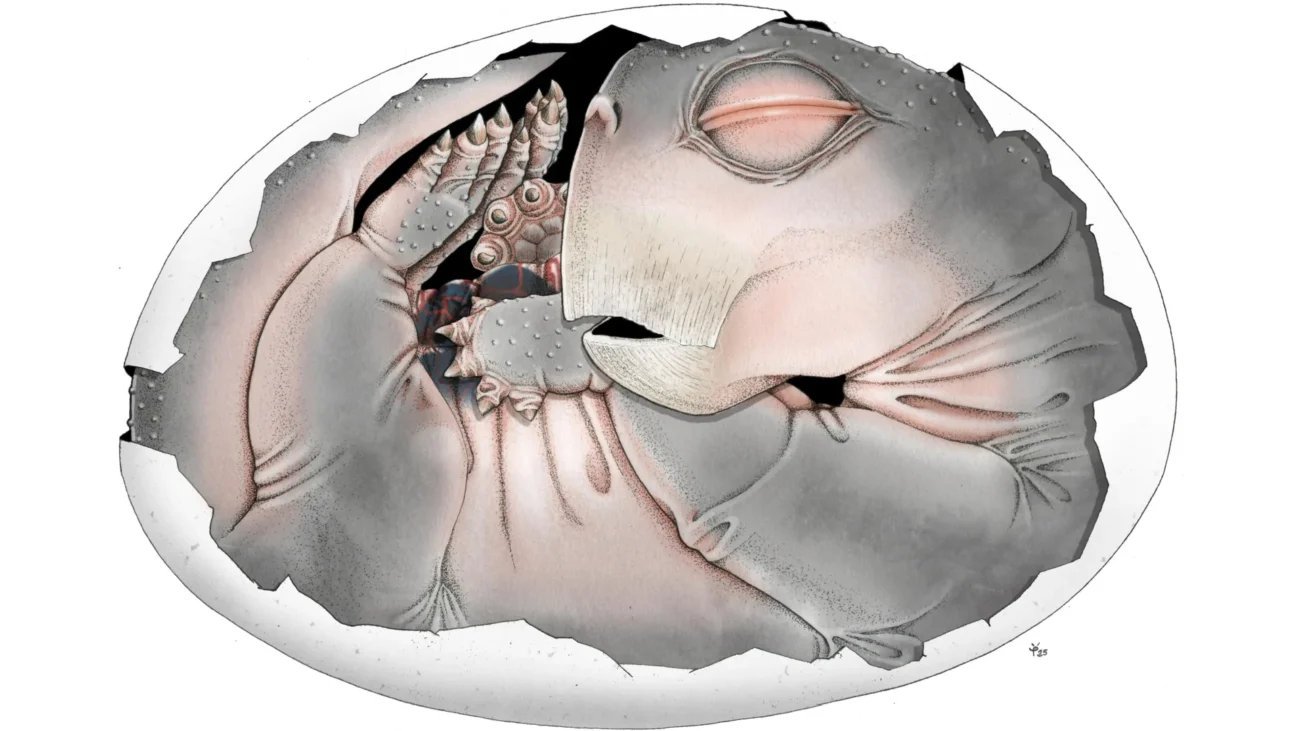
The discovery of a remarkably preserved 250-million-year-old fossilized egg, containing a Lystrosaurus embryo, is revolutionizing our understanding of early mammal evolution and shedding new light on one of Earth’s most dramatic survival stories. This groundbreaking find, detailed in the journal PLOS ONE, provides the first definitive evidence that the ancestors of mammals laid eggs, resolving a long-standing scientific enigma that has captivated paleontologists for decades. Lystrosaurus, a resilient and adaptable plant-eating creature, rose to prominence in the wake of the devastating End-Permian Mass Extinction, an event that decimated terrestrial life and reshaped the planet.
The Cataclysmic End-Permian Mass Extinction: A World Reborn
Around 252 million years ago, Earth experienced its most severe extinction event, a cataclysm often referred to as the "Great Dying." This period marked the boundary between the Permian and Triassic geological periods. The primary driver of this mass extinction is widely believed to be massive volcanic activity in the Siberian Traps. These eruptions released enormous quantities of greenhouse gases, primarily carbon dioxide, into the atmosphere, leading to a rapid and extreme increase in global temperatures. This "hothouse" Earth scenario triggered a cascade of environmental disasters: widespread ocean acidification, anoxia (oxygen depletion) in the oceans, and prolonged, severe droughts on land.
The consequences for life were catastrophic. It is estimated that up to 96% of marine species and 70% of terrestrial vertebrate species perished. The flora and fauna of the planet were decimated, leaving behind a barren and unstable landscape. Ecosystems collapsed, and the path for the evolution of new life forms was dramatically altered. It was within this desolate and challenging post-extinction environment that Lystrosaurus emerged as a dominant force, demonstrating an extraordinary capacity for survival and proliferation.
Lystrosaurus: The Unlikely Survivor
Lystrosaurus, a genus of dicynodont therapsids, was a pig-sized, herbivorous creature characterized by its turtle-like beak and a pair of tusks. Despite its somewhat peculiar appearance, it possessed a robust physiology and a remarkable ability to adapt to extreme conditions. Following the End-Permian extinction, Lystrosaurus became incredibly abundant, particularly in the terrestrial ecosystems of the supercontinent Pangaea. Its widespread distribution and sheer numbers made it a hallmark species of the Early Triassic period.
For decades, scientists have sought to understand the factors that contributed to Lystrosaurus’s unparalleled success in the face of such overwhelming environmental devastation. Its ability to not only survive but thrive in a world wracked by extreme heat, atmospheric instability, and persistent drought has been a subject of intense scientific inquiry. The discovery of its fossilized egg, containing an embryo, offers crucial insights into its reproductive strategies and, by extension, its resilience.
A Fossilized Secret: The Lystrosaurus Embryo Egg
The pivotal discovery was made by an international team of researchers led by Professor Julien Benoit, Professor Jennifer Botha from the Evolutionary Studies Institute at the University of the Witwatersrand in South Africa, and Dr. Vincent Fernandez from the ESRF – The European Synchrotron in France. Their investigation focused on a fossil specimen unearthed during a field excursion in 2008.
Professor Jennifer Botha recounted the initial discovery: "This fossil was discovered during a field excursion I led in 2008, nearly 17 years ago. My preparator and exceptional fossil finder, John Nyaphuli, identified a small nodule that at first revealed only tiny flecks of bone. As he carefully prepared the specimen, it became clear that it was a perfectly curled-up Lystrosaurus hatchling. I suspected even then that it had died within the egg, but at the time, we simply didn’t have the technology to confirm it."
The preparation of the fossil revealed a miniature Lystrosaurus, curled in a fetal position. However, the crucial element—the eggshell—was largely absent, leading to initial uncertainty about whether the embryo had indeed died within its protective casing.
Unlocking the Past with Advanced Imaging Technology
The breakthrough in confirming the embryo’s presence within an egg came with the application of cutting-edge synchrotron X-ray computed tomography (CT) scanning. This advanced imaging technique, utilizing the powerful X-rays at the ESRF, allowed researchers to peer inside the fossilized nodule with unprecedented detail, revealing the delicate skeletal structure of the embryo without the need for destructive dissection.
Dr. Vincent Fernandez described the significance of the imaging process: "Understanding reproduction in mammal ancestors has been a long-lasting enigma, and this fossil provides a key piece to this puzzle. It was essential that we scanned the fossil just right to capture the level of detail needed to resolve such tiny, delicate bones." The scans confirmed the presence of a well-developed Lystrosaurus embryo, providing the first concrete evidence of an egg from a mammal ancestor.
Resolving a Fundamental Question: Did Mammal Ancestors Lay Eggs?
The discovery unequivocally answers a question that has long puzzled evolutionary biologists: did the earliest ancestors of mammals reproduce by laying eggs? The answer, confirmed by this Lystrosaurus fossil, is a resounding yes. This finding places Lystrosaurus squarely within the lineage leading to modern mammals, which today are predominantly characterized by live birth, although the monotremes (platypus and echidnas) retain egg-laying as their reproductive mode.
The Enigma of Soft-Shelled Eggs and Their Rarity
The researchers hypothesize that the scarcity of such fossilized eggs is due to their likely composition. Unlike the hard, calcified eggshells of dinosaurs and birds, which readily fossilize, the eggs of Lystrosaurus are believed to have been soft-shelled. This characteristic would have made them far more susceptible to decay and decomposition before fossilization could occur, explaining why they are so rarely found. The preservation of this particular egg, even with its damaged shell, is therefore an exceptional stroke of paleontological luck.
Clues from the Embryo: Development and Independence
Beyond confirming egg-laying, the detailed scans of the Lystrosaurus embryo provided crucial insights into its developmental stage and potential life strategies. Professor Julien Benoit noted a significant observation regarding the embryo’s jaw structure: "When I saw the incomplete mandibular symphysis, I was genuinely excited. The mandible, the lower jaw, is made up of two halves that must fuse before the animal can feed. The fact that this fusion had not yet occurred shows that the individual would have been incapable of feeding itself."
This observation, coupled with the relatively large size of the egg compared to the anticipated size of the hatchling, suggests a specific reproductive strategy. In modern animals, large eggs are often rich in yolk, providing ample nutrients for the developing embryo to reach a relatively advanced stage of development before hatching. This would have allowed the Lystrosaurus hatchlings to be largely independent shortly after birth, a trait known as precociality.
A Strategy for Survival in a Harsh World
The implications of these findings for Lystrosaurus’s survival in the post-extinction environment are profound. The study suggests that Lystrosaurus produced relatively large eggs, which would have offered several advantages:
- Nutrient Richness: A larger yolk would have provided sustained nourishment, enabling the embryo to develop fully within the egg and hatch at a more mature stage. This reduces the immediate need for parental provisioning.
- Drought Resistance: In the arid conditions prevalent after the End-Permian extinction, larger eggs with a greater yolk reserve would have been more resilient to desiccation, increasing the chances of successful hatching.
- Early Independence: Precocial hatchlings would have been capable of feeding themselves and evading predators soon after hatching. This independence would have been a critical advantage in an environment where parental resources might have been scarce or unpredictable.
This reproductive strategy—producing large, yolk-rich eggs that lead to precocial offspring—allowed Lystrosaurus to grow quickly and reproduce early, a "fast-track" approach to life that proved highly effective in the unstable and resource-limited ecosystems of the Early Triassic. It negated the need for extensive parental care, which might have been unsustainable for a species trying to recolonize a devastated planet.
Broader Implications for Evolutionary Biology and Climate Resilience
The discovery of the Lystrosaurus egg fossil is more than just a resolution to a paleontological puzzle; it has significant implications for our understanding of evolutionary adaptation and resilience in the face of environmental crises.
Deep-Time Perspective on Resilience: As Professor Benoit articulated, "In a modern context, this work is highly impactful because it offers a deep-time perspective on resilience and adaptability in the face of rapid climate change and ecological crisis. Understanding how past organisms survived global upheaval helps scientists better predict how species today might respond to ongoing environmental stress." The Lystrosaurus story highlights how specific reproductive and developmental strategies can confer a remarkable advantage during periods of extreme environmental upheaval.
Evolutionary Pathways: This finding contributes to the broader understanding of the evolutionary trajectory from synapsids (the group that includes mammal ancestors) to mammals. It reinforces the idea that the lineage leading to mammals retained certain ancestral traits, such as egg-laying, for a considerable period, even as other groups were evolving towards live birth. The persistence of egg-laying in monotremes today may be a vestige of this ancient reproductive strategy.
South African Paleontology Milestone: Professor Botha emphasized the significance of this discovery within the context of South African paleontology: "It is also thrilling because this discovery breaks entirely new ground. For over 150 years of South African paleontology, no fossil had ever been conclusively identified as a therapsid egg. This is the first time we can say, with confidence, that mammal ancestors like Lystrosaurus laid eggs, making it a true milestone in the field."
The Future of Paleontological Research
This remarkable find underscores the indispensable role of advanced imaging technologies in modern paleontology. Techniques like synchrotron X-ray CT scanning are transforming the field, allowing scientists to extract detailed information from fossils that were previously inaccessible without damaging the specimens. The ability to "see inside" fossils non-destructively opens up new avenues for research and promises further breakthroughs in our understanding of ancient life.
The story of Lystrosaurus and its fossilized egg serves as a powerful testament to the adaptability of life on Earth. It demonstrates that even in the face of cataclysmic events, life finds a way, often through ingenious and unexpected evolutionary strategies. As scientists continue to explore the fossil record, discoveries like this not only fill in the gaps of our planet’s history but also offer invaluable lessons for confronting the environmental challenges of our own era. The resilience of Lystrosaurus in a world reborn from ashes provides a profound perspective on the enduring power of life.

