


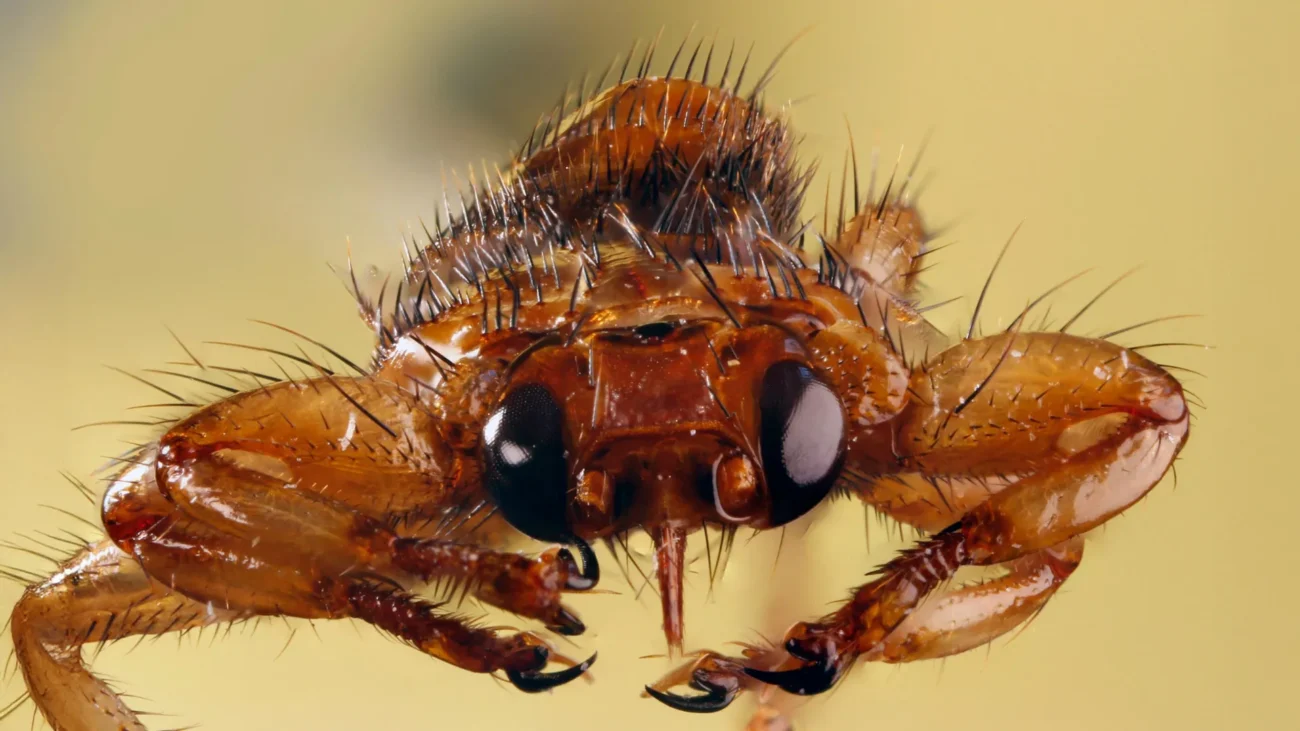
A remarkable adaptation in the visual system of deer keds, a ubiquitous blood-feeding fly, has been unveiled by a collaborative study from Aberystwyth University and the University of Florence. The research indicates that these parasites undergo a significant reduction in visual sensitivity once they successfully locate a host, permanently shedding their wings and transitioning from aerial hunters to sedentary ectoparasites. This strategic recalibration of their sensory apparatus suggests a profound evolutionary trade-off, prioritizing energy conservation for essential parasitic functions over the energetically demanding pursuit of vision.
The Evolutionary Paradox of the Deer Ked
Deer keds, scientifically classified under the genus Lipoptena, are a fascinating group of dipteran insects found across diverse continents, including Europe, Asia, Africa, and the Americas. Their life cycle presents a stark dichotomy: a mobile, visually-oriented phase dedicated to host-finding, followed by a permanently grounded, parasitic existence. As winged adults, deer keds are adept flyers, employing both their keen eyesight and their ability to navigate air currents to locate suitable hosts, most commonly various species of deer. However, their predatory success is often short-lived. Upon landing on a warm-blooded mammal, the ked undergoes a dramatic metamorphosis, permanently detaching its wings. The remainder of its life is spent burrowing within the host’s fur, feeding exclusively on blood.
This dramatic shift in lifestyle prompted scientists to investigate the underlying physiological and genetic adaptations that facilitate such a profound transition. The research, published in the esteemed Journal of Experimental Biology, delves into the intricate interplay between an organism’s environment and its sensory capabilities, highlighting how evolution sculpts sensory systems to align with an organism’s ecological niche.
Dr. Roger Santer, a leading researcher from the Department of Life Sciences at Aberystwyth University, who spearheaded the investigation, articulated the fundamental principle guiding their inquiry. "Vision plays a vital role in animal behavior, but it is also energetically expensive," Dr. Santer explained. "Evolution favors sensory systems that are efficiently matched to an animal’s way of life. Some blood-feeding flies rely heavily on vision, while others live permanently on hosts and have little need for it. Deer keds are especially interesting because they switch between these two lifestyles."
Methodology: Tracking Sensory Shifts Through the Life Cycle
To unravel the mysteries of the deer ked’s adaptive vision, the research team meticulously examined specimens at different stages of their life cycle. This comparative approach allowed them to observe the physiological changes that accompany the transition from a free-flying insect to a sessile parasite. Winged adults, actively engaged in host-seeking behavior, were collected and analyzed. These were then contrasted with wingless adults that had been retrieved from the fur of deer, representing individuals that had fully embraced their parasitic lifestyle.
The core of the investigation focused on a specific class of genes known as opsins. Opsins are light-sensitive proteins that form the basis of photoreceptor cells in the eyes, playing a crucial role in detecting and processing visual information. By quantifying the expression levels of these opsin genes, researchers could gauge the activity and potential sensitivity of the flies’ visual systems. The hypothesis was that a reduction in the need for flight-based host detection would correlate with a downregulation of visual genes.
Key Findings: The Dimming of the Parasite’s Eye
The results of the gene expression analysis provided compelling evidence for a significant alteration in the deer ked’s visual machinery. Dr. Santer elaborated on these findings: "We found that a flying deer ked’s visual system is much like that of a tsetse fly, which famously hunt out mammal hosts in Africa. However, after a deer ked loses its wings and becomes an ectoparasite, activity of its opsin genes reduces to around half the previous level."
This reduction in opsin gene activity is not indicative of complete blindness. Instead, it suggests a deliberate downregulation of visual sensitivity. The researchers interpret this as a strategic energy-saving measure. "This suggests that the flies do not lose vision entirely, but that their visual sensitivity is reduced," Dr. Santer stated. "We think the fly might be sacrificing sight to conserve energy for functions such as digestion and reproduction."
The implication is that once a deer ked has established itself on a host, the intense visual acuity required for aerial navigation and prey detection becomes a redundant and metabolically costly burden. By diminishing investment in its visual system, the ked can redirect precious metabolic resources towards processes essential for survival and reproduction in its new, stationary environment. This could include enhanced digestive capabilities to efficiently process blood, or increased energy allocation for reproductive success, ensuring the continuation of the species.
Broader Implications: Understanding Parasite Adaptation and Control
The study’s findings offer more than just an intriguing glimpse into the life of a single insect species. They contribute significantly to our broader understanding of parasite adaptation and the remarkable ways in which organisms evolve to exploit new ecological niches. The ability of a parasite to undergo such a rapid and profound sensory recalibration underscores the power of natural selection in shaping biological systems.
The research team posits that a deeper comprehension of how deer keds and similar biting flies utilize their sensory systems could have tangible benefits in the future. Improved knowledge of their host-detection mechanisms, including their visual cues and olfactory sensitivities, could pave the way for more effective monitoring and control strategies. This is particularly relevant given the potential for these flies to transmit diseases, although deer keds themselves are not typically vectors of major human pathogens, they can be a nuisance and cause irritation to their hosts.
Context and Chronology of the Research
The research project was initiated to explore the evolutionary plasticity of sensory systems in response to significant lifestyle changes. The idea of investigating deer keds stemmed from their unique life history, offering a natural experiment in adaptation.
- Early Research Phase (Hypothesis Generation): Scientists observed the distinct life stages of deer keds, noting the transition from winged, mobile hunters to wingless, sedentary parasites. This observation naturally led to questions about how their sensory systems might adapt to such a dramatic shift.
- Specimen Collection and Life Cycle Analysis: Researchers embarked on collecting deer keds at various stages. Winged individuals were sampled from areas where deer are prevalent, while wingless specimens were carefully removed from the pelts of deer. This ensured a direct comparison between the two life phases.
- Genetic Analysis (Opsin Gene Expression): The core of the experimental work involved analyzing gene expression in the collected samples. Techniques such as quantitative real-time PCR (qPCR) or RNA sequencing would have been employed to measure the abundance of opsin mRNA, a proxy for gene activity. This phase likely spanned several months to ensure robust data.
- Data Interpretation and Publication: Following the genetic analysis, the data was meticulously processed and interpreted. The findings were then prepared for dissemination through peer-reviewed channels, culminating in the publication in the Journal of Experimental Biology. This process typically involves multiple rounds of review and revision.
Supporting Data and Analogous Organisms
While the article focuses on deer keds, the concept of sensory adaptation in parasites is well-documented across various taxa. For instance, some parasitic worms, which live entirely within the digestive tracts of their hosts, have greatly reduced or entirely lost their visual systems, as light is irrelevant in their dark, nutrient-rich environment. Conversely, free-living stages of some parasites might possess more developed sensory organs to locate hosts.
The comparison made to tsetse flies (Glossina species) in the study is significant. Tsetse flies are renowned for their visual hunting prowess, using their large compound eyes to spot their mammalian hosts from a distance. The fact that the winged deer ked shares similar visual system characteristics with tsetse flies highlights the importance of vision for active, mobile blood-feeders. The subsequent reduction in opsin gene activity in the wingless ked further emphasizes the energy-saving strategy.
Potential Future Directions and Broader Impact
The insights gained from this study could have broader implications beyond entomology. Understanding how organisms reallocate resources and modify sensory perception in response to environmental or lifestyle changes is a fundamental question in evolutionary biology. This research contributes to a growing body of evidence demonstrating the remarkable plasticity of biological systems.
Furthermore, for industries and public health initiatives focused on vector control, understanding the sensory ecology of biting insects is paramount. While deer keds may not be primary disease vectors, many closely related species are. By dissecting the sensory adaptations of flies like the deer ked, researchers can build a more comprehensive picture of how these insects navigate their world, detect hosts, and ultimately, how they can be deterred or managed. This could lead to the development of novel attractants or repellents based on a deeper understanding of their sensory perception, or more targeted and efficient trapping mechanisms. The study serves as a compelling example of how fundamental biological research can illuminate complex evolutionary processes and offer practical avenues for future innovation.

