


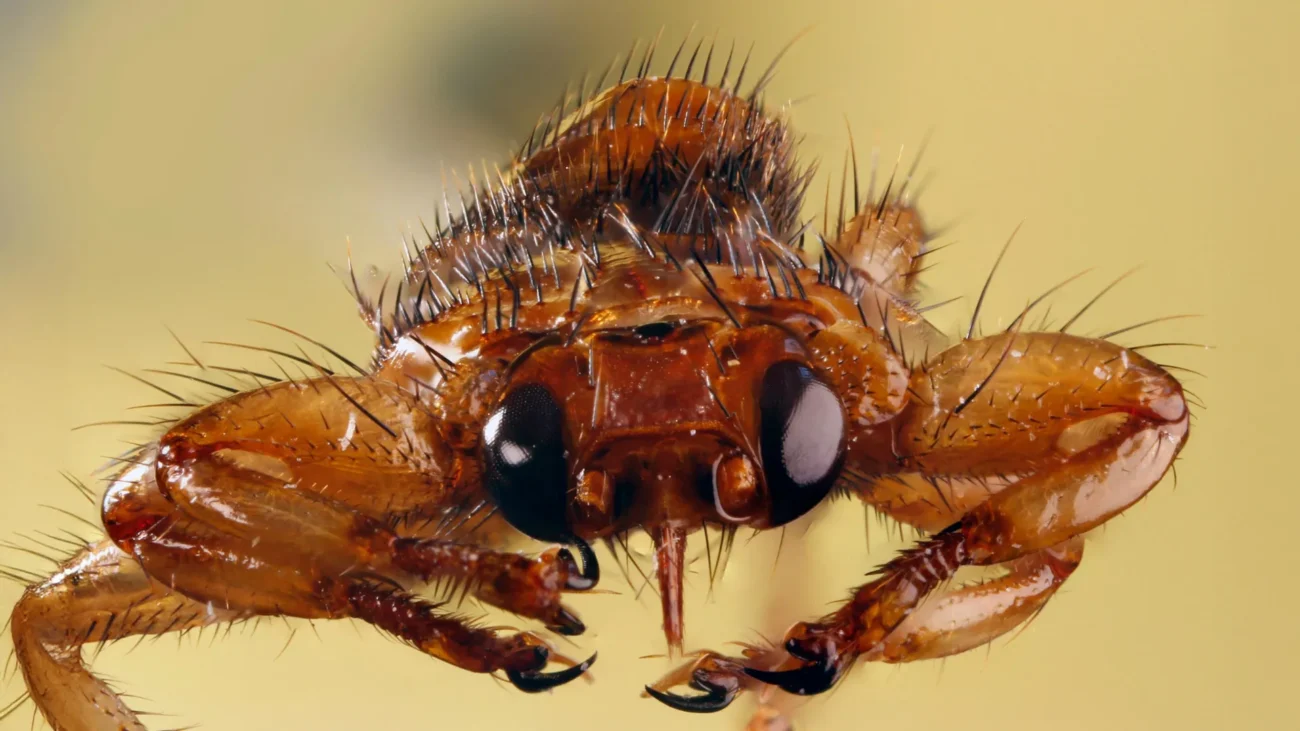
A remarkable adaptation in the evolutionary journey of deer keds, a type of wingless, blood-feeding fly, has been unveiled by a collaborative research effort between Aberystwyth University and the University of Florence. The study reveals that these ubiquitous parasites, found across continents, undergo a significant shift in their sensory capabilities, specifically a dramatic reduction in visual sensitivity, once they have successfully attached to a host. This strategic recalibration of their sensory apparatus appears to be a finely tuned evolutionary response, allowing the flies to reallocate valuable energy resources from the energetically demanding process of sight to functions crucial for their enduring parasitic existence.
The findings, published in the prestigious Journal of Experimental Biology, offer a compelling glimpse into the intricate ways organisms adapt to fundamental changes in their ecological niche. Deer keds, scientifically classified within the Hippoboscidae family, are characterized by their flattened bodies and their remarkable ability to transition from aerial hunters to permanently attached ectoparasites. This life cycle metamorphosis is not merely physical; it is underpinned by profound physiological and behavioral adjustments, with the reduction in visual acuity emerging as a key component of their parasitic strategy.
The Dual Life of the Deer Ked: From Aerial Searcher to Fur Dweller
Deer keds, also commonly referred to as "louse flies," present a fascinating paradox in the insect world. In their adult, winged stage, they are active predators, employing a combination of flight and keen vision to locate suitable hosts. While their primary targets are ungulates like deer, they are opportunistic feeders and will readily infest other mammals, including livestock and, occasionally, humans. This initial phase of their adult life is characterized by a constant search, a dynamic interplay of movement and sensory perception aimed at finding a stable, nutrient-rich environment.
The turning point in a deer ked’s life occurs upon successfully landing on a host. This moment triggers a dramatic and irreversible transformation. The insect permanently sheds its wings, a radical act that signifies a complete abandonment of its aerial existence. From this point forward, the wingless ked dedicates its remaining lifespan to navigating the dense fur of its host, a life spent in perpetual pursuit of blood meals. This transition from a mobile, searching organism to a sedentary, embedded parasite necessitates a fundamental re-evaluation of the organism’s biological priorities.
Unraveling the Sensory Shift: A Focus on Opsin Gene Expression
Scientists at Aberystwyth University, led by Dr. Roger Santer of the Department of Life Sciences, in conjunction with researchers from the University of Florence, embarked on a mission to understand the underlying mechanisms of this remarkable adaptation. Their investigation zeroed in on the sensory systems of the deer ked, hypothesizing that such a drastic shift in lifestyle would inevitably be accompanied by corresponding changes in how the insect perceives its environment.
"Vision plays a vital role in animal behavior, but it is also energetically expensive," explained Dr. Santer. "Evolution favors sensory systems that are efficiently matched to an animal’s way of life. Some blood-feeding flies rely heavily on vision, while others live permanently on hosts and have little need for it. Deer keds are especially interesting because they switch between these two lifestyles." This observation formed the conceptual bedrock of the study, highlighting the unique evolutionary position of deer keds as a model for understanding sensory adaptation in response to ecological niche shifts.
The research team meticulously collected deer keds at various stages of their adult life. This included sampling winged adults that were actively engaged in host-seeking behaviors and comparing them with wingless adults that had been retrieved from the fur of deer, signifying their established parasitic status. This comparative approach allowed the researchers to directly assess the physiological differences between the two distinct phases of the deer ked’s adult life.
A critical focus of the study was the investigation of opsins, a family of light-sensitive proteins that are fundamental to vision in most animals. Opsins are encoded by specific genes, and their expression levels are directly indicative of the eye’s sensitivity to light and its capacity for visual processing. By examining the activity of these opsin genes, the researchers aimed to quantify the reduction in visual capability associated with the transition to a parasitic lifestyle.
The results of this genetic analysis were striking. The research team discovered a significant downregulation in the expression of opsin genes in wingless deer keds compared to their winged counterparts. "We found that a flying deer ked’s visual system is much like that of a tsetse fly, which famously hunt out mammal hosts in Africa," Dr. Santer elaborated. "However, after a deer ked loses its wings and becomes an ectoparasite, activity of its opsin genes reduces to around half the previous level. This suggests that the flies do not lose vision entirely, but that their visual sensitivity is reduced."
This reduction in opsin gene activity translates directly to a diminished capacity for the flies to detect light and process visual information. It signifies a deliberate evolutionary trade-off, where the energy that would have been expended on maintaining a highly sensitive visual system is instead redirected. "We think the fly might be sacrificing sight to conserve energy for functions such as digestion and reproduction," Dr. Santer noted, underscoring the adaptive advantage of this sensory recalibration. The flies do not become blind, but their vision becomes significantly less acute, sufficient for navigating the immediate vicinity within fur but no longer optimized for long-range detection from the air.
The Broader Implications: Understanding Parasite Evolution and Control
The implications of this research extend beyond the specific biology of the deer ked. It provides invaluable insights into the broader principles of parasite adaptation and the remarkable plasticity of sensory systems in response to environmental pressures. The study demonstrates that evolutionary pressures can lead to a strategic de-emphasis of certain sensory modalities when they are no longer paramount for survival and reproduction.
This research offers a concrete example of how organisms optimize their biological machinery for their specific ecological roles. The energetic cost of maintaining sophisticated sensory organs like eyes is considerable. In environments where these senses become less critical, natural selection favors individuals that can reduce this expenditure, channeling those resources into more immediately beneficial functions, such as nutrient assimilation, immune evasion, or reproductive success.
The findings also hold potential practical applications in the realm of pest management and disease control. A more profound understanding of how deer keds and other biting flies utilize their senses could pave the way for more effective strategies to monitor and control their populations. For instance, if visual cues are less important for established parasites, control methods might need to focus on other sensory modalities or behavioral attractants that are more relevant to their parasitic lifestyle.
The study’s publication in the Journal of Experimental Biology places it within a respected scientific discourse, allowing for peer review and further investigation by the wider scientific community. This rigorous process ensures the validity and significance of the findings. The collaborative nature of the research, involving institutions from different countries, highlights the global importance of understanding parasitic organisms and their interactions with hosts.
A Chronology of Adaptation
While the study itself is a recent development, the evolutionary process it describes has unfolded over millennia. The deer ked’s lineage has adapted to a life that requires distinct phases of mobility and immobility, foraging and feeding.
- Ancestral State: It is plausible that ancestral forms of hippoboscid flies were more reliant on flight and vision for their entire adult lives, similar to many other predatory insects.
- Emergence of Parasitism: Over evolutionary time, some lineages began to exploit the rich, stable environment offered by host animals. This likely conferred a survival advantage, allowing for consistent access to nutrients.
- Wing Loss and Sensory Reorganization: The permanent shedding of wings and the subsequent reduction in visual sensitivity represent a key evolutionary innovation that solidified the parasitic lifestyle. This adaptation would have been driven by the energetic benefits of no longer needing to maintain flight muscles and a highly acute visual system, while simultaneously enhancing the capacity for digestion and reproduction within the host environment.
- Modern Deer Ked: The deer ked as we know it today is the product of these evolutionary pressures, exhibiting a specialized sensory system that is finely tuned to its parasitic existence.
Supporting Data and Scientific Context
The reduction in opsin gene activity observed in deer keds is consistent with a broader understanding of sensory ecology and evolutionary trade-offs. For example, species that live in perpetually dark environments, such as deep caves or the deep sea, often exhibit reduced or absent eyes, as vision is not a useful sense in such conditions. Conversely, nocturnal predators often possess highly specialized visual systems adapted for low-light conditions.
The tsetse fly, mentioned by Dr. Santer as a comparative example, is a well-studied blood-feeding insect that relies heavily on vision to locate its hosts, particularly in the open savannah environments where it is prevalent. The contrast between the tsetse fly’s visually oriented hunting strategy and the deer ked’s post-attachment sensory reduction underscores the diverse evolutionary pathways that blood-feeding insects have taken.
The energetic cost of vision is not a trivial matter. The human eye, for instance, is a complex organ that consumes a significant portion of the body’s metabolic energy. While precise figures for insects vary, the principle of energy conservation holds true across the animal kingdom. By downregulating opsin gene expression, the deer ked effectively reduces the metabolic burden associated with maintaining the cellular machinery of its visual system. This conserved energy can then be allocated to processes such as:
- Digestion: Breaking down complex blood proteins into usable nutrients requires substantial metabolic energy.
- Reproduction: Producing eggs and supporting the development of offspring is an energetically demanding undertaking.
- Immune Evasion: Surviving within a host organism often involves mechanisms to circumvent or suppress the host’s immune responses, which can also be metabolically costly.
Future Directions and Broader Impact
The research team’s findings are likely to stimulate further investigations into the sensory biology of other parasitic insects. Understanding these adaptations is not merely an academic exercise; it has tangible implications for human and animal health. Many parasitic insects are vectors for diseases such as malaria, dengue fever, and Lyme disease. By deciphering the sensory mechanisms that drive their host-finding behavior and their persistence on hosts, scientists can develop more targeted and effective interventions.
The ability of deer keds to effectively "switch off" or significantly reduce their reliance on vision after finding a host suggests a sophisticated level of biological regulation. Future research could explore the specific molecular pathways involved in this gene downregulation and investigate whether similar mechanisms are at play in other parasitic species. Furthermore, understanding the precise thresholds of visual sensitivity that remain in the wingless keds could offer clues about their remaining navigational needs within the host’s fur.
In conclusion, the study by Aberystwyth University and the University of Florence provides a compelling narrative of evolutionary adaptation, illustrating how a seemingly simple act of shedding wings can be accompanied by profound physiological changes. The deer ked’s strategic reduction of visual sensitivity is a testament to the power of natural selection in shaping organisms to thrive in their specific ecological niches, offering valuable lessons in the intricate dance between life, environment, and the remarkable efficiency of biological design.

