


The story of an ancient cave on the Caribbean island of Hispaniola, where a giant barn owl, a hutia rodent, and a burrowing bee once crossed paths, has unfolded into a remarkable scientific discovery. While only two of them are said to have left the cave, the third’s presence, or rather its enduring legacy, has provided paleontologists with an unprecedented glimpse into the ingenuity of nature and the hidden lives of ancient creatures. The one that remained behind was the hutia, its skeletal remains becoming an unexpected haven for a new generation of life. This extraordinary narrative, preserved in stone for millennia, reveals how the remnants of predation transformed into a nursery for an entirely different species, highlighting a unique and previously undocumented form of nesting behavior by burrowing bees.
A Predatory Past and an Unexpected Future
The initial scenario, likely unfolding thousands of years ago, paints a vivid picture of survival in the wild. A colossal barn owl, a formidable nocturnal predator, would have captured a hutia, a substantial rodent native to the Caribbean. The owl, in its instinctual drive to provide for its young, would have transported its prey to the safety of its cave, a common practice for many avian predators. Once the meal was consumed, the unfortunate hutia’s remains would have been left scattered within the cave’s dark recesses.
It was into this ancient larder, long after the owl and its prey had vanished, that a solitary burrowing bee arrived. Driven by the fundamental imperative to reproduce, the bee sought a suitable location to construct its nest. The cave, with its accumulated layers of fine, clay-rich silt, offered a promising environment. As the bee began its diligent excavation, it encountered the fossilized remains of the hutia. This seemingly random encounter, however, proved to be serendipitous.
Nature’s Ingenuity: Fossilized Skeletons as Ready-Made Nests
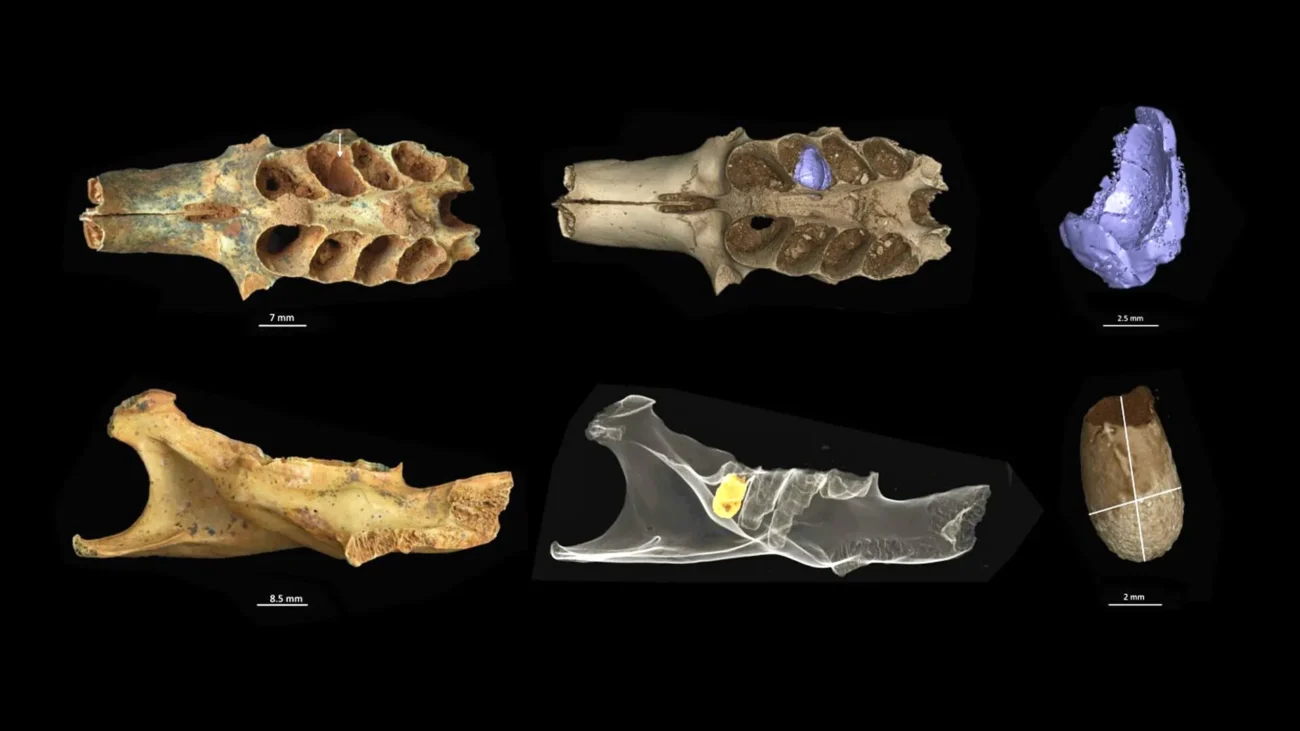
The hutia’s jawbone, specifically the empty sockets where its teeth once resided – known as alveoli – presented an ideal opportunity for the bee. These natural cavities, remarkably, possessed dimensions that closely approximated the size required for a bee’s nest. The bee, rather than laboriously excavating from scratch, ingeniously utilized these pre-existing, hollow spaces. Over time, this behavior was not an isolated incident. Subsequent generations of bees discovered and exploited these fossilized bone structures, transforming the remnants of an ancient meal into a thriving nursery. This remarkable adaptation has left behind an extraordinary fossil record, a testament to the enduring power of evolution and the surprising ways life finds to persist.
The Discovery: A Keen Eye in the Field
The revelation of this unusual nesting behavior might have easily been overlooked. The meticulous process of fossil excavation often involves the thorough removal of all surrounding sediment, including anything that might reside within the dental alveoli. However, the keen observation of Lazaro Viñola Lopez, a doctoral student at the Florida Museum of Natural History, proved pivotal. While excavating fossils in the Cueva de Mono, located in the southern Dominican Republic, Viñola Lopez encountered a large number of hutia fossils, suggesting the cave had served as a long-term feeding site for giant barn owls over an extended period.
Instead of adhering to the conventional practice of immediately cleaning the fossils, Viñola Lopez’s curiosity led him to inspect them closely. He noticed a particular cavity within a hutia mandible that stood out. Its inner surface was unusually smooth, a stark contrast to the rough, porous texture of bone. This anomaly sparked his interest, prompting further investigation.
From Suspected Wasps to Identified Bees: A Correction in Identification
Viñola Lopez’s initial hypothesis, based on a previous experience, pointed towards wasp nests. He recalled a similar find in Montana in 2014, where wasp cocoons were discovered amongst dinosaur fossils. He initially believed he was observing a comparable phenomenon, envisioning a short scientific paper detailing the presence of wasp nests within the hutia mandibles.
He shared his preliminary findings with his colleague Mitchell Riegler, another doctoral student at the museum. Riegler, initially occupied with other research, expressed a degree of skepticism, deeming the project "niche." However, the idea resurfaced when Riegler accepted a challenge from a former advisor to complete a scientific paper within a week. This collaborative effort, a "game back and forth," as Riegler described it, reignited the investigation into the mysterious structures.
The team’s initial assumption of wasp nests began to falter as they delved deeper into the research. Upon reviewing literature on ichnofossils – traces of past biological activity such as footprints, droppings, or nests – they noticed inconsistencies. Wasp nests are typically characterized by rough walls constructed from chewed plant material and saliva. The smooth surfaces observed in the fossilized cavities did not align with this description.
Further research led them to the true identity of the nest builders. Bees, particularly certain species of burrowing bees, are known to line their nests with a waxy secretion. This secretion creates a waterproof and polished interior, a characteristic that precisely matched the smooth surfaces observed in the fossilized alveoli. This critical detail led to the groundbreaking realization: they were not documenting wasp nests, but rather the remarkable nesting behavior of bees.
A Rare and Unprecedented Behavior Unveiled
This correction significantly amplified the importance of their discovery. The use of pre-existing fossil structures by bees for nesting without alteration was unprecedented. While there is one other known instance of burrowing bees nesting inside a cave, it did not involve the exploitation of fossilized material in this manner. A prior report mentioned bees drilling into human bones, a different behavior altogether, distinct from the passive occupation of natural cavities observed in this case.
Recognizing the profound implications of their findings, the researchers adopted a more comprehensive approach. They consulted with modern bee specialists, meticulously reviewed extensive scientific literature, and Viñola Lopez revisited the Cueva de Mono to conduct a more thorough geological examination of the cave’s layers.
A Rescue Mission in the Face of Development
The research faced an unexpected challenge when plans were proposed to develop the land surrounding the cave, with intentions to convert it into a septic tank. Fortunately, this development was ultimately halted. However, the threat prompted the research team to undertake a "rescue mission" to recover as many fossils as possible from the cave before any potential irreversible damage could occur. This urgent effort proved successful, yielding a significant collection of valuable specimens.
Nests Discovered Across a Spectrum of Fossil Types
The culmination of their research, published in the Proceedings of the Royal Society B, offers a detailed account of the cave’s geological history and the extraordinary nesting habits of these ancient bees. The discovery of bee nests was not confined to the hutia jawbones. In one remarkable instance, a nest was found within the pulp cavity of a sloth tooth, an organism that once roamed the Caribbean before human arrival. Another nest was located inside a hutia vertebra, occupying the space that once housed the animal’s spinal cord.
Through the use of CT scans, the researchers were able to examine the internal structures of these fossilized cavities. These scans revealed that some cavities contained multiple layers of nests, ingeniously stacked one inside another, akin to Russian nesting dolls. This suggested that certain bees, rather than excavating entirely new tunnels, would reuse existing cavities if they remained empty. In one striking example, six distinct bee nests were found meticulously arranged within a single hutia alveolus.
Environmental Factors Driving This Unique Adaptation
The study also proposes a compelling explanation for this unusual behavior, rooted in the unique geological landscape of the region. The area surrounding the Cueva de Mono is characterized by karst topography – a terrain composed of sharp, porous limestone that lacks stable soil.
"The area we were collecting in is karst, so it’s made of sharp, edgy limestone, and it’s lost all of its natural soils," Riegler explained, underscoring the challenging environment. "I actually fell on it at one point, so I can tell you all about it."
In such a landscape, any soil that does accumulate on the surface is prone to being washed into caves. Within these subterranean environments, this washed-in material settles, creating pockets of suitable conditions for burrowing insects. These sheltered pockets of sediment within the caves may have represented some of the most viable nesting opportunities for burrowing bees in the region, driving their adaptation to utilize even the most unexpected of substrates.
A Cave Rich with Untold Stories
The Cueva de Mono continues to hold many secrets. The research team is actively studying other fossils recovered from the cave, with further publications anticipated in the future. This ongoing work promises to shed more light on the complex ecological interactions and evolutionary adaptations that have occurred within this ancient Caribbean ecosystem.
The findings from the Cueva de Mono represent a profound testament to the adaptability of life. In this instance, a cave that once served as a site of predation and decay has been transformed into a cradle of new life, thanks to the resourcefulness of a tiny, determined insect. This discovery underscores the intricate web of life and the remarkable ways in which organisms can evolve to thrive, even in the most unexpected of circumstances, leaving behind a legacy that transcends time and species. The story of the owl, the hutia, and the bee is a powerful reminder that the natural world is a continuous source of wonder and scientific inquiry, with countless stories waiting to be uncovered.

