


For decades, the prevailing scientific consensus held that dinosaur fossils were, for all intents and purposes, mineralized rock. The transformative processes of fossilization, it was believed, inevitably obliterated any vestige of original biological material, leaving behind only stony impressions of ancient life. However, a groundbreaking study, meticulously centered on an extraordinarily well-preserved Edmontosaurus fossil, is poised to fundamentally challenge this long-held assumption, potentially revolutionizing our understanding of prehistoric life.
Researchers, spearheaded by a distinguished team from the University of Liverpool, have unearthed compelling evidence suggesting that traces of original organic molecules, most notably collagen, persist within dinosaur bones dating back approximately 66 million years. This remarkable discovery lends significant weight to a controversial theory that has polarized the paleontological community for over three decades, opening up unprecedented avenues for scientific inquiry.
Unveiling Preserved Collagen in Ancient Bone
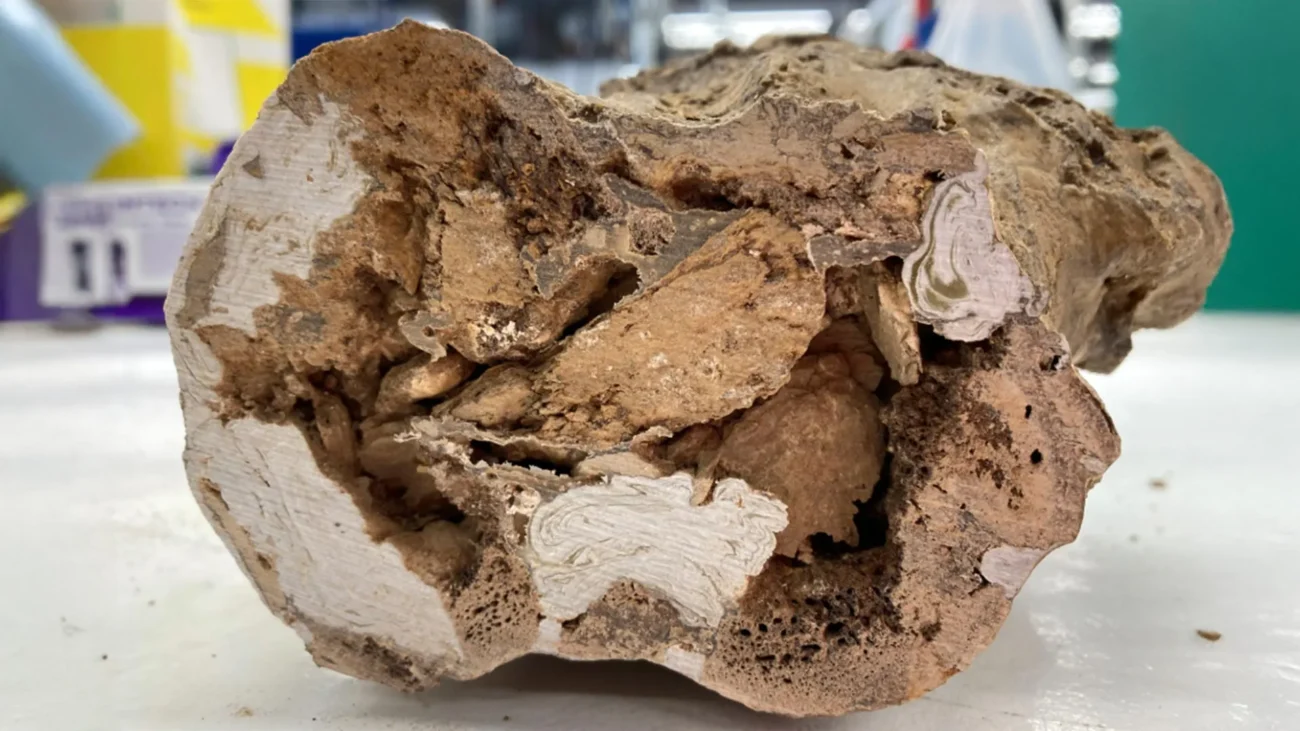
The linchpin of this pivotal study is a substantial Edmontosaurus sacrum, a critical component of the dinosaur’s hip region, weighing in at an impressive 22 kilograms. Unearthed from the renowned Hell Creek Formation in South Dakota, this fossil belongs to an Edmontosaurus, a large, herbivorous duck-billed dinosaur that coexisted with iconic predators like Tyrannosaurus rex during the twilight of the Cretaceous Period.
Through the application of a sophisticated suite of advanced laboratory methodologies, including cutting-edge protein sequencing and multiple forms of mass spectrometry, the scientific team was able to detect residual collagen embedded deep within the fossilized bone matrix. Collagen, a fundamental structural protein integral to bone tissue, is notoriously resilient, making its identification in such an ancient context particularly significant. Its presence strongly counters the possibility of it being a modern contaminant, a persistent hurdle in previous investigations.
Further bolstering the findings, researchers from the University of California, Los Angeles (UCLA) independently identified hydroxyproline, an amino acid intrinsically linked to collagen in bone tissue. The presence of hydroxyproline served as a crucial confirmation, providing robust support for the conclusion that degraded collagen fragments were indeed genuinely integral to the fossil itself, rather than superficial intrusions.
Professor Steve Taylor, chair of the Mass Spectrometry Research Group at the University of Liverpool’s Department of Electrical Engineering & Electronics, articulated the profound implications of their work. "This research shows beyond doubt that organic biomolecules, such as proteins like collagen, appear to be present in some fossils," he stated. "Our results have far-reaching implications. Firstly, it refutes the hypothesis that any organics found in fossils must result from contamination."
A Long-Standing Debate Ignites Anew
The assertion of preserved soft tissues and proteins within dinosaur fossils has been a lightning rod for intense scientific debate since the early 2000s. For years, a significant contingent of paleontologists argued that any organic materials detected were likely the result of modern contamination or residual bacterial activity, rather than authentic molecular remnants from the dinosaurs themselves.
One of the most high-profile and galvanizing discoveries in this ongoing discussion occurred in 2005, when paleontologist Mary Schweitzer and her colleagues reported the identification of soft tissue structures within a Tyrannosaurus rex fossil. Subsequent investigations, building upon this seminal work, identified potential collagen and structures resembling blood vessels in additional dinosaur specimens, including hadrosaurs, a group to which Edmontosaurus belongs.
The current Edmontosaurus analysis distinguishes itself through its rigorous, multi-faceted approach. By employing a combination of independent testing methods on the very same fossil specimen – including advanced microscopy, detailed chemical analysis, and precise protein sequencing – the research team aimed to systematically eliminate the possibility of contamination. This integrated strategy significantly strengthens the case that the identified molecules are indeed original to the dinosaur, offering a more definitive answer to the long-standing debate. The comprehensive findings were formally published in the peer-reviewed journal Analytical Chemistry in 2025, under the title "Evidence for Endogenous Collagen in Edmontosaurus Fossil Bone."
The Transformative Potential of Molecular Survival
The implications of this discovery are profound and far-reaching. If proteins, like collagen, can indeed survive for tens of millions of years within fossilized remains, it unlocks an entirely novel dimension for studying extinct animals. Molecular traces, previously thought to be irretrievably lost to time, could now provide an unprecedented source of information about the lives and evolutionary histories of dinosaurs.
Tiny molecular fragments have the potential to reveal intricate evolutionary relationships between dinosaur species that are currently difficult, if not impossible, to discern from skeletal morphology alone. Furthermore, researchers may gain invaluable insights into dinosaurian growth patterns, aging processes, their physiological adaptations, and even the prevalence of diseases that afflicted these ancient creatures.
Professor Taylor highlighted the necessity of re-examining historical fossil collections. "Scientists may now need to revisit fossil samples collected over the past century," he remarked. "Cross-polarized light microscopy images taken decades ago could contain overlooked evidence of preserved collagen in ancient bones." He elaborated, suggesting that these previously scrutinized images might reveal intact patches of bone collagen, "potentially offering a ready-made trove of fossil candidates for further protein analysis. This could unlock new insights into dinosaurs, for example revealing connections between dinosaur species that remain unknown." This suggests a retrospective scientific endeavor, where old discoveries might yield new revelations.
The Enigma of Molecular Persistence
Beyond the immediate implications for paleontology, this discovery poses a captivating scientific enigma: how have these delicate organic molecules managed to endure for such immense geological timescales? Proteins are inherently unstable, prone to degradation over time, particularly across the vast spans of millions of years. Yet, certain fossilized remains appear to have achieved the remarkable feat of preserving microscopic biological structures under specific, yet to be fully understood, conditions.
Current scientific investigations are increasingly focused on the role of mineral interactions within bone. It is hypothesized that these mineral matrices may act as protective shields, sequestering fragments of collagen and significantly slowing their complete decay. Recent research into fossil biomolecules suggests that particular burial environments, characterized by specific geochemical conditions, coupled with the intricate microscopic architecture of fossilized bone, could create remarkably stable microenvironments that dramatically retard chemical breakdown.
The Edmontosaurus fossils, in particular, have long been celebrated for their exceptional state of preservation. Numerous specimens unearthed over the last century have yielded detailed skin impressions and other soft tissue features, leading to their popular moniker, "dinosaur mummies." These exceptionally preserved specimens provide fertile ground for exploring the mechanisms of organic molecule survival.
More recent paleontology research continues to uncover surprisingly detailed soft tissue preservation in Edmontosaurus specimens, including evidence of fleshy structures and remarkably intact skin anatomy. These findings, when viewed in conjunction with the current collagen discovery, are collectively reshaping the scientific paradigm of fossil interpretation. Instead of viewing fossils solely as inert, stony replicas of ancient bones, researchers are increasingly recognizing some specimens as potential molecular time capsules, capable of retaining tangible traces of prehistoric biology for millions of years after the organism’s demise. This paradigm shift promises to enrich our understanding of the deep past in ways previously confined to the realm of science fiction.

