


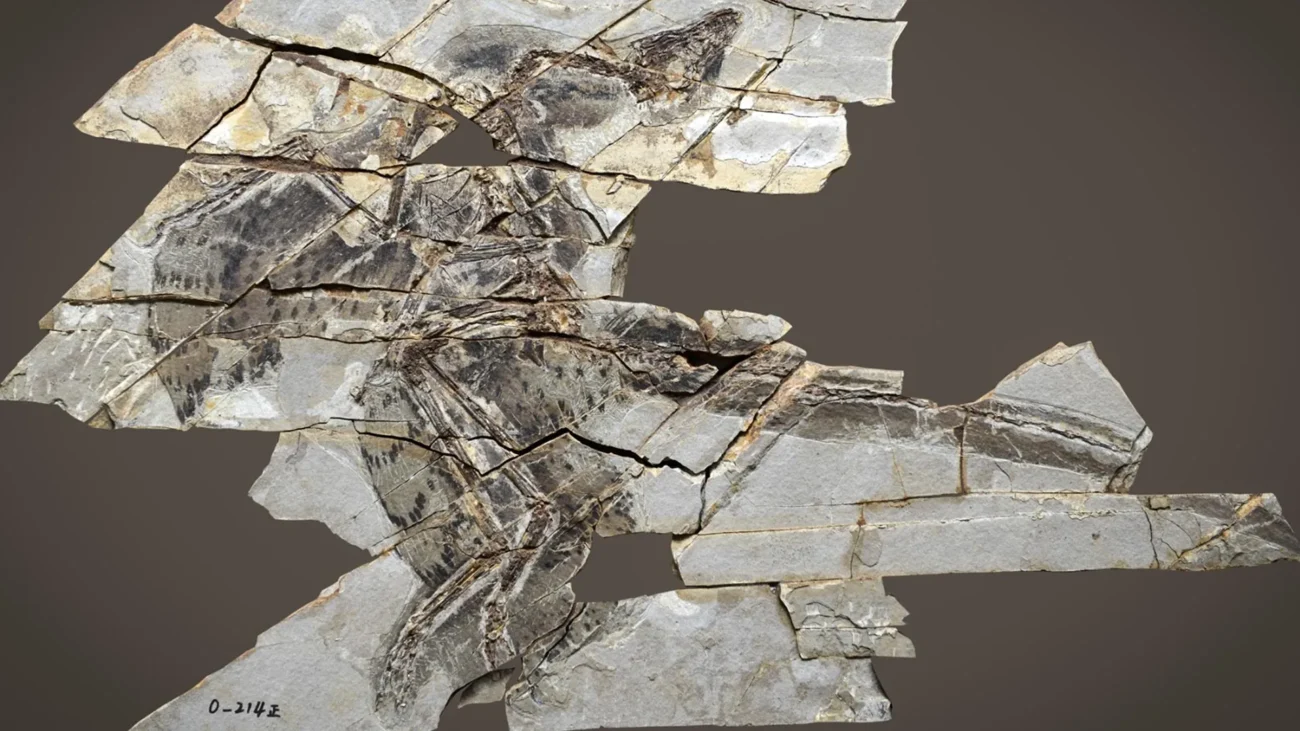
A groundbreaking study of exceptionally preserved dinosaur fossils has challenged long-held assumptions about the evolution of flight, suggesting that some feathered dinosaurs, despite possessing the plumage, had already relinquished the ability to fly. This revelation, stemming from meticulous analysis of fossilized molting patterns, offers a profound new perspective on the intricate and often circuitous path that led from terrestrial reptiles to the soaring birds of today.
The research, spearheaded by Dr. Yosef Kiat of Tel Aviv University’s School of Zoology and the Steinhardt Museum of Natural History, in collaboration with international colleagues from China and the United States, has been published in the esteemed journal Communications Biology by Nature Portfolio. The findings are based on an examination of nine remarkably intact fossils of Anchiornis, a small, feathered dinosaur that roamed the Earth approximately 160 million years ago during the Jurassic period. These specimens, unearthed in eastern China, are extraordinary not only for their preservation of feathers but also for retaining their original coloration, a rarity that has allowed scientists unprecedented insight into the functional capabilities of these ancient creatures.
The Enigma of Feathered Flightlessness
For decades, the discovery of feathered dinosaurs has been instrumental in bridging the evolutionary gap between non-avian dinosaurs and modern birds. The prevailing hypothesis has been that feathers, particularly those found on the wings, were primarily adaptations for flight. However, the Tel Aviv University-led study introduces a compelling counter-narrative. By analyzing the molting patterns of Anchiornis, the researchers have identified strong evidence that this particular species, despite its prominent wing feathers, was likely incapable of sustained flight.
"Feather molting seems like a small technical detail," explained Dr. Kiat in a statement accompanying the study’s release. "But when examined in fossils, it can change everything we thought about the origins of flight, highlighting how complex and diverse wing evolution truly was." This sentiment underscores the transformative potential of the research, suggesting that the development of flight was not a linear progression but rather a dynamic process involving both the acquisition and, in some cases, the loss of aerial capabilities.
A Glimpse into the Jurassic: The Anchiornis Case Study
The focus on Anchiornis is particularly significant. This genus, belonging to the Pennaraptora group of feathered dinosaurs, lived during a pivotal period in evolutionary history. The Pennaraptora, which emerged around 175 million years ago, are considered close relatives of modern birds and represent the sole dinosaur lineage to survive the cataclysmic mass extinction event at the end of the Mesozoic Era, 66 million years ago. Scientists have long believed that the Pennaraptora were among the earliest groups to develop feathers for flight.
The Anchiornis fossils from eastern China are of exceptional quality, attributed to unique geological and environmental conditions that facilitated their preservation. These conditions not only preserved the delicate feather structures but also their pigmentation, allowing for detailed analysis of their color patterns. The nine specimens examined each displayed wing feathers characterized by a striking white base with a distinct black spot at the tip. This preserved coloration provided a crucial visual cue for the researchers.
Deciphering Molting: The Key to Understanding Flight
The core of the study lies in understanding the process of feather molting. Feathers, being protein-based structures, grow over a period of two to three weeks, drawing nourishment from a blood supply. Once fully developed, they detach from this blood supply and become nonliving material. Over time, these feathers become worn and are eventually shed and replaced by new ones—a process known as molting.
Dr. Kiat elaborated on the significance of this biological cycle: "Birds that depend on flight, and thus on the feathers enabling them to fly, molt in an orderly, gradual process that maintains symmetry between the wings and allows them to keep flying during molting." This continuous, symmetrical shedding ensures that an animal can maintain aerodynamic stability even while replacing a significant portion of its flight feathers.
In stark contrast, flightless birds exhibit a more erratic and irregular molting pattern. "In birds without flight ability, on the other hand, molting is more random and irregular," Dr. Kiat explained. "Consequently, the molting pattern tells us whether a certain winged creature was capable of flight."
The Evidence: Irregular Molting in Anchiornis
The researchers meticulously examined the preserved feathers of the Anchiornis fossils. They observed a continuous line of black spots along the edges of the wing feathers, indicative of their color pattern. More importantly, they identified developing feathers alongside older ones. The alignment of the black spots on these new, growing feathers was often out of sync with their mature counterparts, a clear indication that they were in various stages of development.
This observation led to a detailed analysis of the molting sequence. The researchers found that the pattern of feather replacement in Anchiornis was not the orderly, symmetrical process seen in modern flying birds. Instead, it was irregular and asynchronous. This irregular molting pattern strongly suggests that Anchiornis did not rely on its wing feathers for flight.
"Based on my familiarity with modern birds, I identified a molting pattern indicating that these dinosaurs were probably flightless," Dr. Kiat concluded. "This is a rare and especially exciting finding: the preserved coloration of the feathers gave us a unique opportunity to identify a functional trait of these ancient creatures—not only the body structure preserved in fossils of skeletons and bones."
Broader Implications for Evolutionary Biology
The finding that Anchiornis was likely flightless, despite possessing well-developed wing feathers, carries significant implications for our understanding of avian evolution. It suggests that the evolution of feathers and the evolution of flight were not necessarily intertwined in a direct, linear fashion. Feathers may have initially evolved for other purposes, such as insulation or display, before being co-opted for flight in some lineages. Conversely, some lineages may have developed flight capabilities and then, due to environmental pressures or changes in lifestyle, subsequently lost them, much like the modern-day ostriches, emus, and penguins.
This research adds Anchiornis to a growing list of feathered dinosaurs that were not capable of flight, reinforcing the notion that the development of flight throughout the evolution of dinosaurs and birds was far more complex and diverse than previously believed. It challenges the idea that the presence of wings automatically equates to the ability to fly.
The study’s lead author highlighted the broader significance: "This finding has broad significance, as it suggests that the development of flight throughout the evolution of dinosaurs and birds was far more complex than previously believed. In fact, certain species may have developed basic flight abilities—and then lost them later in their evolution."
Historical Context: The Rise of Feathered Dinosaurs
The journey from reptiles to birds is a story that has unfolded over millions of years. Dinosaurs, a diverse group of reptiles, first appeared on Earth approximately 230 million years ago during the Triassic period. The split between the lineage that would lead to birds and other reptiles occurred even earlier, around 240 million years ago.
Feathers, the defining characteristic of birds, began to emerge on non-avian dinosaurs much later. Evidence suggests that primitive, filament-like feathers, likely used for insulation or display, appeared as early as the Late Jurassic period. By the Cretaceous period, many dinosaur groups, including theropods—the group that includes Tyrannosaurus rex and the ancestors of birds—possessed a wide array of feather types.
The Pennaraptora, to which Anchiornis belongs, emerged around 175 million years ago. This group is characterized by a suite of features, including long forelimbs and feathers, that point towards an increasing proximity to birds. Fossils from the Jehol Biota in China, where the Anchiornis specimens were found, have provided an extraordinary window into this period, yielding a wealth of feathered dinosaur fossils that have revolutionized paleontology.
The Unfolding Narrative of Wing Evolution
The complexity of wing evolution is further underscored by the varied forms and functions of feathers observed across different dinosaur groups. While some theropods clearly evolved feathers for flight, others, like the enigmatic oviraptorosaurs and dromaeosaurs (which include Velociraptor), developed elaborate feather structures that may have served purposes beyond aerial locomotion, such as thermoregulation, display, or even assisting in terrestrial locomotion by providing lift for leaping or short glides.
The findings regarding Anchiornis suggest a nuanced evolutionary trajectory where the acquisition of flight-enabling features did not always result in the ultimate development of flight. It implies that evolutionary pathways are not always directed towards a single, optimal outcome but can involve experimentation, adaptation, and even regression.
Future Directions and Expert Perspectives
The study by Dr. Kiat and his colleagues opens up new avenues for research. Future investigations could focus on other feathered dinosaur fossils, particularly those with preserved coloration, to determine if similar patterns of flightlessness are present in other lineages. Comparative analyses of feather structure, bone fusion patterns, and muscle attachment sites in these fossils could provide further clues about the biomechanics and capabilities of these ancient animals.
While the study provides compelling evidence, the scientific community often engages in robust debate. However, the methodology employed—analyzing molting patterns based on preserved feather coloration and growth—is a novel and powerful approach. Dr. Kiat’s expertise as an ornithologist with a focus on feathers lends significant weight to his interpretations.
The implications of this research extend beyond the study of dinosaurs. It enriches our understanding of evolutionary processes in general, demonstrating that adaptation is not always a straightforward march towards greater complexity or efficiency. The ability to retrace evolutionary steps, or to abandon a particular evolutionary advantage, is a testament to the adaptive plasticity of life.
In conclusion, the discovery that Anchiornis, a feathered dinosaur from the Jurassic period, likely lost the ability to fly, is a significant contribution to our understanding of evolutionary biology. It underscores the complexity and diversity of wing evolution and highlights that the story of flight is far from a simple narrative of ascent, but rather a rich tapestry woven with innovation, adaptation, and sometimes, the relinquishing of abilities. This research serves as a potent reminder that the fossil record, even after decades of study, continues to hold profound secrets that can reshape our understanding of life’s ancient past.

