


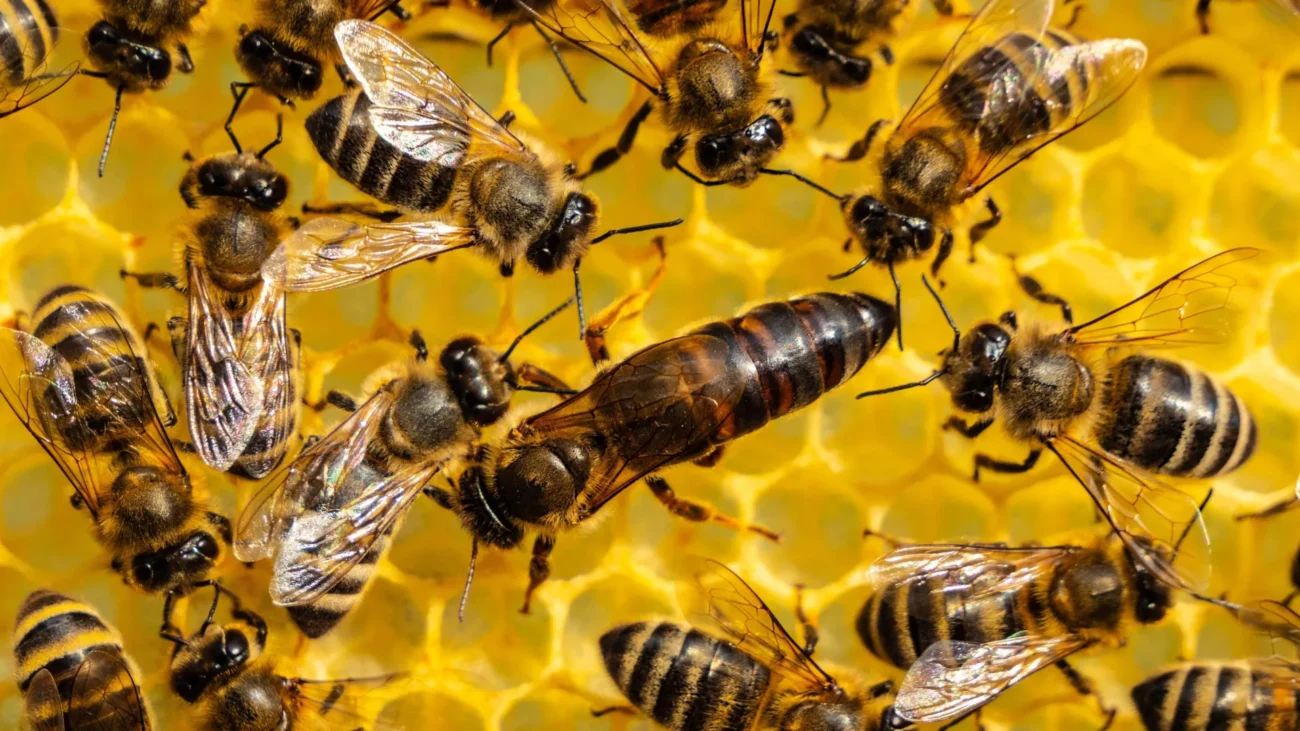
The delicate architecture of a honeybee colony has long been studied as a marvel of collective defense, where thousands of worker bees act as an intricate biological shield against environmental hazards. Traditionally, scientists understood that worker bees served as the primary line of defense, filtering out harmful substances, processing food, and protecting the inner sanctuary of the hive from chemical contamination. However, groundbreaking research published in the journal Current Biology has revealed that the colony’s monarch possesses a secretive and hazardous survival mechanism of her own. When exposed to persistent chemical pollutants over time, honeybee queens engage in a process known as "maternal offloading," actively transferring accumulated pesticides directly into their eggs to preserve their own survival.
This discovery, spearheaded by a multi-institutional team led by the University of California, Davis, in collaboration with the Lawrence Livermore National Laboratory (LLNL) and the U.S. Department of Agriculture’s Agricultural Research Service (USDA-ARS), shatters long-held assumptions about toxicology within honeybee societies. While the worker bees do an admirable job of filtering toxins during initial exposures, their capacity is finite. When the chemical burden overwhelms the workforce, the queen absorbs the excess toxins and redirects them into the very next generation of the hive, creating a ticking time bomb for agricultural ecosystems and the future of global pollination.
The Mechanics of Maternal Offloading
At the heart of this newly documented phenomenon is a grim physiological compromise. Honeybee queens are the biological engine of the hive, capable of laying between 1,500 and 2,000 eggs every day. They are the sole reproducers responsible for generating the workforce that maintains the hive, gathers nectar, and pollinates crops. Because they are so vital to colony continuity, their survival is prioritized by the collective. Yet, as environmental toxins continuously permeate agricultural landscapes, the defense systems erected by worker bees inevitably degrade.
When pesticides infiltrate the hive through contaminated pollen, nectar, and water, worker bees attempt to neutralize the threat. They process the food, sealing off heavily contaminated stores in the honeycomb and diluting toxins before feeding the queen and developing larvae. However, this filtration system has strict physiological limits.
According to Angela Encerrado-Manriquez, the study’s lead author and a recent Ph.D. graduate from UC Davis, the filtration capacity of worker bees is frequently overwhelmed in environments with sustained chemical exposure. "In our study, pesticides began to accumulate in queens over time, suggesting that worker filtration capacity can be overwhelmed," Encerrado-Manriquez noted. "When this happens, queens have their own defense. Maternal offloading allows them to shunt the toxic burden to their eggs."
By packaging these chemical residues into the yolks of their eggs, queens effectively lower their internal toxic load, protecting their own neural and biological functions from acute poisoning. But this self-preservation comes at a devastating cost to their offspring. The developing embryos are suddenly subjected to chemical loads that can impair their growth, disrupt neurological development, or result in outright mortality before they ever hatch, casting a long shadow over the future viability of the colony.
Experimental Design and the "Nanocolony" Breakthrough
To uncover a process as subtle and complex as maternal offloading, researchers had to design an experimental environment that closely mirrored the micro-society of a real beehive without exposing actual agricultural apiaries to uncontrolled risks. The research team constructed specialized experimental setups referred to as "nanocolonies."
Each nanocolony consisted of a compact, conical plastic container featuring a netted bottom for ventilation, housing a single queen bee alongside a cohort of 60 worker bees. This controlled environment allowed scientists to monitor minute changes in behavior, feeding patterns, and chemical distribution over an extended timeline.
The bees within these nanocolonies were sustained on a controlled diet of pollen, water, and food deliberately contaminated with methyl parathion—an organophosphate insecticide commonly deployed in agricultural settings. To track the exact movement of the chemical through the complex biological network of the hive, the researchers utilized a cutting-edge tracing method: the pesticide was tagged with a low-level radioactive marker.
This integration of radioisotopes enabled the research team to map out precisely where the chemical traveled, how much of it was intercepted by worker bees, how much accumulated in the wax and the queen’s bodily tissues, and ultimately, how much was transferred into the eggs.
Chronology of Contamination: A Ten-Day Observation Window
The timeline of the study revealed a steady, alarming erosion of the hive’s collective defenses over a standard ten-day observation period.
On the very first day of exposure, the worker bees performed their duties with high efficiency. They successfully filtered out approximately 95% of the methyl parathion introduced into the nanocolonies, sequestering the harmful compounds into the honeycomb and preventing immediate contact with the queen. This initial success reinforced the historical scientific consensus that worker bees act as an effective biochemical barrier.
However, as the days progressed, the data painted a radically different picture. By the tenth day of continuous, low-level exposure, the filtration rate dropped significantly to 86%. That nine-percentage-point decline represented a critical failure of the workers’ filtration capacity. As the barrier weakened, the pesticide began to pool within the tissues of the queen, accumulating in her ovaries and threatening her systemic health.
Faced with this internal poisoning, the queen’s physiology initiated maternal offloading. The radioactive markers unmistakably showed the pesticide migrating from the queen’s body systems directly into the eggs she laid, confirming that the chemical burden was being successfully shifted to the next generation.
Advanced Technology: Unlocking Detection at the Atomic Scale
Tracing minute quantities of pesticides through a living biological system required analytical tools far beyond traditional toxicology laboratories. This is where the partnership with the Lawrence Livermore National Laboratory proved indispensable.
LLNL researchers utilized biological accelerator spectrometry (BioAMS), a high-sensitivity analytical technique capable of detecting radioactive isotopes at extraordinarily low concentrations. This technology allowed the research team to track the path of environmental toxins without needing to use lethal, high-dose applications of pesticides that would distort natural behavioral responses.
"With BioAMS, we can trace very low levels of a pesticide," explained Bruce Buchholz, an LLNL scientist and co-author of the study. "The pesticide concentrations we used were not lethal and were environmentally relevant to that seen in nature."
This precision is vital because honeybees in real-world agricultural environments are rarely subjected to catastrophic, single-source pesticide spills. Instead, they experience a persistent, low-dose accumulation of various chemicals—ranging from insecticides to fungicides and herbicides—as they forage across vast areas of farmland. BioAMS provided the resolution necessary to prove that even sublethal, background levels of chemical exposure are sufficient to trigger maternal offloading and imperil the reproductive output of the hive.
Implications for Agriculture, Beekeepers, and Colony Collapse
The implications of these findings extend far beyond academic toxicology, raising urgent questions for commercial beekeepers, agricultural growers, and policymakers shaping integrated pest management (IPM) strategies.
Honeybees are foundational to modern agriculture, responsible for pollinating roughly one-third of the human diet. Crops ranging from almonds and apples to blueberries and cucumbers rely entirely on the tireless labor of foraging bees. When honeybee colonies suffer from chronic stressors, agricultural productivity and global food security face immediate risks.
Sascha Nicklisch, senior author of the study and associate professor of environmental toxicology at UC Davis, highlighted the cumulative danger of this chemical buildup. "When pesticides accumulate to the extent that the queen bee has eggs that are so loaded they may no longer develop properly, there could be a tipping point," Nicklisch warned. "There may be a slow creeping effect of chemical accumulation that will contribute to delayed colony collapse."
Colony Collapse Disorder (CCD) has baffled scientists and agricultural experts for decades, characterized by the sudden disappearance of worker bees from a hive. While multiple factors—including habitat loss, varroa mites, pathogens, and poor nutrition—are known contributors, the new findings suggest that chronic chemical offloading could be a hidden driver behind declining reproductive rates and internal colony destabilization. If queens are continuously poisoning their own eggs to stay alive, the hive’s ability to replace aging and dying workers becomes severely compromised, leading to a slow, imperceptible decline that ends in total colony failure.
Future Directions and Unanswered Questions
Despite the groundbreaking nature of the study, researchers emphasize that this is only the first step in understanding a complex biological defense mechanism. Several critical questions remain unanswered, serving as primary targets for future scientific inquiry.
First, scientists do not yet know the exact threshold at which maternal offloading ceases to be a viable survival strategy for the queen. While offloading saves the adult queen in the short term, the long-term physiological toll on her reproductive tract and lifespan remains unquantified.
Second, the research team aims to investigate whether different classes of pesticides—such as neonicotinoids, pyrethroids, and systemic fungicides—trigger identical offloading responses, or if certain chemicals are retained more stubbornly in maternal tissues.
Finally, researchers must evaluate what happens to the larvae that hatch from offloaded eggs. Do they perish immediately, or do they survive into adulthood carrying neurological deficits that impair their foraging capabilities and navigation skills?
The collaborative research effort—which also featured contributions from USDA-ARS scientists Julia Fine and Eliza Litsey, alongside LLNL researchers David Baliu-Rodriguez and Sean Leonard—underscores the complexity of protecting pollinator health in an increasingly industrialized agricultural landscape.
The study received critical financial backing from the USDA’s National Institute of Food and Agriculture, the Non-Assistance Cooperative Agreement program, the PAm-Costco USA Scholarship program, and the University of California National Laboratory Fees Research Program, with work at LLNL performed under the auspices of the U.S. Department of Energy.
As regulatory agencies and agricultural planners review current pest management guidelines, these findings offer a sobering reminder of nature’s limits. Even the most sophisticated biological adaptations, developed over millions of years of evolution, can be pushed to the brink by modern chemistry. Protecting the future of agriculture will require a deeper appreciation of the unseen chemical burdens carried not just by the worker bees in the field, but by the queens holding the entire colony together from within.

