


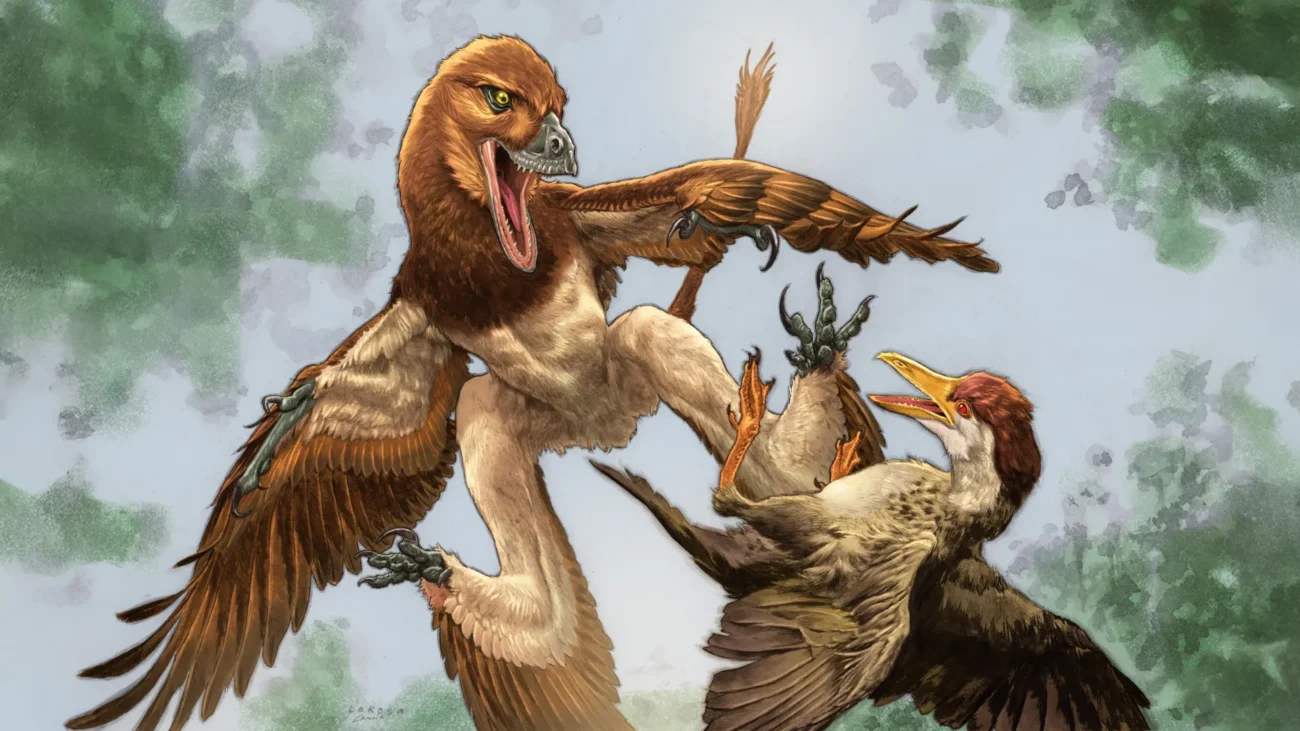
A groundbreaking discovery at a remarkable fossil site in northwestern China is poised to solve a long-standing paleontological puzzle. For years, researchers have been unearthing hundreds of prehistoric bird remains, often found in peculiar clusters of shattered bones compressed into pellet-like masses. These formations bear a striking resemblance to the regurgitated pellets produced by modern owls, leading paleontologists to hypothesize the existence of a larger, non-avian predator that preyed upon these ancient birds. However, direct evidence of such a hunter had remained elusive until now. The recent description of a previously unknown dinosaur species, unearthed from the very same fossil bed, offers a compelling candidate for this ancient avian predator.
A New Dinosaur Unearthed: The Predatory Enigma of Jianchangmaensis
Published in the esteemed Annals of Carnegie Museum, a comprehensive study details the discovery and analysis of Jianchangmaensis, a newly identified dinosaur species that roamed the Earth during the Mesozoic Era. This fascinating creature was a feathered relative of the iconic Velociraptor, distinguished by the presence of long, prominent feathers adorning both its forelimbs and hind limbs. Crucially, distinctive features of its arm and shoulder bones have led scientists to believe that Jianchangmaensis possessed the predatory capabilities and physical attributes necessary to have been responsible for the mysterious accumulations of bird bones found at the Changma fossil site.
Dr. Jingmai O’Connor, Associate Curator of Fossil Reptiles at the Field Museum in Chicago and the senior author of the paper formally describing this new species, articulated the significance of the find. "Scientists have been finding these peculiar, fragmented clusters of bird bones at this site for a considerable time, and the origin of these formations remained a mystery," Dr. O’Connor stated. "This newly identified microraptor dinosaur, Jianchangmaensis, represents our most plausible explanation for these enigmatic deposits. It is the only non-avian dinosaur discovered at this particular site, it was a carnivore, and it was significantly larger than any of the bird species we have previously recovered from here."
The Evolutionary Landscape: Birds and Their Dinosaur Cousins
The modern-day birds, the sole surviving lineage of dinosaurs, have demonstrated remarkable resilience, having weathered the catastrophic asteroid impact that reshaped Earth’s biosphere approximately 66 million years ago. However, long before this cataclysmic event, birds coexisted with a diverse array of dinosaur groups throughout the Jurassic and Cretaceous periods. Among the most closely related to avian dinosaurs were the dromaeosaurs, a family of feathered theropod dinosaurs renowned for their agility and predatory prowess. Velociraptor, a name widely recognized due to its prominent role in popular culture, is a well-known member of this group, though scientific consensus now indicates that these creatures were likely smaller and more heavily feathered than often depicted in fictional portrayals.
Jianchangmaensis belongs to a specialized subgroup within the dromaeosaurs known as microraptors. While many microraptor species were diminutive, with some reaching no larger than a crow, Jianchangmaensis stands out for its considerable size. "Jian is one of the largest microraptor specimens ever discovered," explained Dr. O’Connor. "The fragment of its upper arm bone that we have recovered measures approximately four inches in length. This suggests that the entire dinosaur likely possessed a wingspan of around four feet, placing it in a size category comparable to that of a barn owl."
A Four-Winged Glider: Unraveling Jianchangmaensis’s Locomotion
Although the fossil record for Jianchangmaensis is currently incomplete, with only portions of its anatomy recovered, scientists are confident in inferring key characteristics based on its phylogenetic relationships. It is highly probable that Jianchangmaensis shared a defining feature with other microraptors: extensive feathering on both its arms and legs. This unique arrangement of feathers would have created the distinct appearance of four wings, a remarkable adaptation for locomotion.
However, the prevailing scientific understanding suggests that these feathered dinosaurs were not capable of powered flight in the same manner as modern birds. Instead, their anatomical structures indicate adaptations for gliding. "Jian and the other microraptors were likely not capable of true, powered flight," Dr. O’Connor elaborated. "Rather, they probably engaged in gliding, much like a flying squirrel, using their extensive feather coverage to control their descent through the air." This gliding capability would have provided a significant advantage in navigating their forested environments, allowing them to ambush prey or escape danger with swift, aerial maneuvers.
Naming and Location: A Reflection of Myth and Geography
The scientific name bestowed upon this newly discovered dinosaur, Jianchangmaensis, is a deliberate reflection of both its unique morphology and the geographical context of its discovery. In ancient Chinese mythology, "Jian" refers to a winged creature, evoking the dinosaur’s prominent feathering and presumed gliding abilities. The specific epithet, changmaensis, pays homage to the Changma Basin in China’s Gansu province, the region where the fossil specimen was unearthed by diligent paleontological teams. This nomenclature serves as a lasting testament to the cultural and geographical origins of this significant find.
Illuminating Ancient Ecosystems: The Ecological Significance of Jianchangmaensis
The discovery of Jianchangmaensis is not merely the addition of another dinosaur species to the fossil record; it profoundly enriches our understanding of the ancient ecosystem represented by the Changma fossil site. This area is already renowned for its exceptionally rich fossil bird assemblages, but the presence of Jianchangmaensis introduces a crucial missing piece to the ecological puzzle.
Dr. Matt Lamanna, corresponding author of the study and the Mary R. Dawson Curator of Vertebrate Paleontology and senior dinosaur researcher at the Carnegie Museum of Natural History, emphasized this point. "Jianchangmaensis reveals that non-avian dinosaurs coexisted in what is now the Changma Basin, an area already celebrated for its abundant fossil birds," Dr. Lamanna stated. "Our team has recovered over a hundred bird fossils from Changma, yet until this discovery, we had only found a single specimen of a non-avian dinosaur. Jian provides critical new insights into the biological history of the Changma region and the ecological context in which the ancestors of today’s birds lived."
The presence of a substantial, non-avian predator like Jianchangmaensis at the Changma site helps explain the observed patterns of bird bone fragmentation and accumulation. It suggests a dynamic predator-prey relationship where this feathered dinosaur was a significant threat to the smaller, evolving avian populations. This finding offers tangible evidence to support long-held hypotheses about the predatory pressures faced by early birds.
Broader Implications: Understanding Avian Evolution and Resilience
Beyond its immediate significance for the Changma fossil site, the discovery of Jianchangmaensis contributes valuable data to the broader scientific endeavor of understanding avian evolution. By examining the ecological interactions between early birds and their close non-bird dinosaur relatives, scientists can gain a more nuanced appreciation of the evolutionary pathways that led to the remarkable success of birds.
"You cannot truly understand life on our planet today without examining its origins," Dr. O’Connor remarked. "Birds are arguably the most successful group of terrestrial vertebrate animals on Earth today. Learning about early birds and their close non-bird dinosaur relatives provides us with a deeper comprehension of the factors that made the lineage of birds that survived the extinction event so exceptionally resilient and specialized."
The research team’s collaborative efforts, involving paleontologists from institutions such as the Gansu Geological Museum, the Carnegie Museum of Natural History, the University of Nebraska State Museum, the University of California Museum of Paleontology, Gansu Agricultural University, and the Institute of Vertebrate Paleontology and Paleoanthropology of the Chinese Academy of Sciences, underscore the international and interdisciplinary nature of modern paleontological research. The detailed anatomical analysis of Jianchangmaensis, combined with its stratigraphic context, offers a compelling narrative of predator and prey in a vibrant Mesozoic landscape, shedding light on the evolutionary crucible from which modern birds ultimately emerged.
A Glimpse into the Mesozoic Food Web
The Changma fossil site, dating back to the Early Cretaceous period (approximately 125 to 100 million years ago), has long been a treasure trove of information about the diversity of early avian life. The abundance of fossilized birds, including species with primitive feather structures and early indications of flight capabilities, has made it a focal point for research into bird origins. The discovery of Jianchangmaensis provides a crucial counterpoint to this avian-centric view, illustrating that the ecosystem was far from solely populated by birds.
The identification of Jianchangmaensis as a dromaeosaur, a group known for its predatory adaptations, places it squarely within the hypothesized apex predator role at the Changma site. Its size, estimated at roughly four feet in wingspan, would have made it a formidable hunter capable of tackling small to medium-sized dinosaurs, including the numerous bird species present. The "pellet-like masses" of shattered bird bones, a phenomenon previously attributed to hypothetical owl-like predators, now have a concrete, dinosaurian explanation. This finding reinforces the concept of convergent evolution, where different lineages can develop similar ecological roles and feeding strategies.
Chronological Context: Piecing Together the Past
The geological strata at the Changma fossil site firmly place Jianchangmaensis within the Early Cretaceous period. This era was a time of significant diversification for both dinosaurs and early birds. The Earth’s continents were in different configurations, and climates were generally warmer than today. The presence of a gliding dromaeosaur like Jianchangmaensis alongside a rich diversity of avian fauna paints a vivid picture of a complex and dynamic food web.
The period preceding the K-Pg extinction event (the asteroid impact) saw a gradual shift in dominance, with avian dinosaurs (birds) becoming increasingly diverse and specialized. However, non-avian dinosaurs, including dromaeosaurs, continued to occupy important ecological niches. The Changma site, with its unique preservation of both predator and prey, offers a rare snapshot of these intricate relationships just as the evolutionary trajectory of birds was becoming more defined.
Supporting Data: Feather Structure and Predatory Adaptations
While the fossil of Jianchangmaensis is not complete, the existing skeletal remains provide crucial data points. The length of the humerus (upper arm bone) and the structure of the shoulder girdle are indicative of adaptations for limb movement and potential aerial locomotion. The inference of long feathers on both forelimbs and hind limbs is based on comparisons with other well-preserved microraptor specimens, such as Microraptor zhaoianus, which clearly exhibit asymmetrical flight feathers on all four limbs.
The analysis of the bird bone clusters themselves provides further supporting data. The fragmentation and compaction of these bones are consistent with being ingested and then regurgitated by a predator. Modern owls, which consume small prey whole and then expel indigestible materials like bones and fur as pellets, serve as a direct analog. The absence of large, crushing bite marks on the bird bones also suggests a predator that consumed its prey more whole rather than tearing it apart with powerful jaws.
Broader Impact: Unraveling the Secrets of Avian Survival
The discovery of Jianchangmaensis has profound implications for our understanding of avian evolution and the factors that contributed to the survival of birds after the mass extinction event. It underscores that the evolutionary success of birds was not solely due to intrinsic adaptations but also influenced by the ecological pressures and opportunities present in their ancient environments. The existence of efficient, non-avian predators like Jianchangmaensis would have likely favored the development of traits such as enhanced agility, escape behaviors, and potentially, the refinement of flight for survival.
By providing a tangible predator for the mysterious bird bone accumulations, this research offers a more complete ecological narrative for the Early Cretaceous. It highlights that the dinosaur-bird evolutionary story is not just about the rise of avian flight but also about the complex interplay between different dinosaurian lineages and the constant struggle for survival that shaped life on Earth. The ongoing study of sites like Changma, with discoveries like Jianchangmaensis, continues to refine our understanding of Earth’s deep past and the remarkable journey of life.

