


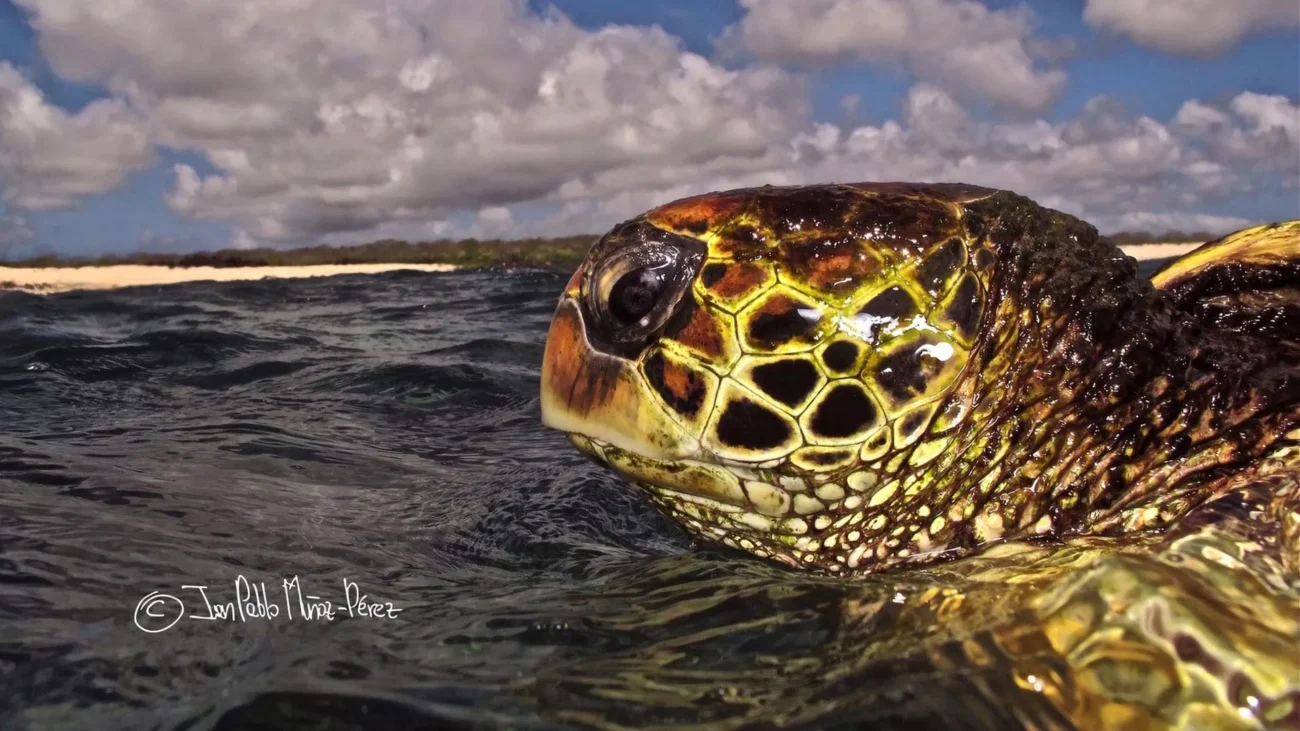
Sea turtles have long captivated marine biologists, conservationists, and nature enthusiasts alike with their epic, transoceanic migrations. Driven by an innate GPS system that integrates celestial cues, ocean currents, and the Earth’s geomagnetic field, these marine reptiles routinely cross thousands of miles of open ocean. They navigate vast aquatic highways to reach optimal feeding grounds, only to return years later to the exact sandy beaches where they hatched to lay their own eggs. This well-documented migratory lifestyle underpins much of modern marine biology and conservation planning. However, a recent scientific investigation in the remote and ecologically unique Galápagos Islands has challenged these long-held paradigms, uncovering a distinct population of green sea turtles that prefers staying close to home over undertaking massive oceanic voyages.
Published in the journal Frontiers in Amphibian and Reptile Science, a comprehensive new study reveals that "yellow-morph" green sea turtles—one of two genetically distinct forms of the species inhabiting the Galápagos archipelago—exhibit surprisingly sedentary behavior. Contrary to expectations that these creatures would eventually roam across vast stretches of the Pacific Ocean, researchers discovered that tracked individuals spent the entirety of a multi-year observation period confined within the boundaries of the Galápagos Marine Reserve. This unexpected residency sheds new light on the complex ecological dynamics of the region, providing vital data for regional conservation strategies and prompting marine scientists to reevaluate the behavioral flexibility of migratory species.
Unraveling the Identity of the Galápagos Green Sea Turtles
To understand the significance of this discovery, it is essential to examine the unique taxonomy and biology of green sea turtles (Chelonia mydas). Among the seven extant species of sea turtles, the green sea turtle stands apart due to its distinct dietary shift. While hatchlings and juveniles are omnivorous, consuming a mix of animal and plant matter to fuel their rapid early growth, mature adults transition to a strict herbivorous diet. As they age, their primary food sources become coastal marine vegetation, specifically seagrasses and benthic algae.
Within the species, scientists recognize distinct regional morphs and genetic lineages. In the eastern Pacific, researchers frequently encounter the "black-morph" green sea turtle, which typically ranges from southern California down the western coast of the Americas. Conversely, the "yellow-morph" green sea turtle is predominantly found across the tropical and subtropical expanses of the western Pacific.
The Galápagos Islands represent a rare and fascinating ecological crossroads where these two distinct forms converge. It is the only known location on Earth where yellow and black morphs share the exact same marine waters, mingling in shallow coastal zones and grazing on identical species of marine vegetation. Despite sharing habitat and diet, however, the two morphs are not identical. Researchers have observed that young yellow morphs typically outgrow their black-morph counterparts, hinting at underlying physiological, metabolic, or genetic differences that marine biologists are only beginning to understand.
Chronology of the Galápagos Tracking Initiative
The recent study originated from a collaborative effort led by Dr. John W. Rowe, a professor at Alma College in the United States and the corresponding author of the research, alongside co-author Dr. Juan Pablo Muñoz Pérez, a professor at the Universidad San Francisco de Quito in Ecuador. The primary objective was to map the spatial ecology of the yellow-morph green sea turtles: determining how much territory they utilize, which specific habitats they favor, and whether they regularly commute between the scattered islands of the expansive 198,000-square-kilometer Galápagos Marine Reserve.
The fieldwork commenced in 2015. Researchers systematically and carefully captured nine adult yellow-morph green sea turtles in shallow coastal waters surrounding four distinct islands within the archipelago. The cohort comprised seven males and two females. In keeping with the tradition of field biology, the researchers assigned individual nicknames to the subjects to facilitate easy tracking and identification during data analysis.
Advanced technology played a central role in the methodology. The research team outfitted each of the nine turtles with sophisticated electronic satellite transmitters secured to their carapaces. These tracking devices were programmed to transmit precise geographic coordinates via the low-orbit Argos satellite network whenever the turtles surfaced to breathe.
The monitoring phase was extensive, with individual turtles tracked for durations lasting up to 418 days. The tracking periods typically concluded when a transmitter naturally detached from a turtle’s shell or exhausted its battery life and ceased signal transmission.
Spatial Preferences and Movement Patterns
The telemetry data yielded a clear portrait of coastal fidelity. Rather than launching into deep-water pelagic migrations, the yellow-morph turtles demonstrated a marked preference for shallow, nearshore habitats. While occasional excursions took individual animals up to 25 kilometers away from the nearest coastline, the vast majority of recorded locations clustered tightly around the islands.
The scope of their home ranges varied considerably among individuals, yet the data revealed distinct behavioral patterns. On average, each turtle maintained a home range spanning approximately 1,498 square kilometers. Within this broad average, however, the day-to-day movements varied wildly from one subject to another:
- Site-Specific Residents: Five of the nine tagged turtles spent the overwhelming majority of the study period anchored to the waters surrounding a single island.
- Inter-Island Commuters: Turtles named Bernardo and Sara regularly traversed the oceanic channels separating Isabela Island and San Cristóbal Island. Meanwhile, a turtle named Leandro moved back and forth between Isabela Island and Española Island.
- The Adventurer: The most mobile individual in the cohort was a turtle named Ainoa. Initially captured and tagged near San Cristóbal, Ainoa subsequently journeyed to the waters of Santa Cruz Island before finally establishing a presence around Isabela Island.
Furthermore, the researchers identified a distinct seasonal rhythm governing these movements. Travel between different islands within the archipelago was not random; instead, it occurred exclusively during the cooler months of the year, spanning from April through October. This seasonal shift likely correlates with shifting oceanographic conditions, water temperatures, and seasonal fluctuations in the abundance and distribution of preferred marine vegetation.
Official Insights and Ecological Inferences
The implications of these findings challenge longstanding assumptions about the obligatory nature of long-distance sea turtle migrations. Taken together, the satellite telemetry data provide robust evidence that yellow-morph green sea turtles inhabiting the Galápagos can exhibit remarkably homebound behaviors, at least during specific phases of their adult lives.
Nevertheless, the research team exercises caution when interpreting the data, emphasizing that these observations capture only a snapshot of the turtles’ multi-decade lifespans. It remains entirely possible that longer, transoceanic migrations occur during other life stages or under different biological pressures.
This possibility is particularly salient for female turtles. "Since female yellow-morph green sea turtles are not known to lay eggs on the beaches of the Galápagos, we believe that they will eventually leave the area to return to their natal beaches in the western Pacific," explained Dr. Muñoz Pérez. He contrasted this with the behavior of female black-morph green turtles, some of which do utilize Galápagos beaches for nesting. Depending on the individual, black-morph females may remain year-round residents of the archipelago, travel to nearby oceanic islands, or even undertake long journeys to distant feeding grounds off the coasts of Central and South America.
The behavioral dichotomy between the two morphs underscores the remarkable evolutionary plasticity within the species. It also highlights the intricate behavioral adaptations required for distinct genetic lineages to coexist within the same insular ecosystem.
Conservation Implications for the Galápagos Marine Reserve
Beyond academic curiosity, the study carries profound implications for conservation management and environmental policy within the Galápagos Marine Reserve. Historically, marine conservation initiatives often focus on protecting localized "hotspots"—such as a single nesting beach or a particularly rich coral reef. However, the telemetry data collected by Rowe, Muñoz Pérez, and their colleagues demonstrate that such localized strategies may be insufficient for protecting mobile marine life.
Because several of the tracked turtles routinely crossed open channels to forage across the waters of multiple islands, their survival is inextricably linked to the ecological health of an interconnected network of habitats, rather than any single isolated site. If the marine environment degrades in the open channels or secondary feeding grounds used during their seasonal movements, the entire population could face severe ecological bottlenecks.
Consequently, the researchers have issued clear recommendations for regional authorities. Preserving the integrity of the Galápagos Marine Reserve requires maintaining high habitat quality across all associated islands and transit corridors.
"Since individual turtles may rely on waters around multiple islands, the quality of habitat that is available for foraging should be maintained intact across all islands, and not allowed to degrade anywhere," Dr. Rowe emphasized.
As climate change, shifting ocean temperatures, and human pressures continue to threaten marine ecosystems worldwide, studies like this one provide the empirical foundation necessary for effective environmental stewardship. By understanding the nuanced, localized behaviors of species traditionally viewed as universal wanderers, conservationists can better tailor management frameworks to protect the delicate balance of life within one of the planet’s most treasured natural laboratories.

