


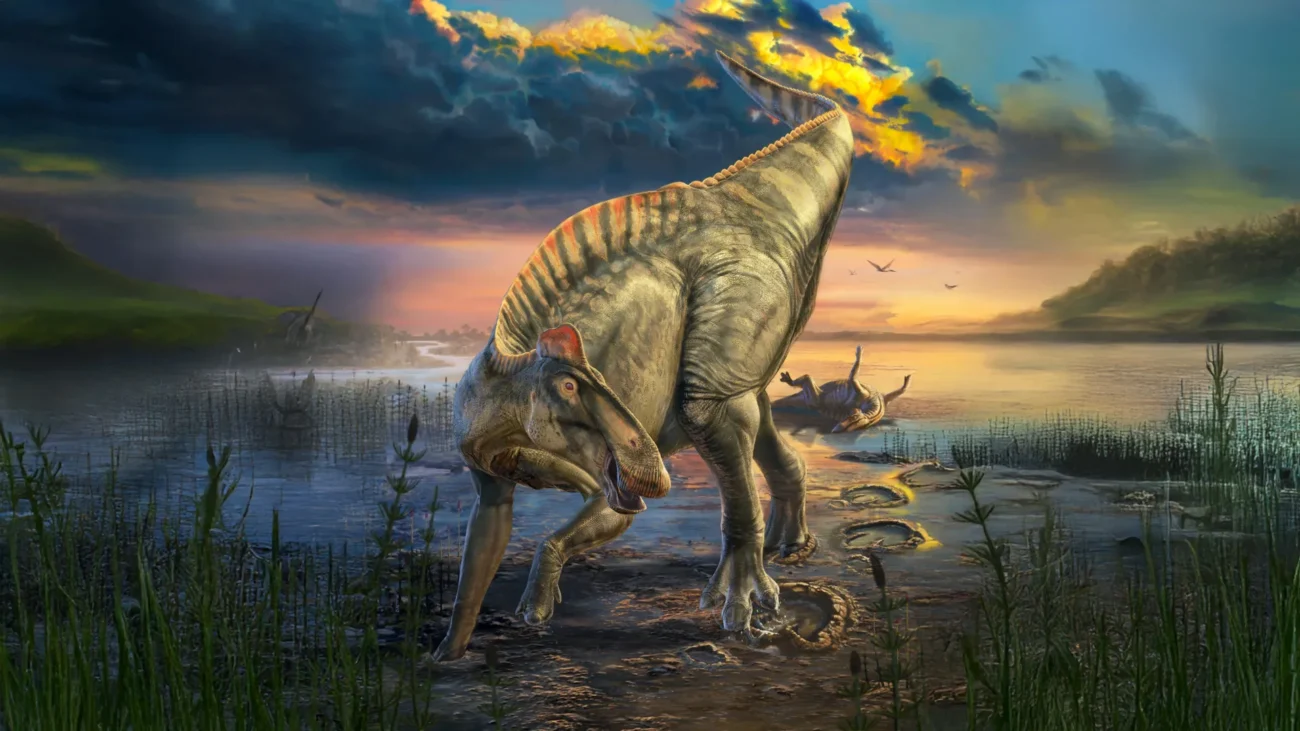
In a groundbreaking study published in the esteemed journal Science, researchers from the University of Chicago have unveiled a revolutionary understanding of dinosaur preservation, detailing how the remains of the duck-billed dinosaur, Edmontosaurus annectens, were transformed into astonishingly detailed "mummies" approximately 66 million years ago. This unique process, which the scientists have aptly named "clay templating," has provided an unprecedented glimpse into the life and appearance of these prehistoric giants, preserving delicate features of skin, scales, and even hooves with remarkable fidelity.
Unlocking the Secrets of "Clay Templating"
The process of clay templating, as described by the University of Chicago team, hinges on a delicate interplay of natural forces and biological decay. Following the death of an Edmontosaurus annectens, its soft tissues, rather than disintegrating entirely, were encapsulated by a remarkably thin layer of clay. This clay coating, less than a hundredth of an inch thick, settled over the skeleton after burial, acting as an intricate mold or "mask." Crucially, this clay film preserved the external morphology of the dinosaur with astonishing accuracy, capturing the fine textures of its skin, the arrangement of its scales, and the precise shape of its hooves.
Advanced imaging techniques, including hospital-grade and micro-CT scans, played a pivotal role in deciphering the secrets held within these ancient fossils. By combining these high-resolution scans with thin-section analysis, X-ray spectroscopy, and detailed clay mineralogical studies, the researchers were able to reconstruct a vivid, three-dimensional image of what the Edmontosaurus annectens would have looked like in life.
A Fleshed-Out Vision of a Prehistoric Giant
The reconstructions derived from this meticulous research have painted a picture of the Edmontosaurus annectens that is far more detailed than anything previously documented. The digital models reveal a striking crest running along the length of its neck and torso, a distinctive row of spikes adorning its tail, and unique hooves that encased its toes. When these findings are integrated with the fossilized footprint evidence from the same geological period, the overall appearance and locomotion of this duck-billed dinosaur, long a subject of speculation but never before visualized with such precision, become remarkably clear.
"It’s the first time we’ve had a complete, fleshed-out view of a large dinosaur that we can really feel confident about," stated Dr. Paul Sereno, the senior author of the study and a Professor of Organismal Biology and Anatomy at the University of Chicago. Dr. Sereno highlighted the significance of the geological formations in Wyoming where these specimens were discovered, describing them as a unique "mummy zone" that continues to yield surprising fossils.
Rediscovering Wyoming’s Ancient "Mummy Zone"
The journey to understand these mummies began with a meticulous process of historical retracing and geological detective work. Dr. Sereno and his team, armed with old field photographs and detailed geological maps, revisited the badlands of east-central Wyoming. This region had been the site of the initial discovery of several classic dinosaur mummies in the early 20th century. Their efforts successfully pinpointed a concentrated area, a "mummy zone," within the sedimentary layers representing ancient river sands, where these exceptional fossils were found.
Within this rediscovered zone, the research team unearthed two new Edmontosaurus mummies: one representing a younger individual and the other a somewhat older specimen. Both of these specimens exhibited extensive and continuous patches of preserved external skin surface, providing the critical pieces of evidence necessary to construct a comprehensive profile of the animal’s soft anatomy.
Dr. Sereno emphasized a crucial distinction between these dinosaur mummies and those created by humans, such as those found in Egyptian tombs. He clarified that the preserved skin, spikes, and hooves in these specimens are not original organic material. Instead, they consist of an extraordinarily thin clay coating that formed on the exterior of the carcass shortly after burial. "This is a mask, a template, a clay layer so thin you could blow it away," Dr. Sereno explained. "It was attracted to the outside of the carcass in a fluke event of preservation."
The Mechanics of Ultra-Thin Clay Films
The formation of these extraordinary fossils is attributed to a specific sequence of geological and biological events. The researchers propose that after death, the Edmontosaurus carcasses would have initially dried in the sun before being rapidly buried by sudden flash floods. A microbial film present on the outer surface of the carcass then played a key role. Through electrostatic forces, this film attracted clay particles from the surrounding wet sediment. This attraction resulted in the formation of a wafer-thin clay template that precisely replicated the three-dimensional shape of the animal’s exterior. Over vast geological timescales, the original soft tissues would have decayed, leaving behind the fossilized clay film and the underlying skeleton.
Meticulous Preparation and Digital Reconstruction
The fragility of these paper-thin clay layers demanded an exceptionally careful and painstaking approach to their excavation and study. Tyler Keillor, the Fossil Lab manager and a co-author of the study, led the extensive preparation work, dedicating countless hours to uncovering the crucial fossil surfaces without causing any damage.
Concurrently, a separate team, spearheaded by postdoctoral scholar Evan Saitta, employed a suite of advanced techniques. They utilized 3D surface imaging and CT scans, meticulously comparing the preserved soft anatomy with fossilized footprints discovered in the same geological context. By carefully aligning the dinosaur’s skeletal structure and soft-tissue impressions with the fossilized footprints, they were able to definitively match the mummified feet to a specific track. This integrated approach allowed digital artists to collaborate with the scientists, generating lifelike reconstructions that vividly illustrate the Edmontosaurus as it moved through its ancient environment, likely near the twilight of the dinosaur age.
"I believe it’s worth taking the time to assemble a dream team in order to generate science that can be appreciated by the general public," Dr. Sereno commented. "We’ve never been able to look at the appearance of a large prehistoric reptile like this—and just in time for Halloween."
A Detailed Portrait: Crests, Spikes, Scales, and Thin Skin
Working with the two newly described mummies proved to be a synergistic endeavor, as the specimens beautifully complemented each other. This allowed the researchers to assemble a complete and remarkably detailed outline of the Edmontosaurus annectens. "The two specimens complemented each other beautifully," Dr. Sereno remarked. "For the first time, we could see the whole profile rather than scattered patches."
The comprehensive analysis revealed a continuous feature running along the dorsal midline of the animal. This structure began as a fleshy crest adorning the neck and torso, transitioning into a single row of distinct spikes that ran along the tail. Each spike was precisely aligned with a vertebra, fitting snugly against its neighbors.
Furthermore, the study provided unprecedented insights into the dinosaur’s scale patterns. The largest polygonal scales were observed on the lower body and tail. However, the majority of the animal’s body was covered in remarkably small, pebble-like scales, measuring only 1 to 4 millimeters across. These tiny scales are surprisingly delicate for a dinosaur that could reach lengths exceeding 40 feet. Evidence of fine wrinkles preserved across the ribcage suggests that the skin of this duck-billed dinosaur was relatively thin.
The Discovery of "Hooves" and Heel Pads
Perhaps the most astonishing discovery emerged from the examination of the larger mummy’s hind feet: the presence of hooves. The tips of each of the three hind toes were encased in a distinct, wedge-shaped hoof with a flat underside, bearing a striking resemblance to the hooves of modern horses.
To confirm the appearance of these feet in life, the researchers integrated CT scan data of the mummified feet with 3D images of the most well-preserved duckbill footprint from the same geological epoch. Through careful alignment of skeletal and soft-tissue data, they produced a highly detailed reconstruction of the hind foot. Intriguingly, unlike the forefoot, which appears to have made contact with the ground solely through its hooves, the hind feet also possessed a fleshy heel pad situated behind the hooves.
"There are so many amazing ‘firsts’ preserved in these duck-billed mummies — the earliest hooves documented in a land vertebrate, the first confirmed hooved reptile, and the first hooved four-legged animal with different forelimb and hindlimb posture," Dr. Sereno stated, underscoring the profound implications of these findings for vertebrate paleontology.
A New Paradigm for Dinosaur Soft Tissue Research
Beyond revealing these striking anatomical details, the research has established a practical and robust framework for future investigations into dinosaur soft tissue preservation. The authors have outlined novel preparation techniques, a standardized terminology for describing soft structures and scale types, and a comprehensive imaging pathway from fossil specimen to lifelike reconstruction. They have also provided a detailed scientific explanation for the natural conditions that lead to the formation of dinosaur mummies.
This work offers more than a series of isolated discoveries; it proposes a generalizable model for dinosaur mummification based on the principle of clay templating. This model can now be applied and tested on other fossil specimens that may have undergone similar preservation processes.
The research team has outlined clear next steps for their ongoing work. These include focused searches for additional specimens exhibiting this type of exceptional preservation within the same Wyoming rock formations and in other geological regions. They also plan to conduct biomechanical studies that can now leverage accurate external body outlines and perform complementary analyses to determine the specific environmental conditions and geological contexts that favor clay templating.
"This may be the single best paper I’ve released," Dr. Sereno concluded, reflecting on the comprehensive nature of the study. "From field to lab to 3D reconstructions along with a suite of useful terms defined, it’s a tour de force, and it tells a coherent story about how these remarkable fossils come to be and what we can learn from them." The implications of this research extend far beyond a single dinosaur species, offering a revolutionary lens through which to view the soft tissues of prehistoric life and potentially unlocking a wealth of new information about the ancient world.

