


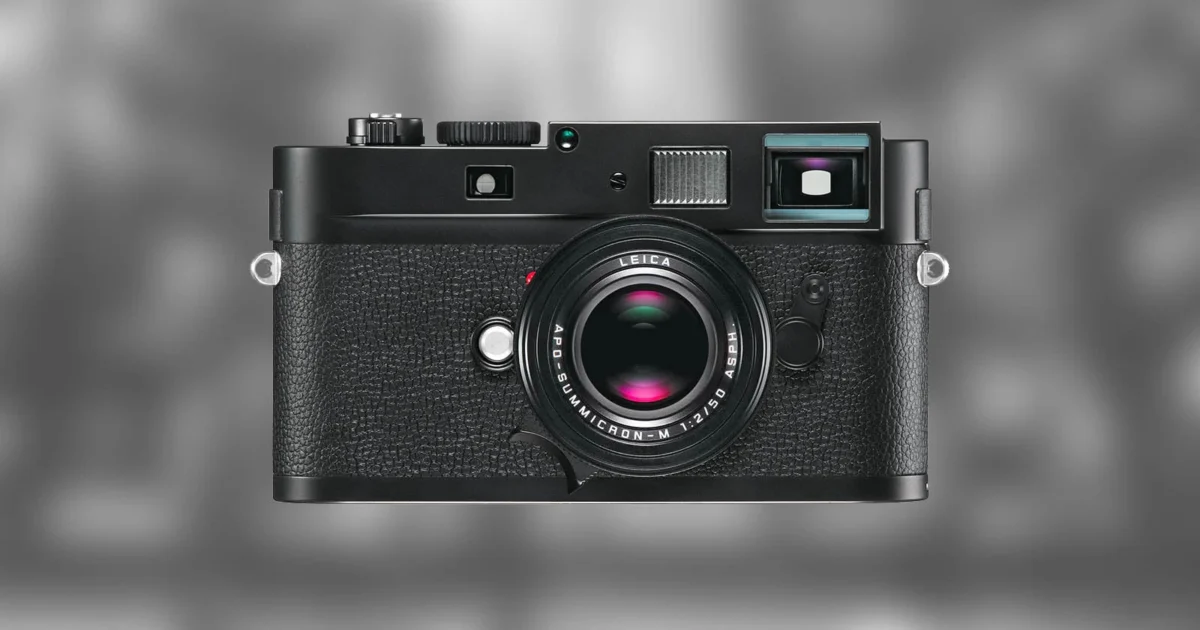
In the high-velocity landscape of 2026 digital imaging, a period dominated by artificial intelligence-driven autofocus, 60-plus megapixel sensors, and extreme high-ISO capabilities, an unusual trend has emerged within the professional photography community. Despite the availability of cutting-edge hardware like the Leica M11-P and various medium-format systems, a significant number of visual artists and street photographers are intentionally reverting to a tool that is technically obsolete by every modern metric: the Leica M9 Monochrom. Originally released in May 2012, this 14-year-old digital rangefinder has maintained a cult-like status that defies the standard depreciation cycles of consumer electronics, raising questions about the intersection of technical perfection and aesthetic character in modern journalism and art.

The Technological Foundation of the M9 Monochrom
The Leica M9 Monochrom represented a radical departure from digital imaging norms upon its debut. While contemporary cameras utilized color filter arrays (Bayer filters) to interpolate color data, the M9 Monochrom featured a dedicated black-and-white sensor. By removing the Bayer filter, Leica allowed the sensor to capture pure luminance at every pixel site. This eliminated the need for "demosaicing"—the mathematical process used to calculate color—which inherently results in a slight softening of the image.

At the heart of the M9 Monochrom is a 18-megapixel full-frame CCD (Charge-Coupled Device) sensor manufactured by Kodak. In the decade following the M9’s release, the industry almost entirely transitioned to CMOS (Complementary Metal-Oxide-Semiconductor) technology due to its superior power efficiency, faster readout speeds, and better high-ISO performance. However, the CCD sensor in the M9 Monochrom is often cited by experts for its unique "organic" rendering. Because CCD sensors transport charge across the chip without individual pixel-site amplification (unlike CMOS), they are often credited with producing a more "CCD-specific" micro-contrast and a tonal graduation that many photographers compare to traditional silver-halide film.

A Chronology of the Leica Monochrome Series
To understand the enduring appeal of the original M9 Monochrom, one must examine its place within the broader evolution of the Leica M-system. The lineage of dedicated black-and-white digital cameras is relatively short, making each iteration a significant milestone in photographic history:

- May 2012: The Leica M9 Monochrom (Original): The first of its kind, featuring the 18MP Kodak CCD sensor. It introduced the concept of a digital camera that could only see in black and white.
- April 2015: The Leica Monochrom (Typ 246): This model marked the transition to CMOS technology, offering 24 megapixels, Live View, and video capabilities. While technically superior, some purists argued it lost the "bite" of the CCD sensor.
- January 2020: The Leica M10 Monochrom: A significant leap to 40 megapixels with a massive increase in ISO range (up to 100,000). It featured a much quieter shutter and a slimmer body.
- April 2023: The Leica M11 Monochrom: The current flagship, boasting a 60-megapixel multi-resolution sensor and internal storage. It offers the highest dynamic range ever seen in a monochrome-only digital camera.
Despite these advancements, the 2012 original remains a staple for photographers like Tomer Vaknin, who argue that the technical limitations of the older model—such as a dim 2.5-inch LCD screen, a slow buffer that can only handle a few frames before locking up, and a maximum base ISO that pales in comparison to modern units—actually contribute to a more deliberate and successful creative process.

The "Color Paradox" and Compositional Discipline
For many professional photographers, the return to the M9 Monochrom is less about nostalgia and more about a "corrective lens" for the eye. In a modern editorial environment where "pop" and high-saturation color often dictate the success of a frame, the removal of the color spectrum forces a reliance on fundamental photographic principles: light, shadow, texture, and geometry.

Market analysis of street photography trends in 2026 suggests that the "over-processing" of color images has led to a counter-movement toward "Luminance Purity." By utilizing a sensor that lacks a color filter, the photographer is stripped of the ability to use color as a "crutch." This creates what industry insiders call the "Color Paradox": by losing the full spectrum of color, the photographer gains a more acute sense of composition. The M9 Monochrom demands that the user see the world in terms of tonal values, leading to images that possess a grounded, honest quality that is often lost in the computational photography era.

Supporting Data: CCD vs. CMOS Performance Metrics
While modern CMOS sensors provide a wider dynamic range—often exceeding 15 stops in models like the M11—the CCD sensor of the M9 Monochrom operates differently. Data from independent sensor testing labs indicate that while the M9 Monochrom has a lower ceiling for shadow recovery, its "mid-tone richness" remains statistically distinct.

- Luminance Detail: Because there is no light-blocking Bayer filter, the M9 Monochrom captures approximately 100% of the light hitting the sensor, compared to the roughly 30-40% effective light capture of a color sensor before interpolation. This results in a "per-pixel" sharpness that 18 megapixels on a CCD can often rival 30+ megapixels on a standard CMOS sensor.
- ISO Performance: The M9 Monochrom is effectively limited to ISO 3200 or 6400 for usable professional work. However, the "noise" produced by the CCD sensor is often described as "grain-like" rather than the digital "chroma noise" (colored speckles) found in underexposed CMOS files.
- Buffer and Speed: The M9 Monochrom utilizes a Leica Maestro processor that is now several generations old. Writing a single DNG (RAW) file can take several seconds, a stark contrast to the instantaneous bursts of 2026 mirrorless systems.
Historical Challenges: The Sensor Corrosion Issue
The legacy of the M9 Monochrom is not without controversy. Historically, the original CCD sensors produced for the M9 family were susceptible to "sensor corrosion," a condition where the IR-cut glass cover would oxidize, creating spots on the images that could not be cleaned. This led to a massive goodwill program by Leica Camera AG, which replaced affected sensors for several years.

Today, in the secondary market of 2026, M9 Monochrom units that have been fitted with the "ID 15" or "ID 16" replacement sensors (which are immune to corrosion) are highly prized. The scarcity of these functional units has kept the resale value of the M9 Monochrom remarkably high, often selling for prices comparable to much newer, used CMOS-based cameras.

Broader Impact and Implications for the Industry
The continued use of the M9 Monochrom in 2026 highlights a growing divide in the photography industry between "utility" and "expression." For commercial, sports, and wildlife photography, the "obsolescence" of the M9 is absolute; it cannot compete with the speed and resolution required for those fields. However, in the realms of street photography, documentary journalism, and fine art, the camera remains a vital tool.

This phenomenon suggests several implications for the future of camera manufacturing:

- The Demand for Purpose-Built Tools: The success of the Monochrom line has proven that there is a viable market for "limited" cameras that do one thing exceptionally well, rather than trying to be a "do-it-all" hybrid device.
- The Value of Sensory Experience: The tactile nature of the M9—its brass construction, the mechanical feel of the rangefinder, and the simplicity of its menu system—serves as a rebuttal to the "smartphone-ification" of digital cameras.
- Sustainability of Older Tech: The fact that a 14-year-old digital tool is still producing world-class imagery in 2026 challenges the industry’s "planned obsolescence" model. It reinforces the idea that if the fundamental output (the image) is high quality, the age of the processor is secondary.
Ultimately, the M9 Monochrom persists because it offers a "brutal, beautiful, and deeply human" way to see the world. As photographers like Tomer Vaknin demonstrate, the journey of artistic growth often requires putting down the most advanced tools to pick up the most honest ones. In the pursuit of capturing the "truth" of a scene, the 14-year-old Leica M9 Monochrom continues to prove that in the world of light and shadow, perfection is often the enemy of the soul.

