



The global demand for laboratory primates has created a lucrative shadow economy that is driving endangered long-tailed macaques toward the brink of extinction. Driven by the relentless needs of the animal experimentation industry, wildlife trafficking networks across Southeast Asia have scaled up operations, exploiting porous borders, corrupt supply chains, and regulatory blind spots. Year after year, U.S. laboratories and research institutions allocate substantial financial resources to acquire monkeys for pharmaceutical, chemical, and biological testing. This insatiable appetite has transformed regional wildlife trafficking from a localized illicit trade into an organized transnational criminal enterprise deeply intertwined with weapons smuggling, drug trafficking, and money laundering.
The crisis has intensified following the resumption of monkey imports into the United States after a nearly three-year suspension. That multi-year hiatus was triggered by a sweeping federal investigation into international wildlife supply chains and allegations of large-scale document falsification. However, despite increased regulatory scrutiny, investigative findings from organizations like People for the Ethical Treatment of Animals (PETA) indicate that traffickers have simply adapted, shifting their logistics hubs and establishing new overland routes. A particularly sharp surge in trafficking has been documented along the contested border between Thailand and Cambodia, where wild primates are intercepted, laundered through illicit breeding facilities, and funneled into the global laboratory supply chain under the guise of being captive-bred.
An Escalating Regional Crisis Across Southeast Asia
The trafficking of long-tailed macaques (Macaca fascicularis) is not an isolated phenomenon confined to a single border crossing; it is a systemic regional issue spanning Cambodia, Vietnam, Laos, China, and Thailand. For years, criminal syndicates have targeted wild populations, stripping primates of their natural habitats and rewriting their origins through fraudulent documentation.
The mechanics of the trade are brutal and clandestine. Poachers deploy traps in deep forests, frequently capturing entire social groups, including nursing mothers and dependent infants. Once captured, the animals are crammed into restrictive mesh bags, cramped wooden crates, and vehicle floorboards. They endure grueling, multi-day journeys across international borders without adequate food, water, or ventilation. Many succumb to stress, dehydration, trauma, or suffocation before ever reaching their destinations.
Surviving primates are delivered to clandestine holding facilities and breeding farms, where they are subjected to unsanitary and barren conditions. To bypass international trade regulations—specifically the Convention on International Trade in Endangered Species of Wild Fauna and Flora (CITES)—operators routinely employ falsified permits. Wild-caught monkeys are fraudulently relabeled as captive-bred generation after generation, effectively laundering stolen wildlife into legitimate international commerce. Once whitewashed with official-looking paperwork, these primates are exported to biomedical facilities in North America, Europe, and elsewhere.

A Landmark Federal Investigation and Legal Precedents
The vulnerability of the international primate supply chain was exposed in late 2022, when U.S. federal authorities unsealed indictments detailing a massive, multi-million-dollar smuggling scheme. The operation allegedly relied on forged CITES permits to launder tens of thousands of wild-caught long-tailed macaques from Cambodia into the United States.
According to federal court filings, high-ranking Cambodian forestry officials and private exporters conspired to harvest wild monkeys from protected areas, falsely designating them as captive-bred stock at registered breeding facilities. These primates were then sold to U.S.-based pharmaceutical and testing companies at exorbitant prices. The revelations shocked the scientific community and prompted the U.S. Fish and Wildlife Service, along with the Department of Justice, to temporarily freeze imports from key suppliers in the region.
Despite these enforcement actions, the underlying market drivers remain unchanged. As domestic and international oversight ebbs and flows, trafficking syndicates quickly re-establish supply routes. The recent resumption of imports has signaled to criminal networks that the lucrative U.S. market is open once again, prompting an immediate resurgence in poaching and smuggling activities across the Mekong subregion.
Convergence with Transnational Organized Crime
Primate smuggling does not operate in a vacuum. Law enforcement seizures across Southeast Asia increasingly demonstrate that the transport networks moving endangered wildlife are the very same channels utilized for trafficking illegal firearms, narcotics, counterfeit goods, and human contraband.
In August 2026, a major joint operation by Thai law enforcement agencies near the Thai-Cambodian border led to the seizure of a substantial cache of weaponry, including automatic rifles and more than 24,000 rounds of ammunition. Subsequent investigations into the smuggling ring revealed a diversified criminal portfolio. Suspects disclosed that long-tailed macaques were routinely transported alongside illicit cigarettes, undocumented laborers, and contraband using the same riverboats, hidden vehicle compartments, and rural transit routes.
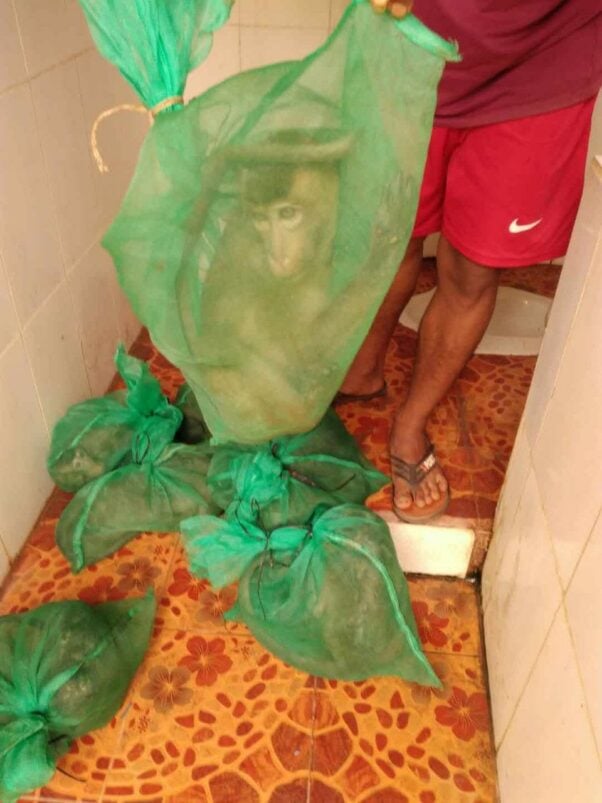
Similar patterns have been documented in Vietnam, where transnational syndicates historically known for trafficking pangolin scales, rhinoceros horn, and elephant ivory have expanded their operations to include the capture and export of primates destined for laboratories in China and beyond. This convergence presents a formidable challenge for regional law enforcement agencies, as wildlife crimes are frequently treated as secondary offenses compared to drug and arms trafficking, despite generating billions of dollars in illicit revenue.
Compromised Science and the Myth of Controlled Variables
Within the biomedical and pharmaceutical research sectors, the justification for using non-human primates often rests on the premise of scientific rigor. Experimenters argue that purpose-bred, specific pathogen-free animals provide standardized genetic and health profiles, thereby controlling variables and ensuring the reproducibility of experimental data.
However, the influx of wild-caught monkeys disguised as captive-bred specimens fundamentally undermines this scientific rationale. Wild primates carry unknown environmental exposures, distinct genetic lineages, varied parasitic loads, and complex immunological histories. When these animals are covertly introduced into laboratory colonies or experimental protocols, they introduce massive, unquantifiable variables into research studies.
Ethicists and independent scientists argue that the reliance on trafficked wildlife compromises the integrity of the data itself. Rather than maintaining controlled, standardized models, laboratories are utilizing animals whose physiological responses may be skewed by chronic stress, trauma, and latent pathogens acquired during their capture and illegal transit. Consequently, the scientific validity of tests conducted on these animals is increasingly called into question by critics within the academic and regulatory communities.
Public Health Risks and Zoonotic Disease Threats
Beyond the ethical dimensions of wildlife trafficking and the degradation of scientific integrity, the unregulated import of wild primates poses a severe, direct threat to public health in the United States and other destination countries.

Primates share close phylogenetic proximity to humans, making them vectors for numerous zoonotic pathogens capable of crossing species barriers. Monkeys captured in the wild and smuggled through unsanitary, crowded conditions are petri dishes for infectious diseases. They arrive without verifiable health certificates, veterinary histories, or quarantine oversight.
Federal health records and epidemiological studies indicate that imported laboratory primates have historically tested positive for dangerous pathogens, including tuberculosis, melioidosis, Shigella bacterial infections, and Herpes B virus—a pathogen that is frequently fatal to humans. When smuggled monkeys are mixed into established breeding facilities or research colonies to refresh stock or conceal their wild origins, they risk introducing novel strains of diseases into domestic animal populations and, potentially, human handlers. Public health advocates emphasize that each unvetted shipment represents an unchecked biological hazard entering the nation’s borders.
Legislative Interventions and Policy Solutions
In response to the converging crises of species depletion, international crime, and public health vulnerabilities, lawmakers and animal advocacy organizations are pressing for decisive legislative action.
A central pillar of these reform efforts is the proposed Preventing Risky Importation of Monkeys to Avoid Toxic Exposures (PRIMATE) Act. This federal legislation seeks to prohibit the importation of non-human primates for use in laboratory experimentation entirely. Proponents argue that enacting the PRIMATE Act would achieve a dual objective: relieving intense pressure on dwindling wild populations of long-tailed macaques, thereby allowing endangered species to recover, and mitigating the biosecurity risks associated with bringing unvetted animals into populated domestic facilities.
Public health advocates and conservationists continue to lobby members of the U.S. Congress to co-sponsor the legislation. Furthermore, pressure is mounting on executive agencies, specifically the U.S. Department of Health and Human Services (HHS), to exercise its regulatory authority to audit and restrict the import pipelines that sustain the animal testing industry.
As international law enforcement agencies grapple with the complexities of transnational wildlife trafficking, the future of the long-tailed macaque hangs in the balance. Whether global regulators will dismantle the monkey-abduction pipeline or allow the high-stakes demands of the experimentation industry to drive the species closer to extinction remains one of the most critical environmental and public health questions of the decade.

