


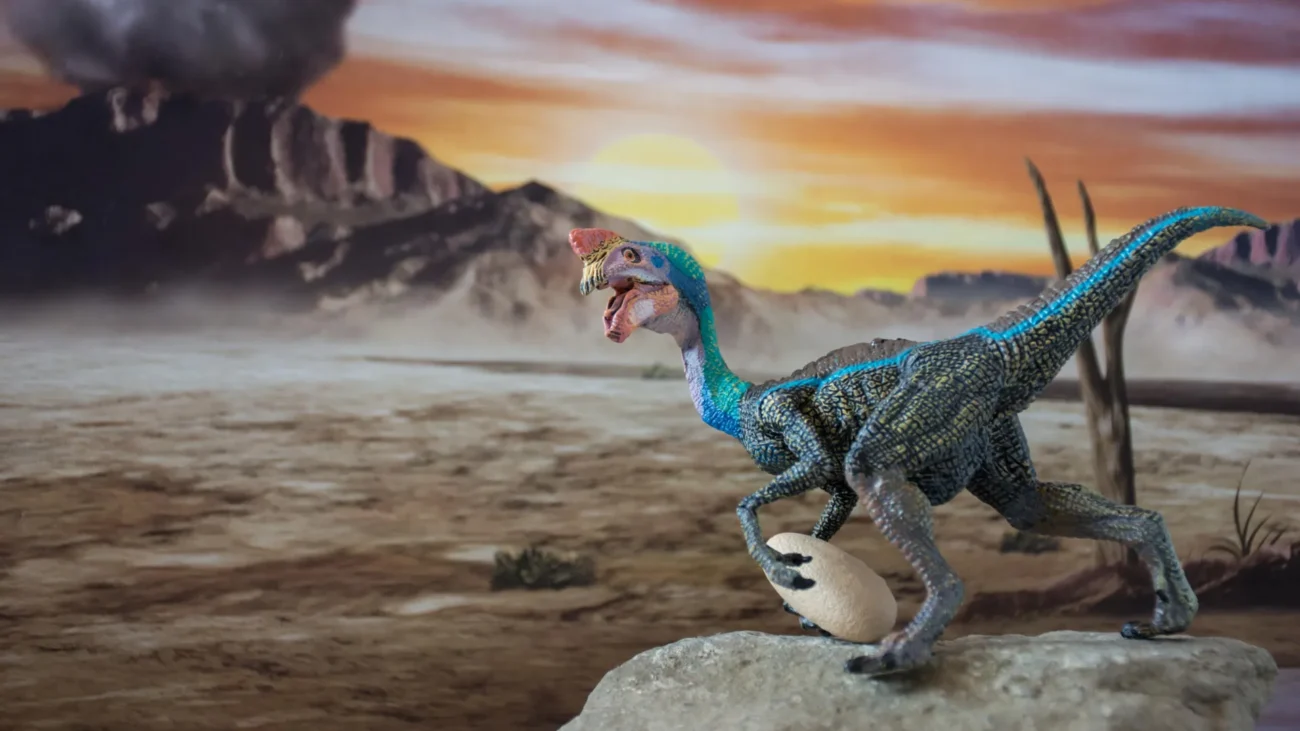
The intricate dance of dinosaur parenting, particularly how extinct species like oviraptors nurtured their young, has long been a subject of scientific fascination and considerable debate. These bird-like, yet flightless, dinosaurs present a unique puzzle: did they employ the passive incubation methods of reptiles, relying on environmental warmth, or did they actively engage in direct egg warming akin to modern birds? A groundbreaking new study, published in the esteemed journal Frontiers in Ecology and Evolution, delves deep into this enigma, employing a novel combination of physical experimentation and sophisticated heat transfer simulations to reconstruct the nesting behaviors and hatching patterns of oviraptors. The findings offer a compelling glimpse into the evolutionary divergence of reproductive strategies between dinosaurs and their avian descendants.
The research, spearheaded by a team of scientists from Taiwan, sought to bridge the gap between fossil evidence and our understanding of living biological processes. By meticulously constructing a life-size model of an oviraptor and a realistic representation of its nest, the researchers were able to empirically test the flow of heat through simulated eggs and to analyze how the presence and positioning of an adult oviraptor might have influenced incubation temperatures. This innovative approach allowed them to move beyond theoretical speculation and gather concrete data on a critical aspect of dinosaur life.
"We demonstrate that the observed variations in oviraptor hatching patterns were a direct consequence of the relative position of the incubating adult in relation to the eggs," explained Dr. Tzu-Ruei Yang, the senior author of the study and an associate curator of vertebrate paleontology at Taiwan’s National Museum of Natural Science. This statement highlights a key takeaway from the research: that the specific arrangement of eggs within the nest, combined with the adult’s presence, played a crucial role in determining developmental outcomes.
Furthermore, the study provided an unprecedented estimate of oviraptor incubation efficiency, revealing it to be significantly lower than that observed in modern birds. Chun-Yu Su, the first author of the study and a student at Washington High School in Taichung at the time of the research, elaborated on this crucial point. "We obtained an estimate of the incubation efficiency of oviraptors, which is much lower than that of modern birds," Su stated. This comparative analysis underscores the distinct evolutionary trajectory of avian incubation, which has been refined over millions of years to optimize embryonic development.
Reconstructing an Oviraptor Nest: A Scientific Endeavor
The scientific endeavor to understand oviraptor incubation began with the meticulous reconstruction of a nesting environment. The model was based on Heyuannia huangi, a well-documented oviraptor species that roamed the landscapes of what is now China approximately 70 to 66 million years ago, during the Late Cretaceous period. This dinosaur, estimated to be about 1.5 meters in length and weighing around 20 kilograms, is known for its distinctive semi-open nests, characterized by eggs arranged in multiple concentric rings.
The construction of the oviraptor model itself was a testament to the researchers’ dedication to scientific accuracy. The torso was expertly crafted using polystyrene foam and supported by a sturdy wooden frame, while layers of cotton, bubble paper, and fabric were employed to faithfully mimic the soft tissues of the animal. The eggs, a critical component of the experiment, were meticulously produced from casting resin, designed to approximate the physical properties and thermal conductivity of real oviraptor eggs. Fossil evidence guided the arrangement of these resin eggs into double rings, replicating the structure of actual oviraptor clutches.
"Part of the difficulty lies in reconstructing oviraptor incubation realistically," acknowledged Su. "For example, their eggs are unlike those of any living species, so we invented the resin eggs to approximate real oviraptor eggs as best as we could." This statement underscores the challenges inherent in paleontology, where scientists must often bridge the gap between extinct life forms and our current understanding of biological principles. The development of these specialized resin eggs represents a significant methodological innovation, allowing for the precise measurement of heat transfer in a simulated oviraptor nest.
Heat, Nest Design, and the Nuances of Hatching Patterns
The core of the study involved a series of experiments designed to unravel the interplay between adult presence, environmental conditions, and egg temperatures, ultimately influencing hatching outcomes. The research team systematically tested various scenarios, meticulously recording temperature fluctuations within the simulated nest.
In colder ambient conditions, the presence of a brooding adult oviraptor had a pronounced effect on egg temperatures. The outer ring of eggs experienced temperature variations of up to 6 degrees Celsius compared to the inner eggs. Such significant thermal gradients are highly likely to induce asynchronous hatching, a phenomenon where eggs within the same clutch do not hatch simultaneously. This can provide offspring with a survival advantage, allowing for staggered emergence and potentially better resource allocation.
Conversely, when the experiments were conducted in warmer environments, the temperature differential across the egg clutch dramatically decreased, dropping to approximately 0.6 degrees Celsius. This suggests that in warmer climates, ambient heat, likely derived from solar radiation, played a crucial role in moderating egg temperatures and potentially influencing hatching patterns. The study’s findings strongly imply that sunlight was a significant factor in oviraptor incubation.
"It’s unlikely that large dinosaurs sat atop their clutches," Dr. Yang elaborated, drawing a distinction between oviraptor behavior and that of many modern birds. "Supposedly, they used the heat of the sun or soil to hatch their eggs, like turtles. Since oviraptor clutches are open to the air, heat from the sun likely mattered much more than heat from the soil." This hypothesis is supported by the morphology of oviraptor nests, which were not fully enclosed or deeply buried, making them more susceptible to external heat sources like the sun.
Dinosaur vs. Bird Incubation Efficiency: A Tale of Two Strategies
A critical aspect of the study involved a comparative analysis of oviraptor incubation strategies versus those employed by modern birds. The vast majority of modern birds rely on a method known as thermoregulatory contact incubation (TCI). This involves the adult bird physically sitting directly on its eggs, acting as the primary heat source and maintaining consistent temperatures. For TCI to be effective, the adult must be able to maintain physical contact with all the eggs in the clutch, ensuring uniform warmth.
The oviraptor’s nesting arrangement, with eggs laid in concentric rings, presented a significant logistical challenge for such direct contact incubation. The study’s findings suggest that oviraptors were likely unable to achieve the consistent, all-encompassing warmth that TCI requires. The physical dimensions of the adult dinosaur and the circular layout of the nest would have made it impossible for the oviraptor to cover and adequately warm every egg simultaneously.
"Oviraptors may not have been able to conduct TCI as modern birds do," Su explained. Instead, the research posits that oviraptors functioned as "co-incubators," with their own body heat contributing to the overall thermal environment, but working in conjunction with external heat sources such as sunlight and potentially warmed soil. This hybrid approach, while less efficient than the dedicated TCI of modern birds, may have been perfectly adapted to their specific nesting style and the environmental conditions of their time. The shift from buried nests to semi-open ones, as evidenced by fossil discoveries, further supports this theory, suggesting an adaptation towards utilizing external heat.
Dr. Yang offered a nuanced perspective on the perceived differences in efficiency: "Modern birds aren’t ‘better’ at hatching eggs. Instead, birds living today and oviraptors have a very different way of incubation or, more specifically, brooding. Nothing is better or worse. It just depends on the environment." This statement emphasizes that evolutionary adaptations are driven by environmental pressures, and what appears as "less efficient" in one context might be perfectly suited to another.
Implications for Dinosaur Parenting and Future Research
While the findings of this study offer significant new insights into oviraptor reproduction, the researchers are careful to acknowledge certain limitations. The study’s conclusions are based on a reconstructed nest and modern environmental conditions, which undoubtedly differ from the complex climatic and ecological scenarios of the Late Cretaceous. These historical differences could have influenced the actual incubation periods and hatching success rates of oviraptors. Furthermore, the study suggests that oviraptors likely experienced longer incubation periods compared to many modern birds, a testament to the slower metabolic rates and potentially different developmental pathways of these ancient creatures.
Despite these caveats, the research represents a substantial leap forward in our understanding of dinosaur parenting. By ingeniously combining physical models with advanced simulations, the study opens up exciting new avenues for investigating the reproductive biology of extinct animals. This methodology could be applied to other dinosaur groups, allowing scientists to reconstruct and test hypotheses about their incubation strategies, nesting behaviors, and parental care.
The study also carries a broader message of scientific encouragement, particularly for students in regions with limited fossil discoveries. "It also truly is an encouragement for all students, especially in Taiwan," concluded Dr. Yang. "There are no dinosaur fossils in Taiwan, but that does not mean that we cannot do dinosaur studies." This sentiment underscores the power of innovative research methods and the global nature of scientific inquiry, demonstrating that groundbreaking discoveries can emerge from diverse locations and through creative approaches to understanding the past. The implications of this research extend beyond oviraptors, offering a valuable model for future paleontological investigations into the fascinating world of dinosaur reproduction and parental care.

