


The avian world is home to countless species that capture public fascination, yet few remain as enigmatic to the general public as Agapornis pullarius, commonly known as the red-headed lovebird. While several of its taxonomic cousins within the Agapornis genus have achieved global popularity as domestic companion animals, the red-headed lovebird occupies a vastly different niche. Known scientifically for its striking plumage and uniquely delicate constitution, this small African parrot is rarely encountered in private households or standard aviculture. Instead, it remains primarily a subject of study for advanced ornithologists, specialized breeders, and conservationists tracking the shifting dynamics of sub-Saharan biodiversity.
A comprehensive examination of the red-headed lovebird reveals a complex narrative involving its natural distribution across West and Central Africa, its ecological interactions within tropical lowland savannahs, a long history of international trade, and the ongoing conservation challenges that threaten localized populations. As global interest in exotic wildlife management intensifies, understanding the biological and behavioral profile of Agapornis pullarius offers vital insights into the fragile balance between human agriculture, international pet markets, and avian preservation.
Taxonomic Profile and Physical Characteristics
Classified within the order Psittaciformes and the family Psittaculidae, the red-headed lovebird is a remarkably distinct yet frequently misidentified species. Adults typically reach a length of up to 15 centimeters (approximately 6 inches) and maintain a modest weight of roughly 45 grams. Their maximum recorded lifespan in optimal conditions approaches 20 years, aligning them with the longevity expectations of other small psittacines.
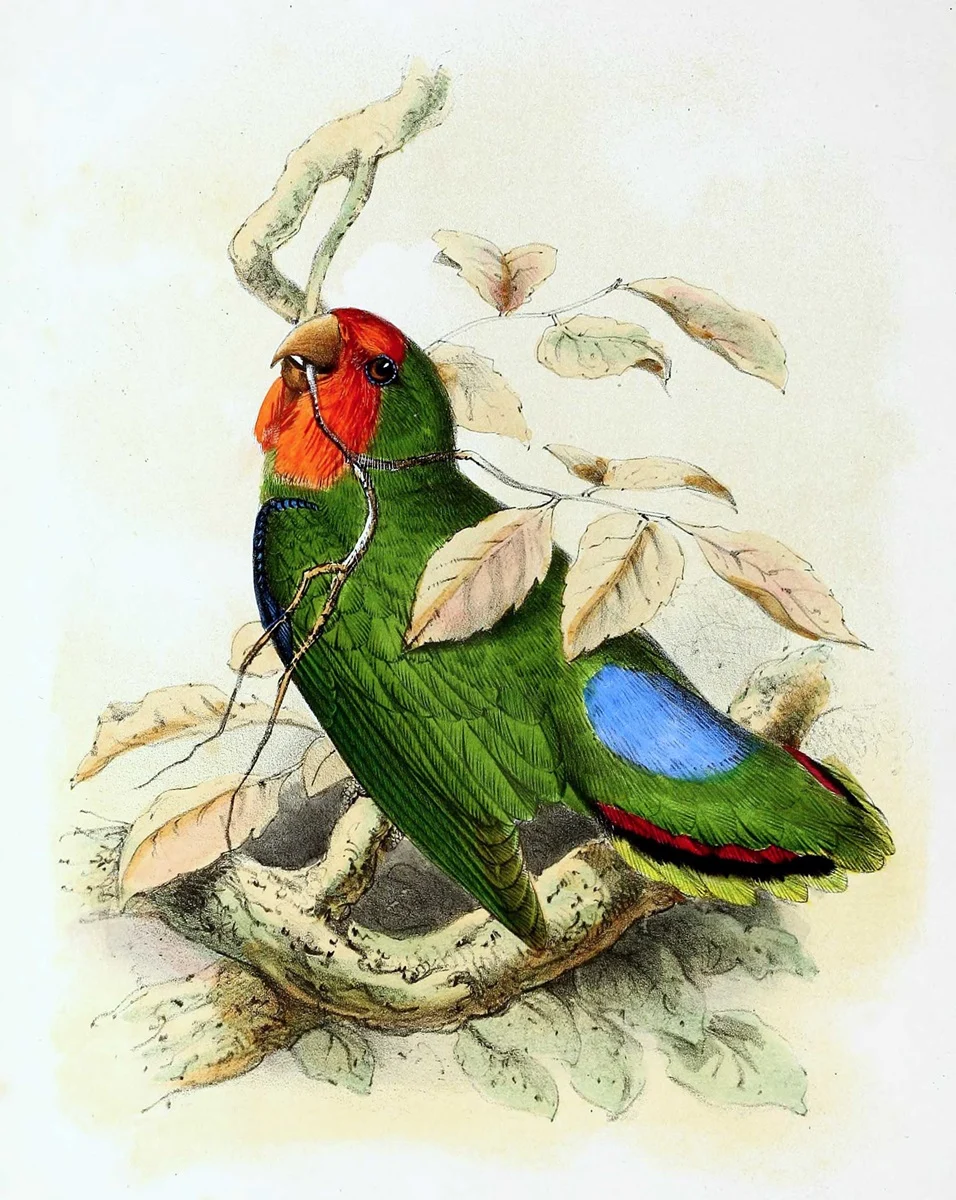
Visually, the species is defined by a vibrant color palette. The primary body plumage consists of a brilliant, uniform green, sharply contrasted by a striking red face and beak. Faint traces of blue embellish the lower back, while a subtle band of red accents the tail feathers. Sexual dimorphism is present, allowing experienced observers to distinguish males from females visually. While males display a vivid scarlet face and bill, females exhibit a more muted, orange-tinted facial coloration and a similarly toned beak.
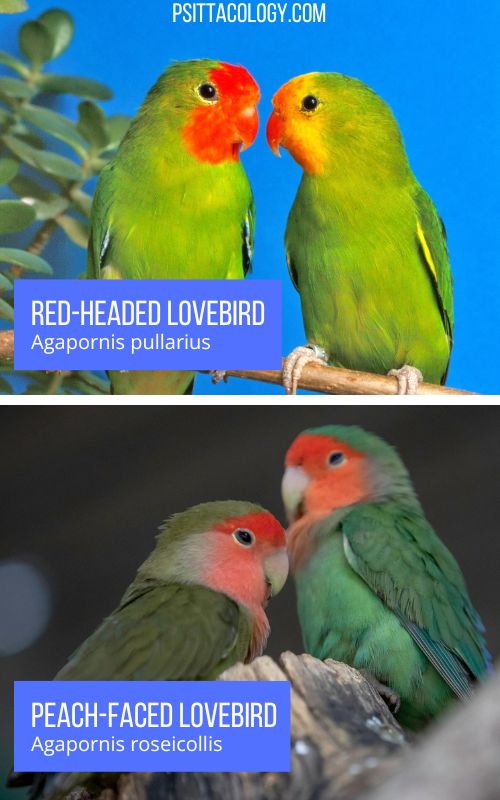
The red-headed lovebird bears a striking superficial resemblance to the peach-faced lovebird (Agapornis roseicollis), a species vastly more prevalent in commercial aviculture. However, morphological differentiation is straightforward upon close inspection: Agapornis pullarius features a distinct red beak, whereas A. roseicollis possesses a pale, beige-colored bill. Furthermore, historical documentation of the species is rich, highlighted by renowned 19th-century avian illustrations, such as the 1869 rendering by naturalist and illustrator John Gerrard Keulemans, which continues to serve as an archival reference for the bird’s precise coloration.
Natural Geographic Distribution and Ecological Niche

Endemic to the African continent, the red-headed lovebird occupies a specific, patchy geographical band extending from western sub-Saharan Africa through Central Africa. Its natural range spans westward to Guinea and stretches eastward as far as Ethiopia. Unlike nomadic avian species that traverse vast continental distances in search of transient resources, red-headed lovebirds are largely sedentary.
Their preferred natural habitat consists of tropical lowland savannahs up to an altitude of 2,000 meters (approximately 6,550 feet), though they are more commonly observed at lower elevations. These birds favor ecosystems interspersed with trees but strictly avoid dense primary rainforests. In the wild, they typically travel in pairs or small, cohesive flocks comprising up to a few dozen individuals.
Ecologically, the species plays a specialized role as a seed predator, relying heavily on grass seeds found throughout its range. This dietary preference frequently intersects with human agricultural practices, particularly the cultivation of crops such as millet. Consequently, local agrarian communities occasionally view the red-headed lovebird as an agricultural pest. Beyond seeds, their diet is supplemented by wild fruits, including figs and guavas, which they forage for across their savannah habitats.
Conservation Status and Historical Trade Pressures
The International Union for Conservation of Nature (IUCN) currently classifies Agapornis pullarius as a species of Least Concern. Despite this baseline classification, field researchers and conservation organizations emphasize that the species is locally uncommon throughout the vast majority of its natural range. Furthermore, empirical data suggests a steady, concerning decline in overall population numbers.
The primary drivers behind this population contraction include habitat destruction driven by agricultural expansion, the intentional culling of flocks by farmers protecting crops, and targeted capture for the international live bird trade. Historical records underscore the scale of commercial exploitation. A comprehensive 2018 wildlife trade study documented that nearly 40,000 red-headed lovebirds had been legally exported from their native regions since 1975.
Esteemed ornithological authorities and reference texts, including the seminal work Parrots: A Guide to Parrots of the World by Tony Juniper and Mike Parr (2010), have noted these shifting population dynamics. The authors observed that while avian abundance can fluctuate due to the species’ semi-nomadic tendencies in certain micro-regions, a genuine overall decline has materialized over the past century, largely fueled by trapping for the commercial pet trade and subsequent maintenance in captivity outside the species’ native range.
Aviculture and the Challenges of Captive Management

While lovebirds such as Fischer’s lovebird (Agapornis fischeri) and the peach-faced lovebird are mainstays of the global pet trade, the red-headed lovebird remains a profound rarity in aviculture. It is kept almost exclusively by dedicated, highly experienced parrot enthusiasts, typically within specialized outdoor aviaries rather than standard domestic cages.
The primary barrier to widespread captive propagation is the species’ exceptionally delicate temperament. Red-headed lovebirds are notoriously nervous, easily startled, and hyper-sensitive to environmental stressors. Wild-caught specimens, in particular, have been documented to succumb rapidly to shock induced by minor auditory disturbances, such as sudden loud noises, or to experience fatal anorexia if subjected to competitive or raucous neighboring species in shared aviaries. Consequently, aviculturists maintain that Agapornis pullarius is fundamentally unsuited to the role of a traditional, tactile household pet. The governing philosophy among specialized keepers is strictly observational: "Look, but do not touch."
For the select group of advanced aviculturists who successfully acquire captive-bred specimens, housing requirements demand meticulous planning. Experts recommend providing a heated aviary for single-species pairing. When maintained indoors, these birds require substantial structural space—cages measuring at least 30 inches (80 centimeters) in width with a precise bar spacing of approximately 0.5 inches (1.25 centimeters), outfitted with diverse natural wood perches to encourage natural gripping and foot health.
Nutritional and Enrichment Protocols in Captivity
Replicating the complex dietary needs of red-headed lovebirds in captivity requires a departure from traditional seed-only regimens. While historical keepers relied heavily on dry or sprouted seeds, contemporary avian veterinary consensus emphasizes the necessity of a high-quality pelleted diet as the nutritional foundation. Supplementation includes premium seed mixes, fresh leafy green vegetables, seasonal fruits, cooked grains, and safe foraged wild weeds. To support metabolic health—particularly during reproductive cycles—aviculturists frequently integrate targeted protein sources such as boiled eggs or mealworms.
Mental stimulation is equally critical, though fraught with unique challenges due to the species’ stress-prone psychology. Because red-headed lovebirds possess high intelligence and are vulnerable to captivity-induced boredom, environmental enrichment must be introduced gradually. Sudden alterations to their enclosure can provoke severe panic responses, requiring keepers to rotate toys, foraging boxes, and perches incrementally to ensure psychological well-being without inducing trauma.
Despite their classification within the broader parrot family, red-headed lovebirds maintain a relatively low baseline noise level compared to larger psittacines. However, when vocalization does occur, their contact calls are characterized by a notably sharp, shrill pitch that distinguishes them acoustically from other lovebird species.
Reproductive Biology and Natural Breeding Adaptations
The reproductive cycle of the red-headed lovebird in the wild is intrinsically tied to seasonal precipitation patterns, with breeding activity peaking during the rainy season when ecological resources and food supplies are most abundant. Unlike many cavity-nesting birds that rely exclusively on standard tree hollows, Agapornis pullarius exhibits a highly specialized nesting behavior: it frequently excavates chambers within active arboreal termite or ant nests (termitaria). Occasionally, pairs will utilize ground-level nests or repurpose old cavities originally carved by woodpeckers.
The nest construction process is strictly divided by gender. The female assumes sole responsibility for burrowing into the dense structure of the termite nest and reinforcing the interior cavity using plant fragments, such as grass leaves, carried securely tucked in her rump feathers. Once the subterranean or arboreal nursery is secured, the female typically deposits a clutch of up to six white eggs.
Replicating this complex subterranean and arboreal reproductive behavior in a captive environment has proven notoriously difficult, contributing to the scarcity of captive-bred populations. Specialized breeders have achieved intermittent success only by engineering custom artificial nesting solutions, such as specially molded cork nest boxes designed to simulate the tactile and thermal properties of natural termite mounds.
Implications and Future Outlook
The trajectory of Agapornis pullarius highlights a broader dilemma within modern conservation and wildlife management. As human populations expand across West and Central Africa, the conversion of tropical savannah landscapes into agricultural zones will likely continue to exert pressure on sedentary avian species dependent on native grasses and micro-habitats. Concurrently, the strict physiological sensitivities that render the red-headed lovebird an impractical commercial pet may paradoxically serve as a biological safeguard against mass over-exploitation for the international pet market, insulating the species from the extreme commercial trends that have impacted other exotic birds.
For the scientific community, ongoing field monitoring and the refinement of specialized avicultural protocols remain essential. Whether through the preservation of natural savannah corridors or the careful, ethical stewardship of captive bloodlines by specialized institutions, the red-headed lovebird remains a testament to the intricate evolutionary adaptations of Africa’s diverse avian fauna—a brilliant splash of red and green requiring vigilance, respect, and continued scientific inquiry.

