


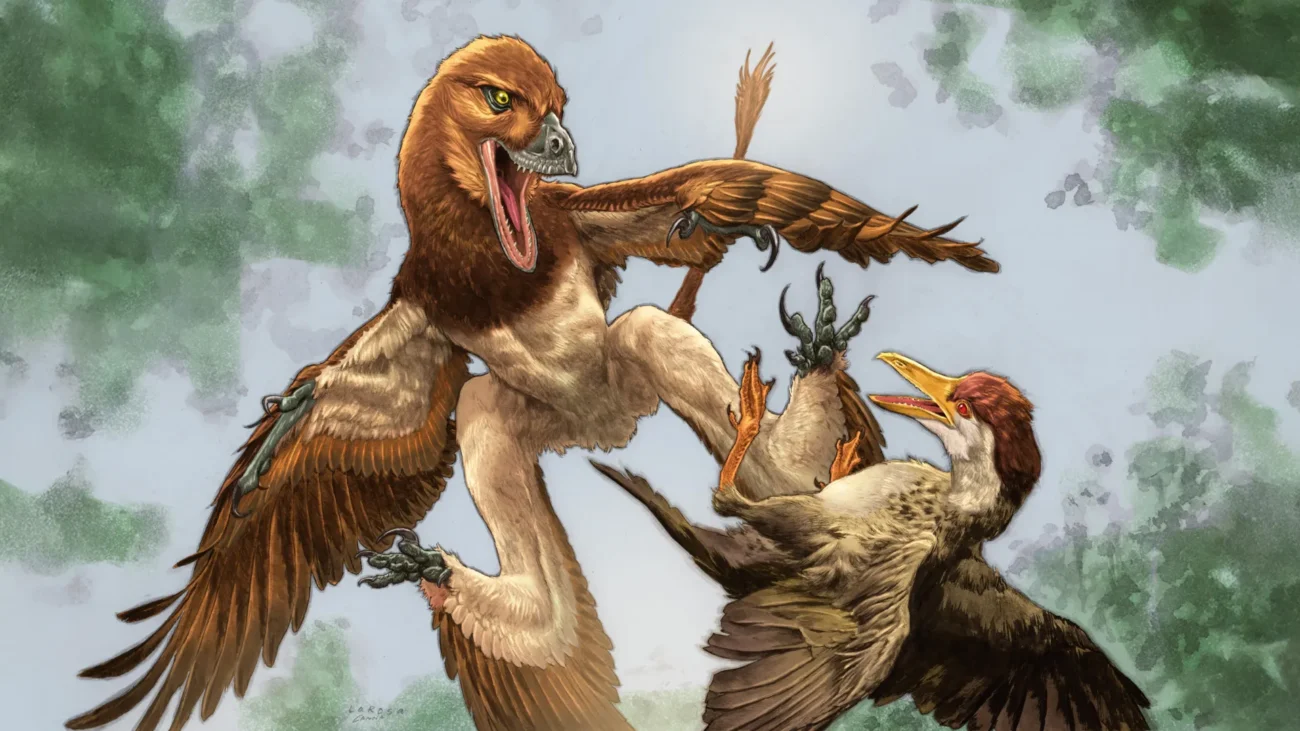
In the rugged, wind-scoured expanses of northwestern China’s Gansu province, the Changma Basin has long been recognized as a treasure trove of prehistoric biodiversity. For decades, paleontologists working in this remote region have unearthed an astonishing abundance of fossilized remains, most notably hundreds of ancient bird specimens that have provided invaluable data on the early evolution of avian species. However, alongside these delicate avian bones, researchers repeatedly encountered a puzzling geological phenomenon: clusters of shattered, compressed bird bones arranged in pellet-like masses eerily reminiscent of the regurgitated pellets produced by modern owls.
For years, these compressed bone beds fueled intense scientific debate. Paleontologists strongly suspected that an apex predator was actively hunting the prehistoric birds of Changma, digesting their soft tissues, and expelling the indigestible remains in tight packages. Yet, despite decades of careful excavation and meticulous analysis, direct physical evidence of such a predator remained frustratingly elusive. No teeth, claw marks, or skeletal remains of a carnivore capable of producing these pellet-like accumulations had ever been identified in the immediate fossil layer.
That prolonged search may finally be over. In a comprehensive study recently published in the Annals of Carnegie Museum, an international team of paleontologists has announced the discovery of a previously unknown dinosaur species from the very same fossil bed. Named Jian changmaensis, this newly described creature was a feathered relative of the infamous Velociraptor, boasting an impressive four-winged anatomy and structural arm adaptations that make it the prime suspect in the ancient bird-hunting mystery. This breakthrough not only sheds light on a localized predator-prey dynamic that transpired millions of years ago but also offers profound insights into the complex ecosystems of the Cretaceous period and the evolutionary trajectory of today’s surviving dinosaurs: birds.
A Feathered Predator in an Avian Sanctuary
To understand the significance of the Jian changmaensis discovery, scientists must place the find within the broader chronological and ecological context of the Mesozoic Era. Modern birds—technically classified as avian dinosaurs—are the sole lineage of dinosaurs to have successfully survived the catastrophic Cretaceous-Paleogene extinction event, triggered by a massive asteroid impact approximately 66 million years ago. However, long before that global cataclysm reshaped the biosphere, avian species shared their terrestrial and aerial habitats with a vast array of non-avian dinosaur groups throughout the Jurassic and Cretaceous periods.
Among the closest evolutionary cousins of early birds were the dromaeosaurs, a clade of small-to-medium-sized, bipedal, feathered theropod dinosaurs renowned for their agility, keen senses, and specialized sickle-like killing claws on their feet. While popular culture immortalized Velociraptor as a human-sized, scaly reptile through cinematic franchises like Jurassic Park, actual paleontological evidence paints a very different picture. Real dromaeosaurs were remarkably bird-like, covered entirely in complex feathers, and generally much smaller than their Hollywood depictions.
Within the dromaeosaur family lies a specialized subgroup known as microraptors. These animals are famous among evolutionary biologists for their peculiar skeletal and integumentary adaptations. While most microraptor species were remarkably diminutive—some growing no larger than a modern crow—the newly uncovered Jian changmaensis breaks the mold, ranking as one of the largest microraptor specimens ever recovered by science.
"Scientists have found these weird, broken-up clusters of bird bones at this site, and we didn’t know what made them. This new microraptor dinosaur, Jian changmaensis, is our best guess," explains Dr. Jingmai O’Connor, associate curator of fossil reptiles at the Field Museum in Chicago and senior author of the research paper. "It’s the only dinosaur found at this site that wasn’t a bird, it was a carnivore, and it was much bigger than everything else that we’ve found there."
Anatomy and Morphology: The Four-Winged Glider
The recovery of Jian changmaensis is based on partial skeletal remains unearthed from the Lower Cretaceous strata of the Changma Basin. Although paleontologists have successfully salvaged only a portion of the animal’s upper arm bone—measuring approximately four inches in length—comparisons with closely related dromaeosaur specimens allow researchers to construct a reliable anatomical profile of the creature.
Based on this four-inch humerus bone, scientists estimate that Jian possessed a wingspan stretching roughly four feet across, putting the dinosaur on par with a modern barn owl in terms of overall physical scale. Crucially, the structural morphology of its arm and shoulder bones exhibits distinct mechanical capabilities that differentiate it from smaller, more primitive relatives.
Like other members of the microraptor subgroup, Jian changmaensis was characterized by an unusual arrangement of elongated, asymmetrical feathers attached to both its forelimbs and its hind limbs. This configuration effectively gave the dinosaur the appearance of possessing four distinct wings. Despite possessing these extensive aerodynamic structures, biomechanical analyses indicate that Jian and its kin were not equipped for sustained, powered flapping flight akin to modern sparrows or pigeons. Instead, the animal was uniquely adapted for arboreal gliding.
"Jian and the other microraptors probably weren’t capable of true, powered flight, but they could probably glide like a flying squirrel," O’Connor notes, highlighting the dynamic ways early theropods exploited forest and woodland niches.
The binomial nomenclature selected for the new species carries specific cultural and geographical significance. The genus name, Jian, is derived from Chinese mythology, referencing a legendary mythical bird-like creature characterized by having only one wing, necessitating pairs to fly—a fitting nod to the animal’s feathered limbs. The specific epithet, changmaensis, honors the Changma Basin in China’s Gansu province, the remote locality where the fossils were meticulously excavated and preserved.
Chronology of Discovery and Research Collaboration
The unearthing of Jian changmaensis is the culmination of years of collaborative international fieldwork and rigorous laboratory analysis. The Changma Basin has been a focal point for paleontological expeditions for over two decades, yielding an exceptionally rich archive of Early Cretaceous life, particularly fossilized enantiornithine and ornithuromorph birds.
While hundreds of avian specimens have been cataloged from the basin by researchers from institutions around the globe, the total absence of non-avian dinosaur fossils had long perplexed the scientific community. Standard taphonomic models—the study of how organisms decay and become fossilized—suggested that terrestrial predators should have been present in the ecosystem to prey upon the dense populations of birds, yet the fossil record remained stubbornly silent regarding these carnivorous inhabitants.
The turning point came when field teams recovered the isolated non-avian dinosaur elements from the same fine-grained sedimentary layers that produced the concentrated bird bone beds and pellet-like fossil masses. Recognizing the exceptional nature of the find, a multidisciplinary team assembled to analyze, describe, and formally classify the specimen.
The research initiative was spearheaded by a prominent cohort of international paleontologists and geologists. Alongside Dr. Jingmai O’Connor of the Field Museum, the study’s corresponding author is Dr. Matt Lamanna, the Mary R. Dawson Curator of Vertebrate Paleontology at the Carnegie Museum of Natural History. The collaborative team also included Ling-Qi Zhou of the Gansu Geological Museum; Dr. Ashley Poust of the University of Nebraska State Museum and the University of California Museum of Paleontology; Da-Qing Li of Gansu Agricultural University; and Dr. Hai-Lu You of the Institute of Vertebrate Paleontology and Paleoanthropology at the Chinese Academy of Sciences.
Together, this coalition combined geological mapping, anatomical comparison, and taphonomic evaluation to link the physical presence of Jian changmaensis directly to the mysterious bird bone accumulations that had puzzled researchers for years.
Filling Ecological Gaps in Ancient Ecosystems
Beyond solving the mystery of the pellet-like fossil masses, the discovery of Jian changmaensis provides critical missing pieces of the ecological puzzle in Cretaceous northwestern China. Reconstructing ancient food webs requires identifying not just the most abundant species—in this case, the numerous primitive birds of Changma—but also the apex consumers that kept population pressures balanced.
"Jian changmaensis reveals that non-avian dinosaurs lived in what is now the Changma Basin, an area famous for its fossil birds," states Dr. Matt Lamanna. "Our team has recovered more than a hundred bird fossils at Changma, but only this single non-avian dinosaur specimen. Jian provides critical new insight into the biological history of the Changma region and the ecological context of the ancestors of today’s birds."
The extreme scarcity of Jian fossils compared to the overwhelming abundance of bird remains makes intuitive ecological sense. In modern ecosystems, predators—especially secondary or tertiary carnivores situated near the top of the food chain—exist in vastly smaller population densities than the herbivorous or omnivorous prey species they consume. The discovery of a single, larger carnivore in an environment saturated with avian prey aligns perfectly with ecological principles observed in contemporary natural habitats.
Furthermore, the presence of an agile, four-winged glider prowling the canopy or cliffs of the ancient Changma environment redefines how scientists view the selective pressures faced by early birds. These avian ancestors were not merely sharing airspace with passive companions; they were actively coexisting with sophisticated, specialized aerial predators capable of navigating complex three-dimensional arboreal habitats.
Broader Implications for Evolutionary Science
The formal description of Jian changmaensis extends far beyond regional paleontology, offering broader implications for our understanding of vertebrate evolution. By examining the close anatomical intersection between non-avian theropods and early birds, researchers can better discern the unique physiological and behavioral adaptations that allowed the avian lineage to navigate the mass extinction event that wiped out their non-avian counterparts.
"You cannot understand life on the planet today without looking at its origins," O’Connor emphasizes. "Birds are arguably the most successful group of land-dwelling vertebrate animals on Earth today—there are roughly 10,000 species of birds alive right now, outnumbering mammals. Learning about early birds and their close non-bird dinosaur relatives gives us a better understanding of what made the group of birds that survived so special."
As analytical techniques in paleontology continue to advance—incorporating high-resolution CT scanning, micro-morphological analysis, and advanced isotopic testing—researchers hope to extract even more data from the Changma fossil beds. Future fieldwork in Gansu province may unearth more complete skeletons of Jian changmaensis, potentially confirming its dietary habits through direct stomach-content analysis or microscopic wear patterns on teeth and bone fragments.
For now, Jian changmaensis stands as a monumental addition to the fossil record: a magnificent, four-winged predator that finally puts a face to the long-standing mystery of China’s ancient bird hunters, illuminating the complex, dynamic, and often brutal relationships that defined the dawn of avian history.

