


The American Federation of Aviculture (AFA) and allied avian welfare organizations are sounding the alarm over an escalating wave of legislative proposals and municipal ordinances that threaten the future of bird ownership, breeding, and exhibition across the United States. While many pet owners and aviculturists traditionally focus on daily husbandry, veterinary care, and dietary science, a growing body of advocacy groups emphasizes that the legal landscape governing animals is shifting rapidly. Proposed bills, local ordinances, and federal rule changes are increasingly impacting private citizens who keep companion birds, maintain aviaries, or operate commercial breeding facilities. Understanding how these laws are drafted, promoted, and enacted has become an essential responsibility for anyone dedicated to aviculture.
Anatomy of a Bill: From Lobbying Desk to Legislative Floor
Historically defined as the formal proposing of a law or laws, modern legislation predominantly takes the shape of a "bill." In most democratic systems, a bill represents the precise statutory framework envisioned by its drafters. These documents typically include an introductory summary outlining the intended scope of the law, designated enforcement agencies, and projected community impacts. However, legal experts warn that these summaries can frequently obscure the true intent or broader legal reach of the text.
While bills are formally introduced by elected representatives at local, state, or federal levels, their origin can often be traced back to specialized lobbying organizations. Animal rights groups and activist coalitions maintain dedicated legislative arms that routinely draft comprehensive policy papers and model legislation. These groups then pitch these pre-written statutes to sympathetic lawmakers for formal introduction. Consequently, the agendas driving these bills do not always align with the practical realities, economic needs, or ethical frameworks of the general public, pet owners, or specialized breeders.
The AFA Legislative Committee and similar advocacy networks monitor these legislative efforts closely, watching for measures that could directly or indirectly undermine the keeping of pet birds, breeder stock, and exhibit species. A frequent challenge for bird owners is recognizing the downstream effects of laws that do not explicitly mention avian species in their initial summaries.
The Trojan Horse of Local Ordinances and Broad Definitions
Municipal governments frequently propose and enact local laws known as ordinances. At first glance, many of these measures appear equitable and straightforward, designed to ensure public safety, public health, or humane treatment. For instance, local governments regularly introduce ordinances limiting the number of specific household pets—such as dogs or cats—that a single resident may own.
These ordinances often begin with a sweeping preamble listing numerous animal categories, including dogs, cats, fish, birds, primates, and others. The legal vulnerability for aviculturists typically arises through subsequent amendments or broad definitional applications. Consider a hobbyist canary breeder maintaining six pairs of birds in a residential aviary. If a municipality passes an ordinance capping the total number of specific animals per household, or if the definitions within a nuisance law are later expanded to encompass all vertebrate species, that breeder could instantly fall out of compliance.
Such a violation can carry steep administrative fines, mandatory compliance orders, or civil court proceedings. Unlike criminal offenses, which involve criminal charges and the potential for incarceration, municipal ordinances are civil matters. For example, if a local ordinance prohibits keeping an inoperable vehicle on residential property, the property owner is not arrested. Instead, they face accumulating civil fines. If the fines go unpaid and the vehicle remains, the municipality can petition a civil court judge, who may impose harsher financial penalties or hold the individual in contempt of court. The same enforcement mechanism applies to animal-related ordinances.
The Legislative Versus Regulatory Process: A Crucial Distinction
A vital component of legislative literacy involves understanding the difference between statutory laws and administrative regulations. Laws and municipal ordinances cannot be enacted or amended without formal votes by elected bodies, such as city councils, county boards of commissioners, state general assemblies, or the United States Congress.
Administrative regulations, however, operate differently. Regulations are the specific rules and enforcement guidelines established to implement a broader law. These rules can often be modified, expanded, or updated without a direct vote by elected officials, provided the agency follows a mandated administrative procedure—such as a public comment period or federal register notice. A prominent example of this mechanism is the United States Fish and Wildlife Service (USFWS) adding a new species to the Endangered Species Act or altering import-export restrictions for exotic birds. While the overarching statute was passed by Congress, the operational rules governing permits, housing, and transport can shift through agency rulemaking.
The Domino Effect of State and Federal Precedents
Avicultural organizations frequently track proposed legislation that appears, on the surface, to have no direct connection to birds. For instance, a bill proposing a local ban on traveling circuses or exotic animal displays may seem irrelevant to a backyard parrot owner. However, experienced legislative monitors recognize that such bills often contain broad, ambiguous verbiage. This wording can create legal loopholes that allow activist groups to secure unchecked amendments later, ultimately pulling pet birds, aviary species, and educational exhibits into the prohibition net.
Across the United States, the volume of anti-animal-use legislation introduced at both the state and municipal levels has risen significantly over the past decade. The language employed in these bills often insulates the proposals behind virtuous concepts, such as eliminating inhumane treatment, curbing animal overpopulation, or protecting public safety. Yet, the downstream regulations authorized by these broad statutes frequently result in the de facto prohibition of private bird ownership, breeding operations, and conservation-based aviculture.
Proactive Engagement and Educational Resources
Industry analysts and conservation advocates stress that monitoring local and state legislative dockets is no longer optional for animal keepers. Proposed legislation that succeeds in one state frequently serves as a template for lawmakers in neighboring jurisdictions. As model bills circulate among national advocacy networks, the cumulative effect can systematically dismantle private animal keeping.
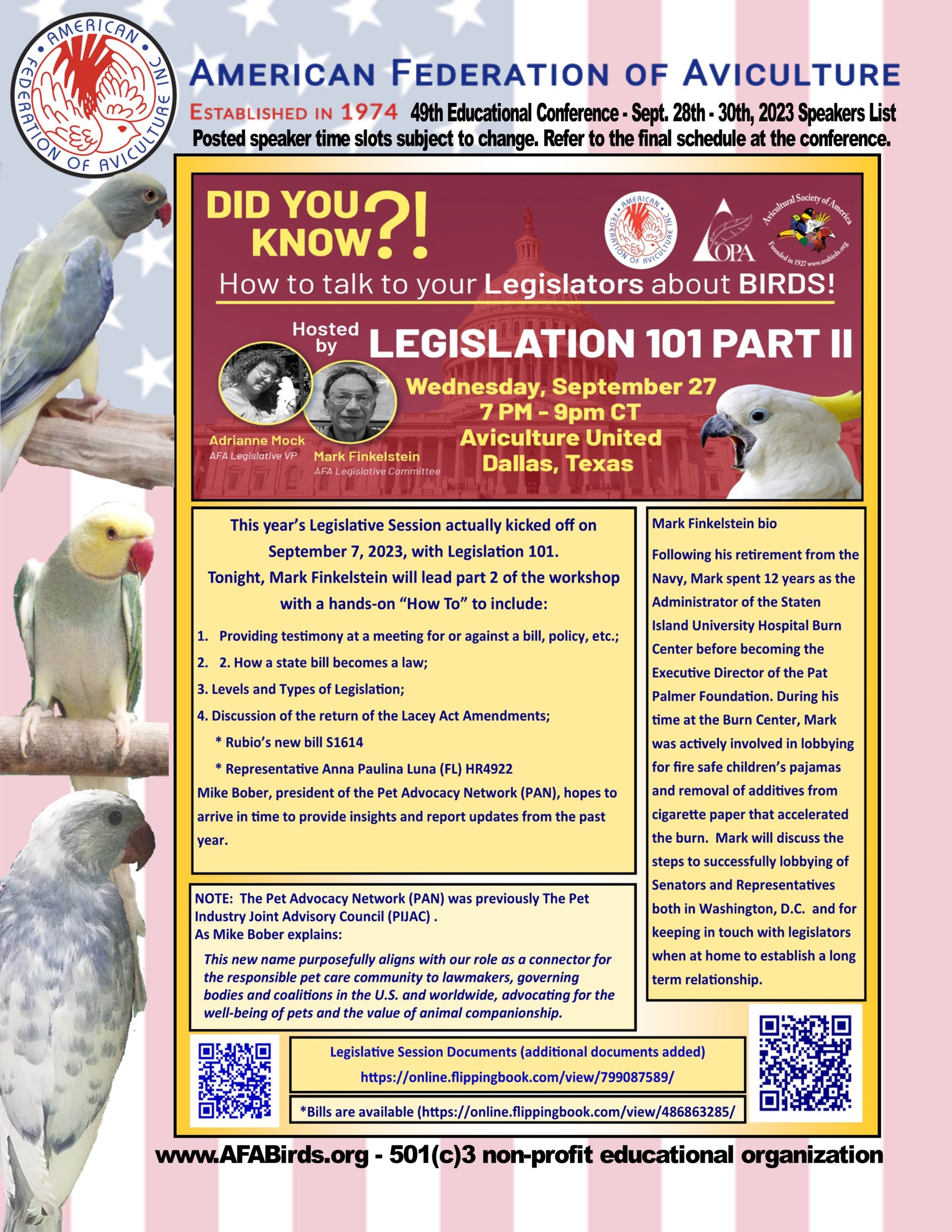
To assist aviculturists, breeders, and pet owners in staying informed, the American Federation of Aviculture maintains a dedicated information portal. Stakeholders can access real-time tracking, analytical breakdowns, and updates by visiting the "Current Legislative Issues" page located under the Legislation tab on the official AFA website. Additionally, organizations provide specialized training programs—such as the Legislation 101 Education Course—and comprehensive guides detailing federal oversight, including compliance with the USDA Animal Welfare Act. By fostering legislative awareness and proactive community engagement, avian advocates hope to safeguard the future of responsible bird keeping for generations to come.

