



Fujifilm North America Corporation has officially announced the expansion of its legendary QuickSnap line, marking the 40th anniversary of the world’s most recognizable one-time-use camera series. The introduction of the QuickSnap Black and White and the QuickSnap Active represents a strategic move by the imaging giant to capitalize on the sustained global resurgence of analog photography. These new variants are designed to cater to a bifurcated market: artistic hobbyists seeking the classic aesthetic of monochrome film and outdoor enthusiasts requiring a rugged, waterproof solution for unpredictable environments. By launching these models, Fujifilm reaffirms its commitment to the "one-time-use" category—a segment often colloquially referred to as "disposable" cameras, though Fujifilm emphasizes a more sustainable lifecycle through established recycling programs.
A Legacy of Accessibility: The 40-Year Chronology of the QuickSnap
The history of the QuickSnap began in 1986 when Fujifilm launched the "Utsurun-desu" in Japan. At the time, photography was a relatively expensive and technical hobby, requiring an investment in hardware and a basic understanding of exposure settings. The QuickSnap revolutionized the market by democratizing the medium, offering a pre-loaded, point-and-shoot device that anyone could purchase at a convenience store or pharmacy.

Throughout the late 1980s and 1990s, the QuickSnap evolved rapidly. In 1987, Fujifilm introduced a model with a built-in flash, drastically expanding the camera’s utility for indoor and nighttime use. By the early 1990s, waterproof versions and panoramic versions had hit the shelves, solidifying the QuickSnap’s reputation as the go-to choice for vacations, weddings, and casual gatherings. Despite the meteoric rise of digital photography in the early 2000s and the subsequent dominance of smartphones, the QuickSnap survived as a niche product that eventually found a second life among younger generations who value the tactile, unedited nature of film.
The 2024 anniversary release is not merely a nostalgic gesture but a response to a quantifiable shift in consumer behavior. Market data indicates that the global film photography market has seen a compound annual growth rate (CAGR) of approximately 5% over the last five years, driven largely by Gen Z and Millennial consumers seeking a "disconnect" from digital saturation.
Technical Specifications: The QuickSnap Black and White
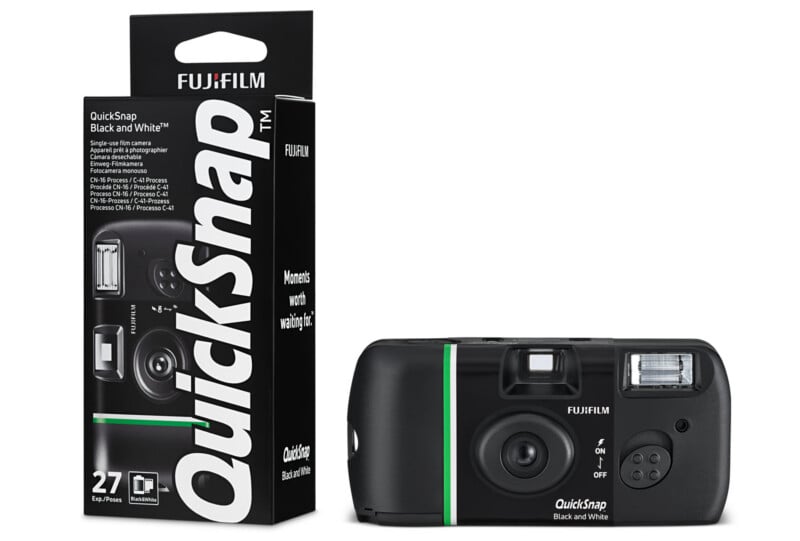
The QuickSnap Black and White is a direct nod to the roots of street photography and artistic portraiture. This model comes pre-loaded with a 27-exposure roll of ISO 400 black-and-white negative film. The choice of ISO 400 is intentional, providing a versatile balance between grain structure and light sensitivity, making it suitable for both bright daylight and overcast conditions.

Mechanically, the camera maintains the simplicity that defined the original series. It features a 32mm f/10 fixed-focus plastic lens. The f/10 aperture, combined with a 1/140s fixed shutter speed, ensures a deep depth of field, meaning most subjects from one meter to infinity will remain in relatively sharp focus. The camera includes a built-in flash with a range of approximately one to three meters, which is essential for black-and-white photography where high contrast and shadow definition are key stylistic elements.
Unlike color film, which uses multiple layers of dye-forming couplers, the black-and-white film in this QuickSnap utilizes silver halide crystals to produce a classic monochromatic image. This provides users with a distinct aesthetic that cannot be perfectly replicated by digital filters, characterized by authentic grain and a specific tonal range in the highlights and shadows.
Engineering for the Elements: The QuickSnap Active
The QuickSnap Active is the successor to Fujifilm’s previous waterproof offerings, redesigned to meet the needs of the modern "active lifestyle" consumer. Encased in a transparent, heavy-duty polycarbonate housing, the camera is rated waterproof up to 35 feet (approximately 10.6 meters) below the surface. This makes it an ideal companion for snorkeling, surfing, and poolside activities where neither a smartphone nor a high-end DSLR would be safe.

To compensate for the loss of light that occurs underwater, Fujifilm has equipped the QuickSnap Active with ISO 800 color negative film. The higher sensitivity of the ISO 800 stock allows for better exposure in the dimmer environments found beneath the water’s surface or under heavy forest canopies. Notably, the QuickSnap Active lacks a built-in flash. This design choice was likely made to ensure the structural integrity of the waterproof seal and to prevent backscatter—a common issue in underwater photography where a flash reflects off particles in the water, resulting in "snowy" spots in the image.
The Active model also features a prominent wrist strap, a simple but vital addition for use in high-motion environments like whitewater rafting or beach volleyball. The oversized shutter button and film advance wheel are designed to be tactile and easy to operate, even when the user is wearing gloves or has wet hands.
Market Context and the "Analog Renaissance"
The release of these two cameras occurs against a backdrop of what industry analysts call the "Analog Renaissance." While the professional sector remains firmly digital, the consumer and "prosumer" sectors have seen a massive influx of interest in film. This is evidenced by the rising prices of vintage film cameras on the secondary market and the expansion of film processing labs in urban centers.
Several factors contribute to this trend:
- Intentionality: As noted by Fujifilm executives, the finite nature of 27 exposures forces the photographer to be more selective and present.
- Aesthetic Authenticity: The chemical process of film development creates a "look" (halation, grain, and organic color shifts) that digital sensors often struggle to emulate convincingly.
- Physicality: In an era of cloud storage, the physical negative and the printed photograph offer a tangible record of a moment.
Fujifilm’s decision to include a black-and-white option is particularly savvy. For years, users wanting black-and-white one-time-use cameras had to turn to competitors like Ilford or Kodak. By introducing its own version, Fujifilm is consolidating its market share and offering a complete ecosystem for the analog enthusiast.
Official Perspectives: The Philosophy of Intentionality
Bing Liem, Division President of the Imaging Division at Fujifilm North America Corporation, emphasized the psychological appeal of the QuickSnap in his official statement. According to Liem, the QuickSnap has served as a "trusted companion" for four decades, but its role has changed in the digital age.

"In the age of endless smartphone imagery, one-time-use cameras have always offered something unique—intentionality," Liem stated. He described the cameras as a "dedicated device" that provides a "departure from the constant beeping, buzzing, or alerts from our electronic devices."
Liem’s comments highlight a growing segment of the market that views photography not just as a way to document life, but as a form of "digital detox." By stripping away the ability to instantly review, edit, or delete a photo, Fujifilm is selling an experience as much as a product. The "filter-free" nature of the QuickSnap is positioned as an "authentic" alternative to the highly curated and often artificial world of social media photography.
Pricing, Availability, and Regional Strategy
Fujifilm has outlined a clear rollout plan for both models, targeting the North American market initially. The Fujifilm QuickSnap Black and White is slated for release in early September 2024. It will carry a Manufacturer’s Suggested Retail Price (MSRP) of $22.90 in the United States and $34.99 in Canada.

The QuickSnap Active, due to its specialized waterproof housing and higher-speed film, will be priced slightly higher. The MSRP for the Active model is set at $24.75 in the U.S. and $36.99 in Canada.
These price points position the QuickSnap as an accessible "impulse buy" for travelers and event-goers, while remaining competitive with other film-based alternatives. The pricing also reflects the increased costs of film production and the specialized manufacturing required for the waterproof variant.
Broader Implications for the Photography Industry
The launch of the QuickSnap Black and White and Active suggests that Fujifilm sees long-term viability in the analog sector. While the company’s Instax line of instant cameras remains its primary driver of growth in the imaging division, the one-time-use analog camera serves a different purpose. It provides a higher-resolution negative that can be professionally scanned and printed in large formats, something that instant film cannot match.

Furthermore, this release may signal a broader stability in the film supply chain. Over the past three years, film photographers have faced significant shortages and price hikes due to supply chain disruptions and increased demand. Fujifilm’s ability to launch new film-based products suggests that production capacities are meeting the needs of the global market.
The environmental impact of "disposable" cameras remains a point of discussion. Fujifilm has addressed this by maintaining a robust recycling system where the plastic shells and internal mechanisms of the QuickSnaps are collected by processing labs and returned to the manufacturer for refurbishment or material recovery. This "circular" approach is essential for the product’s survival in an increasingly eco-conscious consumer market.
As Fujifilm marks this 40-year milestone, the QuickSnap continues to defy the expectations of the digital age. By blending the simplicity of the 1980s with the artistic and adventurous demands of 2024, the company ensures that the "click and wind" of a one-time-use camera will remain a staple of the photographic landscape for years to come.

