


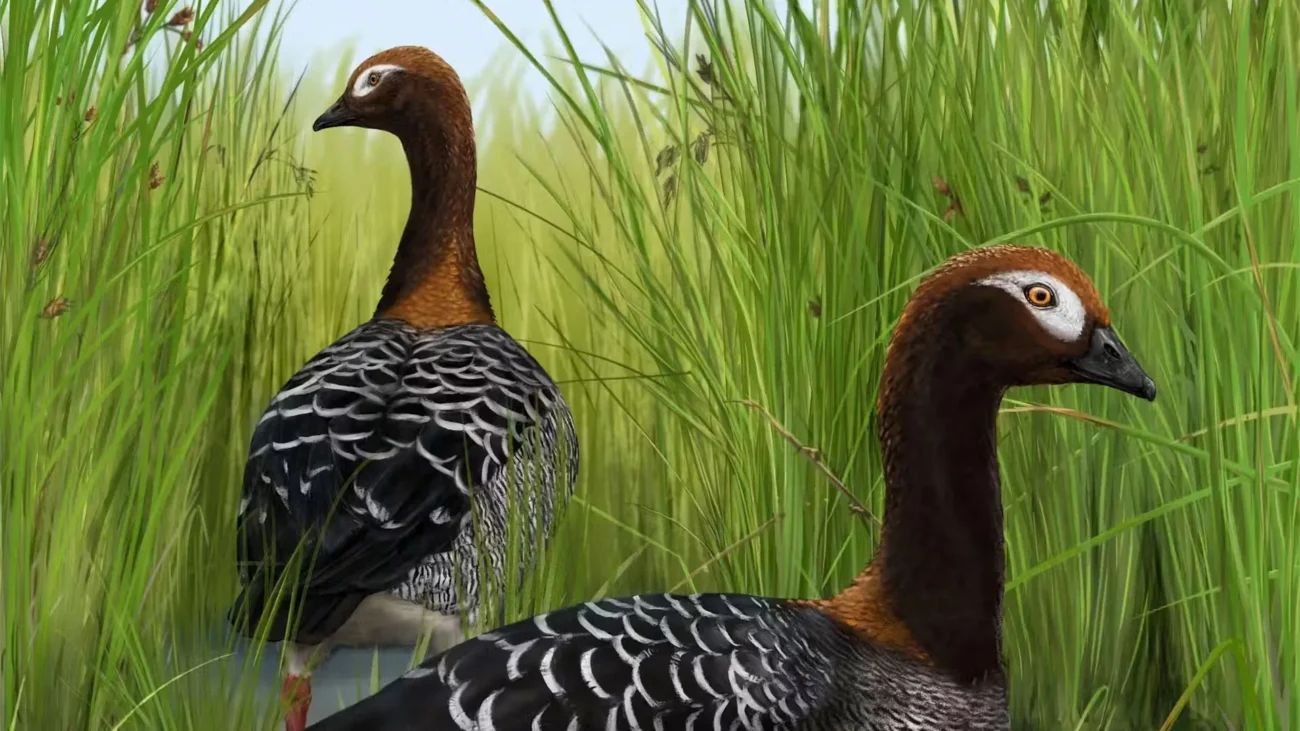
The discovery of a previously unknown species of fossil goose, unearthed from the ancient lakebed deposits of Central Otago, is prompting a significant re-evaluation of how New Zealand’s unique and often endemic birdlife evolved. Researchers from the University of Otago, known in Māori as ÅŒtÄkou Whakaihu Waka, have revealed that this remarkable find provides compelling new evidence suggesting the origins of Aotearoa’s avian inhabitants were far more dynamic and complex than previously theorized. The research, a collaborative effort involving international scientific expertise, underscores the ongoing revelations emerging from the rich fossil record of the St Bathans region.
Unveiling a New Species from the St Bathans Fossil Beds
The St Bathans fossil deposits, a globally renowned repository of Oligocene and Miocene vertebrate fossils, have long been a focal point for paleontological research. These deposits, formed from sediment accumulated in an ancient lake system that existed for millions of years, have yielded a treasure trove of information about prehistoric life in New Zealand. While waterfowl fossils are relatively common within these ancient strata, the identification of goose remains has historically been less frequent, making any new discovery particularly significant.
Associate Professor Nic Rawlence, Director of the Otago Palaeogenetics Laboratory and a co-author of the new study published in the journal Historical Biology, explained the meticulous process undertaken by the research team. "We re-examined every fossil bone that had been previously classified as belonging to geese," Rawlence stated. This comprehensive review involved comparing these specimens not only with other fossil waterfowl recovered from the St Bathans site but also against an extensive comparative collection of modern and extinct bird skeletons housed in various institutions.
The painstaking analysis led to a groundbreaking conclusion: among the existing goose fossil material lay the remains of an entirely undescribed species. "We determined that the bones included an undescribed species, the size of a small goose," Rawlence confirmed. This discovery, a testament to the power of revisiting existing collections with fresh perspectives and advanced analytical techniques, adds a new branch to the evolutionary tree of New Zealand’s geese.
Naming the Ancient Waterfowl: A Nod to Myth and Geology
The newly identified bird has been formally christened Meterchen luti. This evocative scientific name draws inspiration from a beloved children’s nursery rhyme, "Old Mother Goose," a symbolic connection to an ancient avian creature emerging from the geological depths. The genus name, Meterchen, is derived from ancient Greek, translating to "mother goose," while the species epithet, luti, is a Latin term meaning "of the mud," directly referencing the sedimentary environment from which the fossil was recovered. This nomenclature highlights the researchers’ intent to embed a narrative of discovery and geological origin into the scientific identity of the species.
Crucially, the research team has established that Meterchen luti is not closely related to the giant, flightless New Zealand geese, Cnemiornis species, which are known from more recent fossil records and are now extinct. Furthermore, it is also distinct from their closest living relative, the Australian Cape Barren goose. This finding immediately complicates earlier assumptions about the evolutionary lineage of geese in New Zealand, suggesting a more diverse and perhaps independent arrival and diversification of waterfowl ancestors.
Challenging Established Narratives of Avian Arrival and Diversification
The implications of the Meterchen luti discovery extend far beyond the identification of a single new species. When considered alongside recent advances in genetic research, it strongly indicates that New Zealand’s bird history is considerably more intricate and dynamic than scientists had previously assumed. For decades, the prevailing scientific narrative often painted a picture of ancient lineages arriving in New Zealand millions of years ago and evolving in relative isolation. However, emerging evidence, including this fossil find, suggests a more complex pattern of arrivals, extinctions, and adaptations.
Alan Tennyson, the lead author of the study from the Museum of New Zealand Te Papa Tongarewa, elaborated on this paradigm shift. He pointed out that while many bird species have indeed reached New Zealand over vast geological timescales, the ancestors of some of the country’s most iconic large birds, such as the takahē, Forbes’ harrier, and the colossal Haast’s eagle, appear to have arrived surprisingly recently. These more recent colonizations, dating back only four to five million years, indicate that the landscape of New Zealand’s avifauna has been shaped by multiple waves of immigration and subsequent evolutionary radiations.
This new understanding directly challenges an earlier hypothesis that posited the St Bathans goose represented the direct ancestral lineage of the giant flightless Cnemiornis geese. Under that older theory, this lineage would have possessed an exceptionally long history in Zealandia, potentially dating back at least 14 million years. Such a deep evolutionary history would have supported the idea of an ancient, endemic origin for these large flightless birds.
However, the newly presented research highlights a significant conflict with compelling genetic evidence. This genetic data suggests that the ancestors of the Cnemiornis geese actually arrived in New Zealand from Australia much more recently, approximately seven million years ago. This discrepancy was a point of contention that proponents of the older theory often downplayed or dismissed. The rigorous reassessment of the fossil evidence, now bolstered by the discovery of Meterchen luti and its distinct evolutionary placement, provides robust support for the later arrival theory.
A Chronology of Zealandian Avian Colonization and Evolution
The geological history of Zealandia, the largely submerged continental fragment that includes New Zealand, provides a crucial backdrop for understanding these avian migrations and evolutionary events. The St Bathans fossil deposits date back to the late Oligocene and early Miocene epochs, approximately 23 to 5 million years ago. During this period, New Zealand experienced significant geological changes, including periods of submergence and emergence, which would have influenced the island’s biogeography and its capacity to act as a refuge or a stepping stone for migratory species.
- ~23 to 5 Million Years Ago (Oligocene to Miocene): The St Bathans fossil beds are formed in an ancient lake system, preserving a rich snapshot of the fauna present, including the ancestors of Meterchen luti.
- ~14 Million Years Ago: Ancestors of Meterchen luti are believed to have arrived in Zealandia. This lineage eventually went extinct without leaving direct descendants.
- ~7 Million Years Ago: Genetic evidence suggests the ancestors of the Cnemiornis geese arrived in New Zealand from Australia.
- ~5 Million Years Ago to Present: Following their arrival, the Cnemiornis lineage underwent rapid evolution, leading to the development of the giant, flightless forms.
- ~4 to 5 Million Years Ago: Other significant avian lineages, including those leading to the takahē, Forbes’ harrier, and Haast’s eagle, are believed to have arrived in New Zealand.
- Recent Past (Holocene): Human arrival in New Zealand approximately 700 years ago, followed by European settlement, led to widespread extinctions of many endemic species, including the Cnemiornis geese.
This revised timeline paints a picture of Zealandia as a dynamic evolutionary crucible, shaped by both ancient migrations and more recent colonizations. The extinction of the Meterchen luti lineage, despite its ancient arrival, underscores the precariousness of island biogeography and the impact of environmental changes on species survival.
The Power of Integrated Scientific Approaches: DNA and Fossils
Associate Professor Rawlence emphasizes the indispensable role of integrating multiple scientific disciplines in reconstructing these complex evolutionary narratives. "Using all the tools in the toolbox, including DNA and fossils, we can reconstruct how the dynamic geological, climatic, and human history of Zealandia has shaped the evolution of Aotearoa fauna in ever more detail," he stated. This multi-faceted approach, combining traditional paleontological methods with cutting-edge molecular analysis, allows for a more nuanced and accurate understanding of past life.
The study of Meterchen luti serves as a compelling case study. While the fossil itself provides direct morphological evidence and a chronological marker, genetic analysis of related or even distantly related species can offer insights into migration patterns, population history, and evolutionary relationships that might not be discernible from fossils alone. The integration of these data streams helps to resolve ambiguities and challenge long-held assumptions.
Island Gigantism: The Case of Cnemiornis
The Cnemiornis geese provide another remarkable example of how quickly island species can adapt and evolve in the absence of significant predation and competition. Their relatively recent evolution into giant, flightless forms is a striking illustration of island gigantism, a phenomenon where species isolated on islands tend to evolve larger body sizes than their mainland counterparts.
"The relatively recent evolution of the giant flightless Cnemiornis geese offers another striking example of rapid morphological change that can occur within a short timeframe on islands," Rawlence commented. These birds, reaching up to one meter in height and weighing as much as 18 kilograms, were among the largest geese in the world. Their evolution from a smaller, likely flying ancestor into these colossal forms over a mere few million years highlights the powerful selective pressures at play in isolated island ecosystems. This rapid transformation underscores the plasticity of evolution and the unique evolutionary trajectories that island environments can foster.
Broader Implications for Conservation and Biogeography
The ongoing revelations from New Zealand’s fossil record have profound implications not only for understanding evolutionary history but also for contemporary conservation efforts. By piecing together the complex patterns of arrival, diversification, and extinction, scientists can gain a deeper appreciation for the fragility of island ecosystems and the unique evolutionary heritage of species like those found in Aotearoa.
The realization that some of New Zealand’s iconic birds have more recent origins than previously thought suggests that conservation strategies might need to account for these complex histories. Understanding the timing and pathways of colonization can inform efforts to protect existing populations and, where appropriate, consider reintroduction programs based on a thorough understanding of ecological and evolutionary context.
Furthermore, the discovery of Meterchen luti reinforces the importance of continued paleontological research. Ancient lakebeds and sedimentary deposits, like those at St Bathans, represent archives of life that are still yielding secrets. Each new fossil find, especially those that challenge established theories, contributes to a more complete and accurate picture of Earth’s biological past. The dynamic nature of New Zealand’s avian evolution, as revealed by this research, serves as a potent reminder that scientific understanding is a continually evolving process, built upon rigorous investigation and a willingness to revise hypotheses in the face of new evidence. The story of the St Bathans goose is far from over; it is a chapter in the grand, unfolding narrative of life on our planet.

