


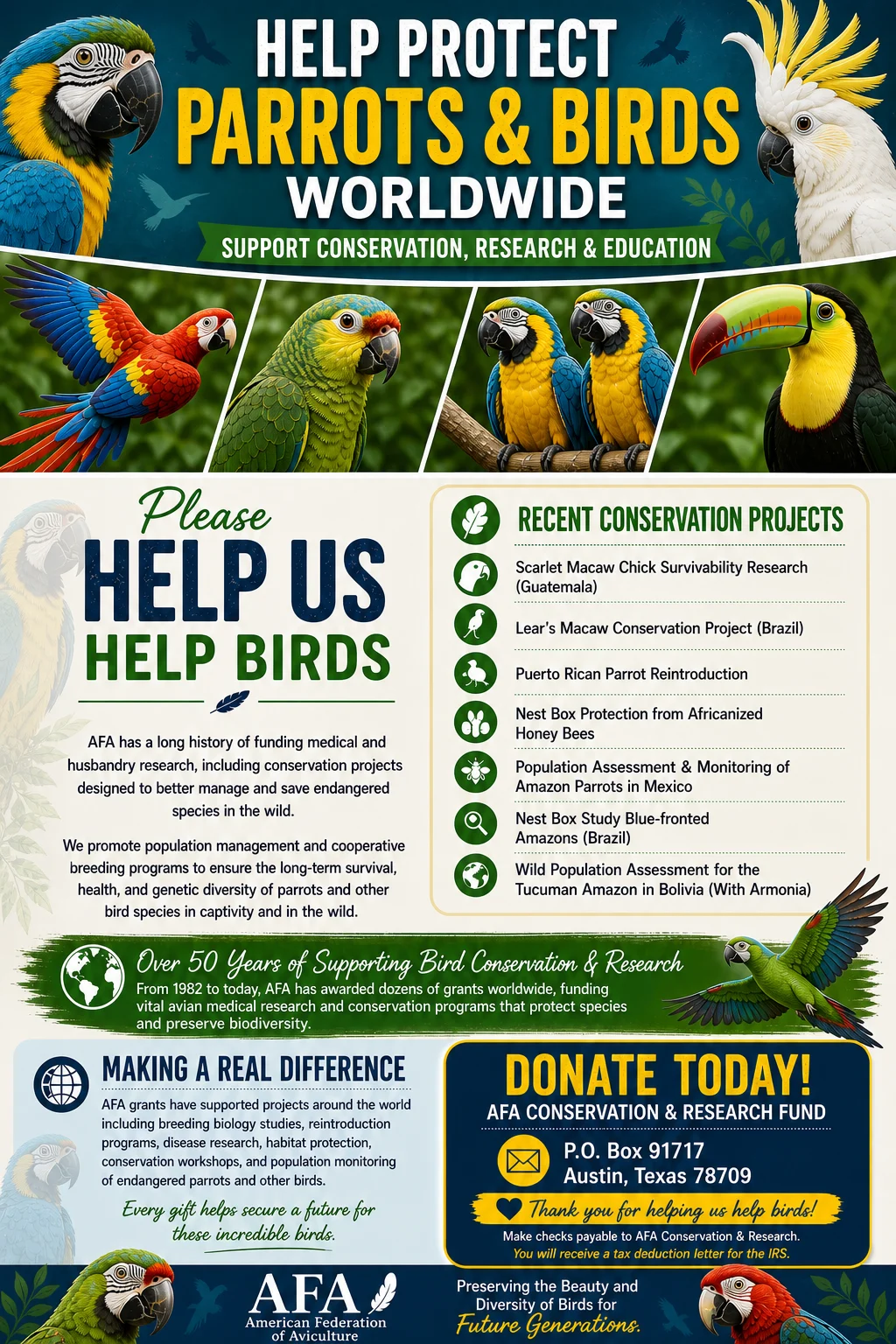
The American Federation of Aviculture (AFA), a premier non-profit educational and avicultural umbrella organization, has significantly ramped up its domestic and international conservation initiatives. Through strategic partnerships, targeted field grants, and rigorous navigation of international wildlife laws, the organization continues to champion the preservation of endangered psittacine species and their native habitats.
The AFA’s renewed conservation push is underscored by a major collaborative effort with Harrison’s Bird Foods, which recently bolstered the organization’s funding capacity with a generous $25,000 contribution. These joint efforts directly fuel grassroots field biology, veterinary research, and habitat preservation projects across Latin America and beyond, bridging the gap between captive aviculture and wild population recovery.
Chronology and Historical Background of the AFA
The roots of the American Federation of Aviculture trace back to the early 1970s, a period marked by regulatory turmoil for bird owners and breeders. During an outbreak of Exotic Newcastle Disease in California, the United States Department of Agriculture (USDA) euthanized thousands of healthy exotic birds housed in private collections. This crisis catalyzed state-level legislative proposals aimed at severely restricting or entirely banning the private ownership of exotic birds.
In response to these existential threats, southern California bird owners and clubs united to establish the AFA in March 1974. Incorporated in California as a 501(c)(3) non-profit educational organization with its national business office currently based in Austin, Texas, the AFA was designed to function as an overarching federation. Over the decades, it has grown to represent thousands of individual members, alongside numerous affiliated bird clubs and regional organizations worldwide.
Historically, the AFA has maintained a robust grant-making program. Between 1982 and 1993 alone, the organization awarded more than 40 separate grants for avian research. Today, the AFA Conservation Committee continues to review proposals annually, typically issuing modest grants of $500 or more to projects that align with its core mission: advancing breeding practices, husbandry, exotic bird living conditions, conservation, scientific research, and legislative awareness.
Current Global Conservation Projects and Field Initiatives
The AFA’s financial contributions and member-supported initiatives directly sustain several high-impact field projects designed to protect vulnerable wild parrot populations from poaching and habitat loss.
At the Chajul Biology Station operated by Natura Mexicana in the Lacandon rainforest of southern Mexico, wild scarlet macaws face near-zero percent fledgling rates without human intervention due to intense poaching for domestic and international pet trade. Designated as a primary AFA conservation focus, Chajul biologists actively monitor wild nests, identify hatchlings, and engage in head-starting programs to rear and release wild-hatched scarlet macaws back into the forest. With over 150 scarlet macaws successfully fledged, the station relies on critical equipment such as brooders, incubators, portable incubators, gram scales, and medical supplies. Fundraising efforts aim to continually equip these field stations to maximize their survival rates.
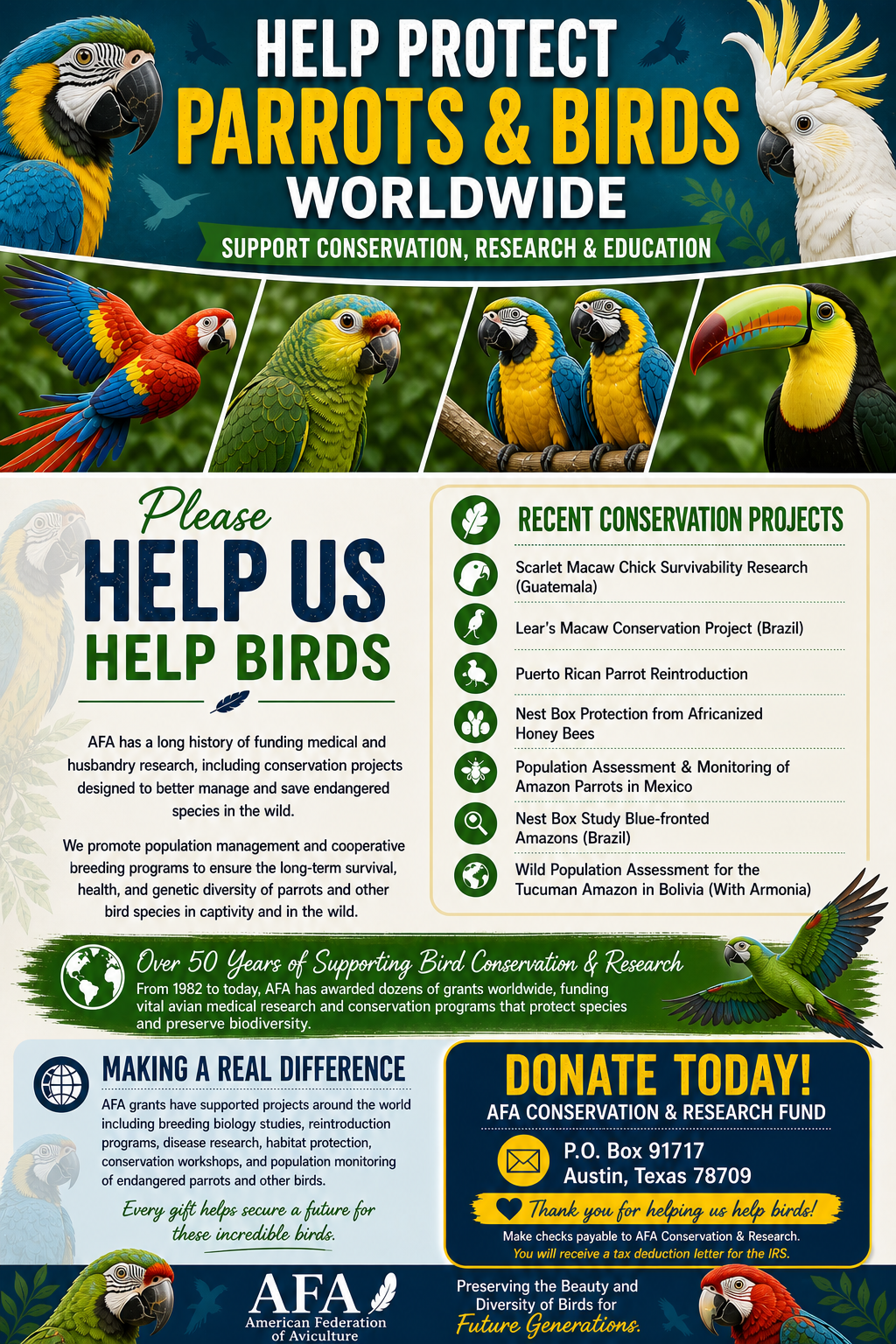
In Guatemala, the Wildlife Conservation Society (WCS) Selva Maya Living Landscape Program has worked since 2002 to assess the conservation status of scarlet macaws within the Maya Biosphere Reserve. By implementing threat-based interventions and experimental population enhancements aimed at increasing chick survivability, the WCS has secured scarlet macaws as one of its top five focal landscape species.
Meanwhile, innovative technological solutions are being deployed to mitigate human-wildlife conflicts and nest-site competition. Principal Investigator Caroline A. Efstathion has pioneered a "push-pull" prevention protocol designed to protect artificial parrot nest boxes from aggressive colonization by Africanized honey bees. By deploying a bird-safe insecticide, permethrin, alongside Nasonov pheromone-baited traps placed in more attractive, south-facing cavities, the protocol safely repels scout bees from parrot boxes. This methodology is gradually being adopted across multiple psittacine conservation sites.
In the Tambopata Region of Peru, comprehensive health assessments are underway. Led by principal investigators J. Jill Heatley, Lizzie Ortiz-cam, and Donald Brightsmith, researchers utilize field-side i-STAT analyzers to evaluate electrolytes, venous blood gases, lactate, and ionized calcium in growing nestlings and free-flighted adult macaws. By combining complete blood counts, parasite evaluations, and physiological baseline data, the project provides invaluable insights for both wild conservation management and clinical avian veterinary practice. These investigations also shed light on the ecological drivers of clay lick utilization among wild parrots.
Furthermore, the AFA continues its support for the Lear’s Macaw Corn Subsidy Program in Brazil, compensating local farmers whose crops are consumed by wild Lear’s macaws, thereby mitigating lethal human-wildlife conflict.

Regulatory Frameworks: CITES, the WBCA, and the ESA
Beyond direct field funding, the AFA actively monitors and engages with international and domestic regulatory bodies to ensure that captive breeding programs and conservation policies remain scientifically sound.
The Convention on International Trade in Endangered Species of Wild Fauna and Flora (CITES) governs the international movement of wildlife. Through official Non-Governmental Observer (NGO) status granted by the U.S. Fish and Wildlife Service (USFWS), the AFA regularly participates in CITES Animals Committee meetings. This presence allows the avicultural community to provide ground-level data on psittacine biology, trade dynamics, and captive population health directly to international policy-makers.
Domestically, the Wild Bird Conservation Act (WBCA) of 1992 serves as a stringent federal barrier against the commercial importation of wild-caught birds into the United States. Following legal challenges in the wake of its enactment, the WBCA effectively halted the mass importation of nearly all CITES-listed parrot species (family Psittacidae). However, the statute incorporates specific exemptions, most notably the creation of Cooperative Breeding Programs (CBPs).
Managed in conjunction with the USFWS, CBPs permit authorized avicultural organizations—such as the AFA, which has overseen programs for species including the Red Siskin, Blue-headed Macaw, Javan Hill Mynah, Red-crested Cardinal, and the Blue-eyed (Ophthalmica) Cockatoo—to import limited numbers of underrepresented species. These imports are strictly restricted to foundational breeding stock aimed at establishing self-sustaining domestic populations rather than supplying the commercial pet trade. Program managers are legally mandated to submit biannual status reports detailing the health and lineage of all imported specimens and their offspring.

Concurrently, the U.S. Endangered Species Act (ESA), signed into law by President Richard Nixon in December 1973, protects native and exotic species threatened with extinction. For aviculturists, the ESA imposes strict interstate commerce restrictions on listed species. While possessing a legally acquired ESA-listed bird generally does not require a federal permit, selling, bartering, or moving the animal across state lines necessitates specific documentation, such as an Interstate Commerce Permit or a Captive-bred Wildlife Permit, unless specific exemptions apply.
Broader Implications and Future Outlook
The multifaceted approach maintained by the American Federation of Aviculture demonstrates a comprehensive model for modern wildlife stewardship. By intertwining financial support for in situ field conservation in Latin America with rigorous advocacy for sustainable ex situ captive management, the organization addresses the dual crises of habitat destruction and regulatory restriction.
As environmental pressures mount across the neotropics and regulatory scrutiny intensifies domestically, the AFA’s ongoing collaboration with corporate sponsors like Harrison’s Bird Foods and scientific researchers ensures that resources continue to reach frontline conservationists. Through transparent grant proposal guidelines, active CITES participation, and meticulous oversight of Cooperative Breeding Programs, the AFA remains a vital bridge between the avicultural community and international wildlife conservation objectives.

