


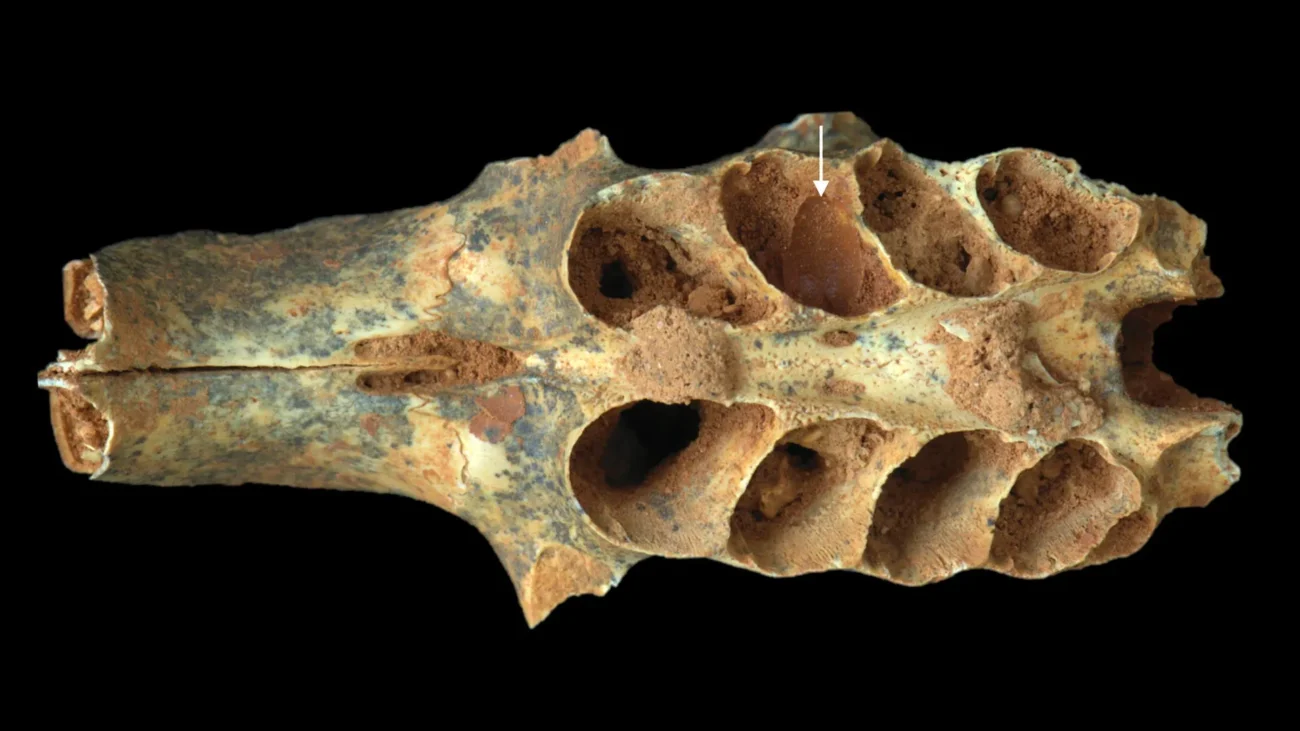
Twenty thousand years ago, the limestone caves of Hispaniola, an island shared by Haiti and the Dominican Republic, were a haven for generations of owls. These nocturnal predators, through their regular regurgitation of indigestible prey remnants, left behind a unique archaeological record: owl pellets. These discarded pellets, containing the bones of countless small animals, have now revealed an astonishing secret. A groundbreaking study published in the prestigious journal Royal Society Open Science details the discovery of ancient bees utilizing the empty tooth sockets within these fossilized jawbones as meticulously crafted nesting sites for their young. This finding represents the first documented instance of bees employing animal bones as nurseries, uncovering an entirely novel and previously unknown nesting strategy within the insect world.
A Fossil-Rich Cave Preserves an Ancient Ecosystem
The Caribbean island of Hispaniola is renowned for its extensive network of thousands of limestone caves, a geological feature that has proven to be a treasure trove for paleontological research. "In some areas, you’ll find a different sinkhole every 100 meters," remarks Lazaro Viñola López, a postdoctoral researcher at the Field Museum in Chicago and the lead author of the study. This particular cave, identified by Juan Almonte Milan, curator of paleobiology at the Dominican Republic’s Museo Nacional de Historia Natural, as an exceptionally rich fossil deposit, became the focus of Viñola López’s doctoral research at the University of Florida and the Florida Museum of Natural History.
The initial descent into the cave was a dramatic affair. "The initial descent into the cave isn’t too deep — we would tie a rope to the side and then rappel down," Viñola López recounts. "If you go in at night, you see the eyes of the tarantulas that live inside. But once you walk down a ten-meter-long tunnel underground, you start finding the fossils." The cave’s internal environment, characterized by layers of carbonate deposits formed during ancient rainy periods, effectively sealed and preserved multiple fossil strata. The vast majority of the unearthed remains belonged to rodents, but the collection also included fossils from sloths, birds, reptiles, and an impressive array of over 50 distinct species, painting a vivid picture of the cave’s past inhabitants and its role in the ancient ecosystem.
A Multifaceted Owl Roost Revealed Through Fossil Evidence
The accumulated fossils within the cave provided compelling evidence of its long-term use by a particular group of animals. "We think that this was a cave where owls lived for many generations, maybe for hundreds or thousands of years," explains Viñola López. "The owls would go out and hunt, and then come back to the cave and throw up pellets. We find fossils of the animals that they ate, fossils from the owls themselves, and even some turtles and crocodiles who might have fallen into the cave." This interpretation suggests the cave served as a stable roosting and nesting site for successive owl generations, with their predatory habits inadvertently creating a unique paleontological archive. The presence of diverse prey species, including small mammals, birds, and reptiles, underscores the owls’ ecological importance as apex predators within this prehistoric environment.
Unveiling an Unexpected Discovery Within Tooth Sockets
While meticulously studying the mammal bones deposited by the owls, Viñola López made a serendipitous observation that would lead to a paradigm shift in understanding ancient bee behavior. During the cleaning of fossilized jawbones, he noticed peculiar smooth deposits filling some of the empty tooth sockets. These formations differed significantly from naturally accumulated sediment. "It was a smooth surface, and almost concave. That’s not how sediment normally fills in, and I kept seeing it in multiple specimens. I was like, ‘Okay, there’s something weird here,’" he states. His initial reaction was one of intrigue and curiosity, recognizing an anomaly that defied conventional geological explanations.
The unusual appearance of these deposits immediately brought to mind an earlier experience during an undergraduate fossil excavation in Montana. There, Viñola López had been shown fossilized wasp cocoons – small, mud-built chambers where developing larvae mature. The resemblance between these ancient wasp nests and the structures he was observing within the fossil jaws was striking, sparking a hypothesis that would require further investigation.
Ancient Bee Nests Revealed Through Advanced Imaging
While honey bees and paper wasps are widely recognized for their elaborate communal nest construction, the vast majority of bee species are solitary. These solitary bees typically excavate small cavities in the ground or in wood, or utilize pre-existing empty structures for their nests, laying their eggs and provisioning them with pollen for their developing larvae. "But actually, most bees are solitary. They lay their eggs in small cavities, and they leave pollen for the larvae to eat," Viñola López clarifies. "Some bee species burrow holes in wood or in the ground, or use empty structures for nests. Some species in Europe and Africa even build their nests in empty snail shells." This background knowledge provided a crucial framework for understanding the potential behavior of the ancient bees on Hispaniola.
To confirm his suspicions, the research team employed state-of-the-art CT scanning technology. This non-destructive imaging technique allowed for the creation of detailed three-dimensional reconstructions of the compacted material within the fossil tooth sockets without causing any damage to the delicate fossils or the sediment itself. The CT scans provided irrefutable evidence. The internal structures of the deposits precisely matched the morphology of mud nests constructed by modern solitary bee species. Incredibly, some of these fossilized nests even preserved grains of ancient pollen, offering direct evidence of the mother bees meticulously collecting and storing food for their developing offspring.
The researchers hypothesize that these ancient bees expertly mixed dirt with their saliva to fashion each minuscule nest, with individual structures measuring less than the diameter of a pencil eraser. Nesting within the hollow tooth sockets of larger animals may have offered a significant survival advantage, providing crucial protection against potential predators such as wasps. This opportunistic adaptation highlights the remarkable ingenuity of these ancient insects in exploiting available resources for reproduction.
A Novel Class of Fossilized Nests: Osnidum almontei
Although the fossil nests themselves were remarkably well-preserved, they contained no fossilized bees. The research team attributes this absence to the cave’s consistently warm and humid environment, which is generally unfavorable for the preservation of delicate insect bodies. Without the physical remains of the bees, definitively identifying the specific species responsible for these unique nests proved challenging. However, the distinct architectural features of the nests were sufficiently unique to warrant their own taxonomic classification.
The fossil nests have been formally named Osnidum almontei, a tribute to Juan Almonte Milan. His pioneering identification of the cave as a significant fossil site and his decades of dedicated study of the region’s paleontology as one of Hispaniola’s foremost experts have been instrumental to this discovery. "Since we didn’t find any of the bees’ bodies, it’s possible that they belonged to a species that’s still alive today — there’s very little known about the ecology of many of the bees on these islands," Viñola López explains. "But we know that a lot of the animals whose bones are preserved in the cave are now extinct, so the bees that created these nests might be from a species that has died out." This uncertainty underscores the vast, unexplored biodiversity of insect life, both past and present, particularly in island ecosystems.
The First Documented Instance of Bees Nesting in Bones
The discovery of Osnidum almontei marks the first scientifically documented case of bees utilizing animal bones as nesting sites. Viñola López suggests that a confluence of environmental factors likely facilitated this unusual behavior. The limestone landscape of Hispaniola is characterized by a scarcity of readily available soil, making traditional underground nesting sites a limited resource for many bee species. Simultaneously, the continuous deposition of owl pellets over millennia provided an abundant and consistent supply of hollow tooth sockets. This ecological niche, created by the interaction of geology and animal behavior, provided an ideal opportunity for solitary bees to adapt and thrive.
"This discovery shows how weird bees can be — they can surprise you. But it also shows that when you’re looking at fossils, you have to be very careful," Viñola López emphasizes. He highlights the critical role of prior experience and keen observation in paleontological research. Had he not possessed the knowledge of fossilized wasp nests from his earlier excavation, he might have inadvertently discarded the unusual sediment during routine fossil preparation.
This finding serves as a powerful reminder of the immense value of trace fossils – indirect evidence of past life. "Even if you’re looking primarily for fossils of larger, vertebrate animals, you should keep an eye out for trace fossils that can tell you about invertebrates like insects. Knowing about insects can tell you a lot about a whole ecosystem, so you have to pay attention to that part of the story," Viñola López concludes. The study of Osnidum almontei not only sheds light on the life and adaptations of ancient bees but also enriches our understanding of the complex ecological dynamics that shaped prehistoric Caribbean ecosystems. It underscores the interconnectedness of species and the often-surprising ways in which life finds a way to persist and evolve.

