


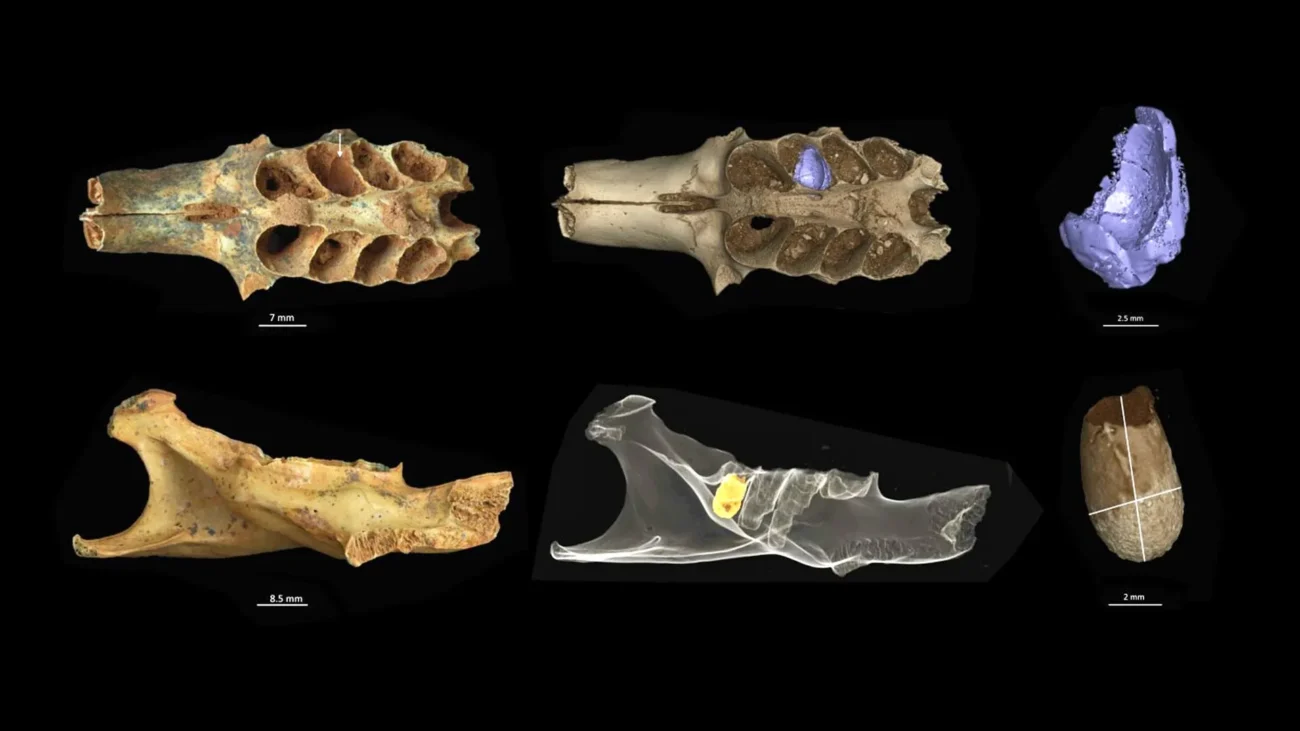
A colossal barn owl, a Caribbean rodent known as a hutia, and a burrowing bee converged within a cave’s shadowed depths. Tragically, only two emerged from the darkness. The silent inhabitant left behind was the one tethered to the earth, incapable of flight. This peculiar narrative, stretching back millennia, has been painstakingly pieced together by paleontologists who discovered an unprecedented natural phenomenon within a Dominican Republic cave: bees utilizing ancient fossilized bone cavities as nurseries.
The drama likely unfolded thousands of years ago on the island of Hispaniola, a landmass shared by Haiti and the Dominican Republic. In this ancient epoch, a giant barn owl, a formidable nocturnal predator, would have carried its prey, a hutia, back to its established lair. This cave, serving as a consistent hunting ground, became a larder for the owl’s hungry offspring. The swift, brutal efficiency of nature meant the hutia’s life was extinguished, its remains subsequently scattered across the cave floor as the owl’s meal concluded. It was within this aftermath, long after the owl and its prey had vanished from the living world, that the unlikely story of the bee began. Drawn by the promise of shelter, a solitary burrowing bee arrived, seeking a secure location to construct its nest amidst the detritus of ancient feasting.
The Ingenuity of Nature: Fossilized Sockets as Bee Nests
The bee, driven by instinct, began its excavation in the fine, clay-rich silt that had accumulated in the cave’s more secluded recesses. Its determined tunneling, however, was interrupted as it encountered the fossilized remains of the hutia. What might have been a deterrent proved to be an unexpected boon. The hutia’s jawbone, preserved in the fossil record, still held its original dental sockets, known as alveoli. Although the teeth themselves were long gone, these hollow spaces remained intact and remarkably empty. Their dimensions, as fate would have it, were an almost perfect fit for the bee’s nesting requirements.
This serendipitous discovery marked the beginning of a unique ecological interaction. Over successive generations, more burrowing bees, likely descendants of the initial explorer, discovered these ready-made subterranean chambers. The hollowed-out alveoli of the hutia bones provided a secure, pre-excavated space, eliminating the need for the bees to expend precious energy digging through the compacted cave sediment. This remarkable adaptation, where a prehistoric predator’s feeding habits inadvertently created a sheltered environment for a later generation of insects, remained hidden for millennia, a testament to the enduring power of natural processes.
A Paleontologist’s Vigilance Uncovers a Remarkable Ichnofossil Record
The preservation of this intricate ecological interplay is largely attributable to the meticulous work of paleontologists and a keen eye for detail during excavation. Lazaro Viñola Lopez, then a doctoral student at the Florida Museum of Natural History, was instrumental in uncovering this extraordinary natural history. His research focused on a specific species of hutia, a large, ground-dwelling rodent endemic to the Caribbean, which was infrequently found in other parts of Hispaniola.
During excavations at Cueva de Mono (Monkey Cave) in the southern Dominican Republic, Viñola Lopez unearthed thousands of hutia fossils, all appearing to belong to the same species. The abundance of these remains suggested that Cueva de Mono had served as a long-term feeding site for giant barn owls, a practice that likely spanned numerous generations of these avian predators.
Instead of immediately cleaning the recovered fossils, a standard procedure to remove surrounding sediment, Viñola Lopez adopted a more circumspect approach. He meticulously inspected each specimen. One particular cavity within a hutia mandible caught his attention. Unlike the rough, porous texture of bone, this interior surface was unexpectedly smooth. This anomaly sparked his curiosity and set in motion a chain of investigation that would lead to a groundbreaking discovery.
From Suspected Wasps to Confirmed Bees: A Shift in Understanding
The smooth interior of the cavity immediately brought to mind a similar find Viñola Lopez had encountered in Montana in 2014 while excavating dinosaur fossils. At that time, he and his colleagues had discovered wasp cocoons interspersed with fossilized material. He initially hypothesized that the smooth-walled structures within the hutia jaws were also wasp nests. He even contemplated writing a short paper documenting this occurrence of wasp nests within fossilized mammal jaws.
He shared this initial theory with fellow doctoral student Mitchell Riegler, who was initially skeptical. Riegler recalled thinking it was a rather niche project given their other academic commitments. The idea lay dormant until Riegler accepted a challenge from a former advisor to complete a scientific paper within a week. This spurred the two students to collaborate, engaging in a rapid-fire writing exercise.
Their initial investigations, based on the assumption of wasp nests, involved analyzing the physical characteristics of the structures. However, upon delving into research on ichnofossils – traces of past biological activity, such as footprints, burrows, or nests – they encountered discrepancies. Standard wasp nests are typically constructed from chewed plant matter mixed with saliva, resulting in a rough texture. The fossilized structures in Cueva de Mono, however, possessed smooth, polished inner surfaces.
This key detail led them to reconsider their initial identification. Research on modern bees revealed that many species line their nests with a waxy secretion. This secretion not only provides waterproofing but also creates a remarkably smooth and polished interior, perfectly matching the observed characteristics of the fossilized nests. The realization dawned: they were not documenting wasp nests, but rather the ancient nurseries of burrowing bees.
A Rare and Unprecedented Behavioral Discovery
This correction in identification elevated the significance of their findings considerably. The use of pre-existing fossil structures by bees as nesting sites, without any apparent modification of the cavities, represented a rare and unprecedented behavior. While there is one other known instance of burrowing bees nesting within a cave environment, and another report of bees drilling into human bones, no prior case documented bees so readily occupying natural cavities within fossilized remains.
Recognizing the profound importance of their discovery, the researchers shifted their focus from a quick publication to a more comprehensive and rigorous study. They consulted with contemporary entomologists specializing in bee behavior and undertook an extensive review of existing scientific literature. Viñola Lopez also returned to Cueva de Mono to conduct a more detailed geological survey of its stratigraphy.
The cave itself faced a period of potential peril when a development project proposed converting the land, including the cave, into a septic tank facility. Fortunately, concerted efforts by the research team and conservation advocates managed to halt the plan. However, the threat spurred a “rescue mission” to recover as many fossils as possible, a successful endeavor that yielded a significant portion of the cave’s paleontological treasures.
Beyond Hutia Jaws: Diverse Fossilized Nurseries
The culmination of their research, published in the prestigious journal Proceedings of the Royal Society B, offers a detailed chronicle of Cueva de Mono’s geological history and the extraordinary nesting habits of these ancient bees. The study revealed that the bees’ nesting choices were not limited to the alveoli of hutia jaws.
In one particularly striking example, a bee nest was discovered nestled within the pulp cavity of a fossilized sloth tooth. These giant ground sloths once roamed the Caribbean but became extinct after the arrival of humans. Another nest was found within a hutia vertebra, occupying the space that had once housed the animal’s spinal cord.
Advanced imaging techniques, such as CT scans, provided further insights into the nesting behavior. These scans revealed instances of multiple nest layers stacked within single cavities. Rather than excavating entirely new tunnels, some bees exhibited a remarkable propensity for reusing existing, unoccupied cavities. In one instance, an astonishing six nests were found meticulously arranged one inside another within a single hutia alveolus, resembling a set of Russian nesting dolls.
Environmental Pressures Driving Adaptations
The researchers also proposed a compelling environmental explanation for this unusual behavior. The region surrounding Cueva de Mono is characterized by karst topography, a landscape of sharp, porous limestone formations. This type of terrain typically lacks stable, deep soil layers essential for burrowing insects.
Mitchell Riegler described the environment as having “lost all of its natural soils,” humorously noting his own experience of falling on the sharp terrain. Any soil that does accumulate on the surface is prone to being washed away by rainfall, often draining into cave systems. These deposits, settling within caves, could have created some of the few viable nesting conditions for burrowing bees in the region. The stable, sheltered environment of the cave, coupled with the readily available, pre-formed cavities within fossilized bones, provided an optimal, albeit unexpected, habitat.
A Cave’s Enduring Secrets and the Resilience of Life
The scientific community continues to explore the wealth of fossils recovered from Cueva de Mono, with further discoveries anticipated in subsequent publications. This ongoing research promises to illuminate more about the ancient ecosystems of Hispaniola and the remarkable adaptability of life.
The work published in the Proceedings of the Royal Society B serves as a compelling testament to the unexpected ways life can adapt and thrive, even in the most improbable circumstances. A cave, once a site of predation and the graveyard of ancient creatures, transformed over millennia into a unique incubator for a new generation, demonstrating the intricate and often surprising connections that weave through the tapestry of life across vast stretches of time. The discovery underscores the importance of preserving these natural archives, as they hold stories of evolutionary innovation and ecological interdependence that continue to captivate and inform our understanding of the planet’s past.

