


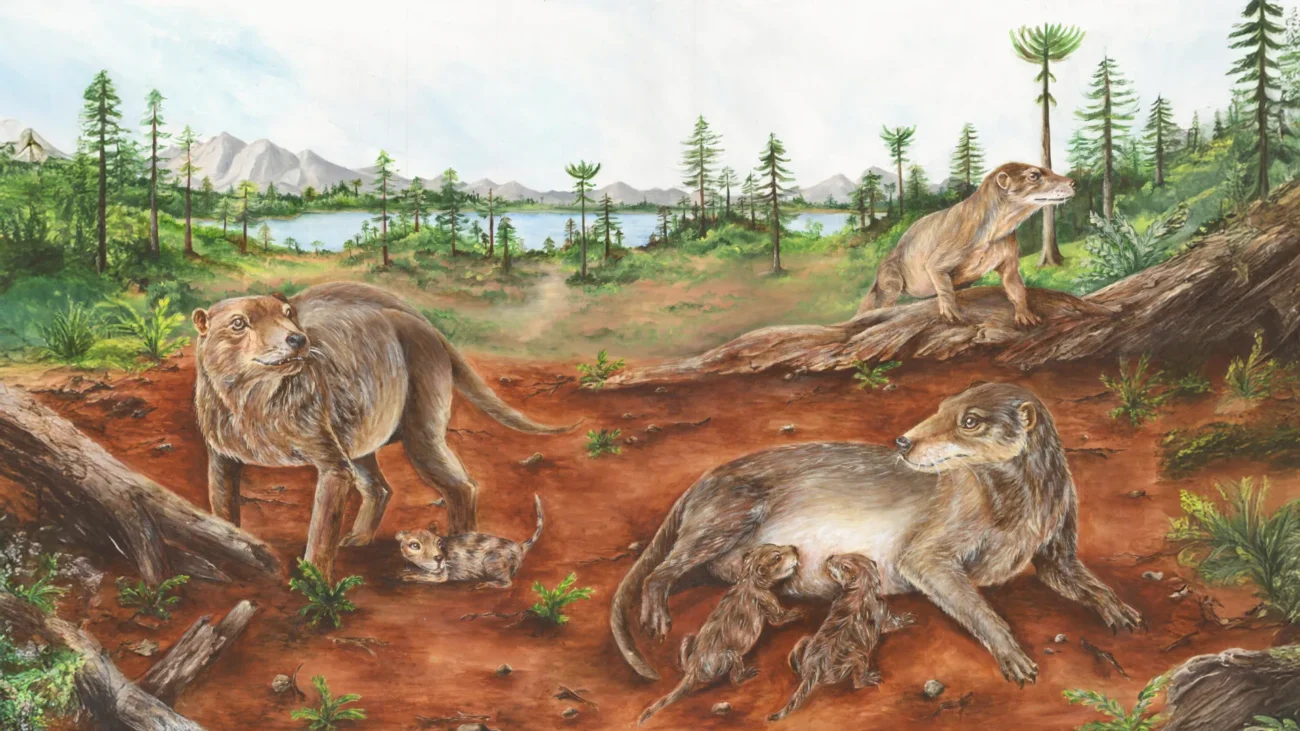
A groundbreaking paleontological study published in the peer-reviewed journal Frontiers in Mammal Science has upended conventional understanding regarding the evolutionary history of mammalian reproduction. For generations, evolutionary biologists and paleontologists operated under the consensus that viviparity—the biological mechanism of giving birth to live young rather than laying eggs—was a relatively late development in the lineage that ultimately led to modern mammals. However, an international team of researchers has uncovered the first compelling, microscopic evidence demonstrating that at least one ancient mammalian ancestor, Chiniquodon theotonicus, engaged in live birth approximately 236 million years ago during the Triassic period.
This profound discovery pushes the estimated origin of viviparity among early cynodonts back by an astonishing 90 to 95 million years. The findings challenge long-held assumptions about the physiological traits of prehistoric synapsids and provide new insights into how ancient creatures adapted to harsh environmental pressures, ecosystem restructuring, and intense predation following the deadliest mass extinction event in Earth’s history.
The Investigation: Unlocking Microscopic Secrets of the Fossil Record
For decades, determining whether ancient mammalian ancestors laid eggs or gave birth to live young was widely regarded by the scientific community as an inscrutable mystery. Soft-tissue structures, embryos, and reproductive organs rarely survive the fossilization process, leaving an immense void in the paleobiological record. Because direct fossil evidence of embryonic tissue in cynodonts had never been documented, researchers were forced to rely on indirect clues, phylogenetic bracketing, and comparative anatomy with modern reptiles and monotremes—the egg-laying mammals like the platypus and echidna.
The breakthrough occurred serendipitously during a postgraduate research course in Argentina. Paleontologists examining the microscopic bone structure of a fully grown Chiniquodon theotonicus fossil—discovered in the fossil-rich badlands of northwestern Argentina—noticed an unusual, highly distinct growth mark embedded within the bone’s matrix.
Subsequent analysis revealed that this structural anomaly was a neonatal line. In contemporary biology, neonatal lines are distinct histological growth rings that form within the bones and teeth of many vertebrates. These lines are triggered by the physiological shock and sharp acceleration in metabolic and skeletal growth that occurs immediately after birth. When an infant transitions from the protected, stable environment of internal gestation or an egg to the external world, the sudden exposure to new environmental stressors and nutritional sources leaves a permanent chronological signature in developing bone tissue.
To verify whether this microscopic growth mark truly represented a birth event rather than a seasonal growth ring or pathological anomaly, the research team devised an ingenious methodology. They estimated the body mass of the Chiniquodon theotonicus individual both as a newborn and at its final adult size. They then cross-referenced these calculations with an expansive comparative dataset encompassing thousands of living mammals, non-avian reptiles, and birds.
Comparative Metrics: How the Ancient Newborn Stacked Up
The research team employed precise measurements of the fossilized skeletal remains to reconstruct the lifecycle mass of Chiniquodon theotonicus. By analyzing the dimensions indicated by the neonatal line alongside the outermost layers representing its adult size, the scientists calculated that the animal weighed approximately 1.7 kilograms at birth and roughly 12 kilograms at maturity.
This mathematical reconstruction revealed a startling biological ratio: the newborn Chiniquodon theotonicus accounted for approximately 14 percent of its eventual adult body mass.
To contextualize this finding, the researchers compared the fossil data against the reproductive patterns of modern amniotes within similar adult weight brackets (ranging from 8 kilograms to 21.5 kilograms). The results highlighted a stark divergence from non-mammalian pathways:
- Reptilian Metrics: Modern reptiles of comparable adult sizes, such as specific species of large snakes, turtles, and crocodilians weighing between 8kg and 14.5kg, produce exceptionally small hatchlings ranging from a mere 9 grams to 53 grams. Consequently, their neonate-to-adult body mass ratios are exceptionally low, hovering between 0.1 percent and 0.6 percent.
- Avian Metrics: Birds of similar adult mass, including select species of pelicans, cranes, and vultures weighing between 8kg and 21.5kg, produce hatchlings scaling from 110 grams to 357 grams. This corresponds to neonate-to-adult body mass ratios of approximately 1.3 percent to 4.5 percent.
- Placental Mammal Metrics: In sharp contrast, modern placental mammals falling into the 8kg to 15kg adult weight range give birth to substantially heavier offspring, with birth weights spanning from 35.5 grams to 1.87 kilograms. Their neonate-to-adult mass ratios can reach as high as 18.77 percent.
For instance, the bay duiker antelope—a modern forest-dwelling mammal—produces offspring that closely match the estimated birth weight of the ancient Chiniquodon theotonicus. Crucially, the researchers deliberately excluded non-placental mammals, such as marsupials that bear extremely underdeveloped young into pouches or monotremes that lay eggs, ensuring a rigorous baseline for comparison.
"We were amazed to find that Chiniquodon theotonicus grouped squarely with extant placental mammals, being clearly distinct from other amniotes like reptiles or birds," noted Dr. Leandro Gaetano, lead author of the study and a prominent paleontologist at the National Scientific and Technical Research Council (CONICET) in Argentina.
Environmental Pressures of the Triassic Period
To understand why viviparity might have evolved so early in the mammalian lineage, researchers must examine the brutal ecological landscape of the Triassic period, which spanned from roughly 252 million to 201 million years ago. The Triassic commenced in the immediate aftermath of the Permian-Triassic extinction event—often referred to as the "Great Dying"—which wiped out over 70 percent of terrestrial vertebrate species and up to 96 percent of marine species.
As global ecosystems underwent a protracted, multi-million-year recovery and restructuring phase, surviving lineages faced unprecedented selective pressures. According to senior study author Adriana Mancuso, also a researcher at CONICET specializing in terrestrial ecosystem evolution, the Triassic environment was characterized by fierce competition for limited ecological resources, intense predatory pressures, and a sweeping global trend toward aridity accompanied by strong seasonal fluctuations.
In such a volatile landscape, reproductive strategy meant the difference between survival and extinction. Egg-laying species (oviparity) expose their developing embryos to significant environmental hazards, including dramatic temperature swings, dehydration in arid soils, fungal infections, and predation of stationary nests. Conversely, viviparous species internalize embryonic development, providing offspring with a mobile, temperature-regulated, and chemically protected environment until they are sufficiently developed to navigate the perils of the external world.
The evolution of live birth in ancestors like Chiniquodon theotonicus may have provided a critical evolutionary edge, buffering vulnerable offspring against the harsh climatic extremes and predatory dangers of the early Mesozoic world.
Chronology of Mammalian Evolutionary Milestones
To appreciate the significance of this discovery, it is helpful to place the findings within the broader evolutionary timeline of synapsids and mammals:
- ~290 Million Years Ago (Permian): The divergence of synapsids—the lineage leading to mammals—from the sauropsid lineage that led to modern reptiles, dinosaurs, and birds.
- ~252 Million Years Ago: The Permian-Triassic mass extinction clears the ecological slate, paving the way for the radiation of cynodonts—advanced therapsids that developed specialized teeth, secondary palates, and the beginnings of endothermy (warm-bloodedness).
- ~236 Million Years Ago (Middle Triassic): Chiniquodon theotonicus roams the floodplains of what is now northwestern Argentina. Histological analysis indicates this species was already utilizing viviparity, achieving a high neonate-to-adult mass ratio comparable to modern placental mammals.
- ~210 Million Years Ago (Late Triassic): The appearance of true mammaliaforms in the fossil record, historically thought to mark the gradual transition toward more modern reproductive and physiological traits.
- ~145 Million Years Ago (Cretaceous): The historical consensus window where researchers previously believed placental and marsupial reproductive strategies fully diverged and firmly established viviparity.
Expert Reactions and Scientific Implications
The implications of the Chiniquodon theotonicus study extend far beyond a single extinct species, prompting a sweeping reevaluation of how paleontologists interpret the fossil record and trace the stepwise acquisition of mammalian traits.
Co-author María Miceli Baro, a graduate student at the University of Buenos Aires, emphasized the rarity of the discovery. "In cynodonts, embryonic tissues were never observed before, let alone a neonatal line," Baro stated. "Through its analysis, we found that a trait that is generally linked to evolutionary success was present in animals long before true mammals originated."
Traditionally, evolutionary biologists viewed mammalian traits—such as lactation, specialized diphyodont dentition (replacing teeth only once), fur, endothermy, and viviparity—as a package deal that evolved in tandem or sequentially as true mammals emerged during the late Triassic and Jurassic periods. However, this study suggests a more complex, mosaic pattern of evolution, where sophisticated physiological traits like live birth were experimented with much earlier in ancestral proto-mammals.
While Chiniquodon theotonicus provides undeniable microscopic proof of ancient viviparity, researchers remain cautious about over-generalizing the finding across the entire cynodont clade without further data.
"It is very well possible that Chiniquodon theotonicus does not represent an isolated case of viviparity among cynodonts," Dr. Gaetano concluded. "It could be evidence of the general switch from laying eggs to giving birth to live young early on in the mammalian lineage. But we need more fossil evidence from diverse geographic regions and stratigraphic layers to test this hypothesis rigorously. Still, it increasingly appears that some cynodonts were far more advanced—and far more similar to present-day mammals—than science previously dared to imagine."
As paleontologists apply these novel histological techniques to other fossil collections worldwide, the microscopic archives preserved within ancient bones may continue to rewrite the history of life on Earth, illuminating the hidden biological innovations that enabled our deepest ancestors to endure the crucible of a changing world.

