


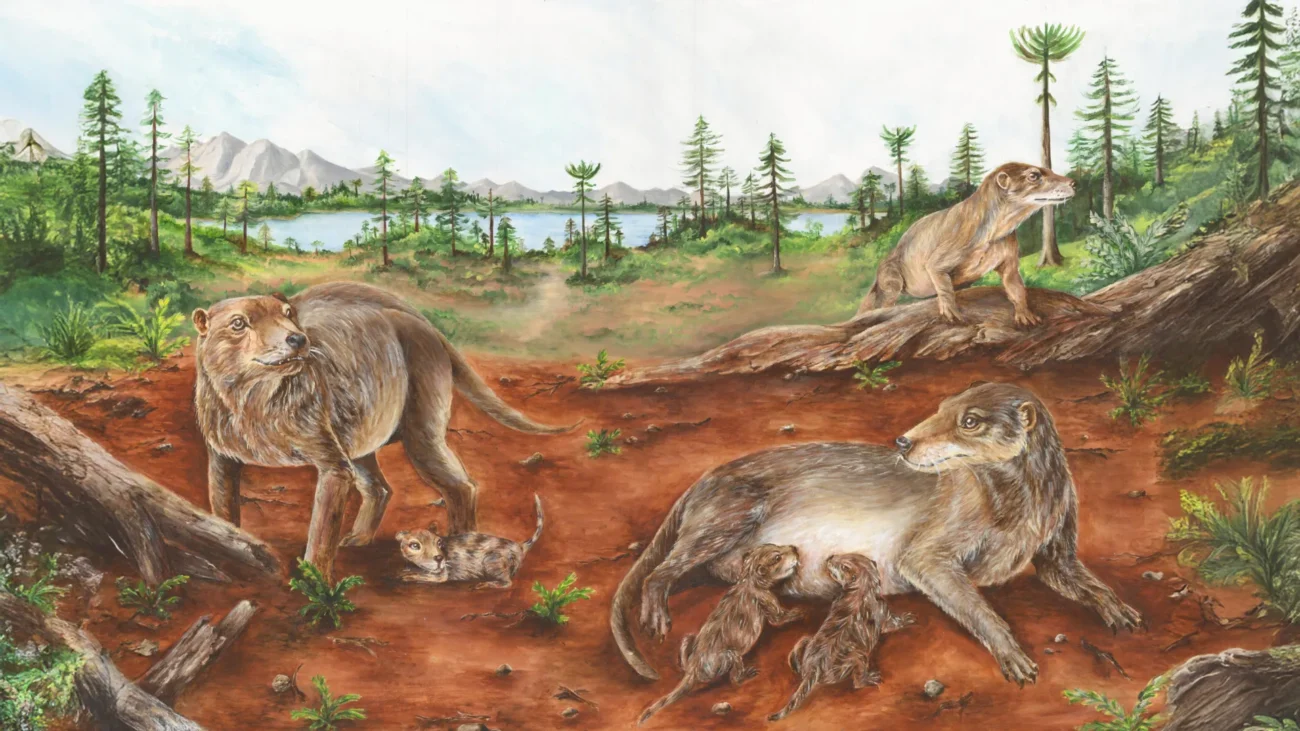
In a groundbreaking paleontological discovery that pushes back the timeline of mammalian reproductive evolution by up to 95 million years, a new study reveals that certain prehistoric mammal precursors gave birth to live young during the Triassic period. Published in the journal Frontiers in Mammal Science, the research centers on Chiniquodon theotonicus, a carnivorous cynodont that roamed the Earth approximately 236 million years ago. By analyzing microscopic growth rings within fossilized bone structures, an international team of scientists has provided the first compelling evidence of viviparity—the trait of giving birth to live offspring rather than laying eggs—in a deep-branching mammalian ancestor.
The findings fundamentally challenge long-held assumptions regarding the developmental milestones of the synapsid lineage, the broader group of animals that eventually gave rise to modern mammals. Until now, the emergence of live birth was widely considered a comparatively recent evolutionary development, tied more closely to the radiation of true mammals following the Cretaceous-Paleogene extinction event. However, this new investigation suggests that key physiological and reproductive adaptations once believed to be exclusive to modern mammals were already successfully operating in the shadow of the dinosaurs during the dawn of the Mesozoic Era.
Unlocking the Microscopic Secrets of the Triassic Fossil Record
The genesis of this scientific breakthrough occurred serendipitously during an advanced postgraduate paleontology course. Researchers closely examining the internal microscopic structure of a fully grown Chiniquodon theotonicus fossil—discovered in the fossil-rich badlands of northwestern Argentina—noticed an unusual and distinct growth mark embedded deep within the bone tissue. To paleohistologists, such anatomical features are often telling, prompting immediate comparisons with the developmental biology of living animals.
The research team identified the anomaly as a neonatal line. These microscopic rings form within bones and teeth as a direct physiological response to the abrupt, intense acceleration of growth that occurs immediately following birth. In egg-laying species, hatchlings experience a different metabolic trajectory, while live-bearing species often display a pronounced growth shift as the neonate transitions from maternal sustenance to independent growth.
To rigorously test this hypothesis, the scientists developed an innovative analytical framework. They calculated the estimated body mass of the Chiniquodon theotonicus individual both at the hypothesized moment of birth—extrapolated from the neonatal line—and at its final adult stage. These mass estimates were subsequently cross-referenced with a comprehensive comparative dataset encompassing thousands of extant species, including modern mammals, non-avian reptiles, and birds.
The methodological hurdle of determining reproductive strategy from fossilized skeletal remains has historically plagued vertebrate paleontology. Because soft tissues rarely fossilize, researchers must rely on indirect osteological proxies. By pioneering this combination of skeletochronology and comparative allometry, the study establishes a powerful new methodology for investigating the reproductive biology of extinct fauna.
An Astonishingly Large Newborn Ratio
The mathematical results of the bone analysis yielded a startling portrait of Chiniquodon theotonicus life history. Calculations based on the skeletal dimensions indicate that a newborn Chiniquodon theotonicus weighed approximately 1.7 kilograms, while the fully grown adult specimen reached an estimated mass of 12 kilograms. This establishes a neonate-to-adult body mass ratio of roughly 14 percent.
To contextualize this proportion, the researchers contrasted the fossil data with contemporary amniotes. Modern reptiles of comparable adult body mass—such as large snakes, crocodilians, and heavy-bodied turtles weighing between 8 and 14.5 kilograms—produce remarkably small hatchlings. Their neonates typically range from a mere 9 to 53 grams, resulting in an exceptionally low neonate-adult body mass ratio of roughly 0.1 percent to 0.6 percent.
Avian species demonstrate a similarly modest investment in relative hatchling size. Large birds, including various species of cranes, pelicans, and vultures with adult masses spanning 8 to 21.5 kilograms, produce offspring weighing between 110 and 357 grams. This corresponds to neonate-adult mass ratios of approximately 1.3 percent to 4.5 percent.
In stark contrast, modern placental mammals of similar adult size—weighing between 8 and 15 kilograms—frequently give birth to substantially heavier, more energetically demanding young. Neonates in this mass bracket can range from 35.5 grams to 1.87 kilograms, pushing neonate-adult mass ratios as high as 18.77 percent. For instance, the bay duiker antelope produces offspring remarkably close in relative and absolute proportion to the estimated dimensions of the ancient Chiniquodon newborn.
By deliberately excluding non-placental mammals—such as monotremes that lay eggs and marsupials that bear extremely underdeveloped, microscopic young before finishing development in a pouch—the researchers underscored the distinct developmental pathway of the fossilized cynodont. The statistical clustering of Chiniquodon theotonicus with extant placental mammals rather than reptiles or birds provided the statistical backbone for their conclusion.
Environmental Pressures and Evolutionary Chronology
The discovery forces a radical reassessment of the timeline concerning the evolution of vertebrate reproduction. Dr. Leandro Gaetano, a paleontologist at the National Scientific and Technical Research Council (CONICET) in Argentina and lead author of the study, emphasized the temporal significance of the finding.
"We show for the first time that live birth was present in at least one mammalian ancestor, Chiniquodon theotonicus, which lived approximately 236 million years ago," Dr. Gaetano stated. "This implies that viviparity among early cynodonts originated in the mammalian lineage at least 95 to 90 million years earlier than previously thought."
To understand why viviparity might have evolved so early, researchers must look to the tumultuous ecological backdrop of the Triassic period. Dr. Adriana Mancuso, a CONICET senior author specializing in terrestrial ecosystem evolution, noted that cynodonts occupied a critical juncture in Earth’s history. They flourished during the Triassic, a protracted era marked by the slow ecological recovery and structural reorganization of terrestrial biomes following the Permian-Triassic extinction event—the most catastrophic biotic crisis in planetary history.
This hazardous post-extinction environment was characterized by intense interspecific competition for limited resources, severe predatory pressures, and a broader global climatological trend toward aridity and pronounced seasonality. Under such ecological stress, reproductive strategies that offered heightened protection to vulnerable embryos provided a decisive evolutionary advantage. While egg-laying species faced environmental exposure, fluctuating temperatures, and nest predation, viviparous species maintained internal thermal and physical stability for their developing young during the most delicate stages of gestation.
Expanding the Scope of Ancient Mammalian Traits
Co-author María Miceli Baro, a graduate student at the University of Buenos Aires, highlighted the rarity of the preserved evidence. "In cynodonts, embryonic tissues were never observed before, let alone a neonatal line," Baro remarked. "Through its analysis, we found that a trait that is generally linked to evolutionary success was present in animals long before true mammals originated."
This revelation challenges the traditional view of evolutionary progression as a linear accumulation of modern traits in step-by-step fashion. Instead, it supports the concept of mosaic evolution, wherein complex physiological systems—such as metabolic regulation, specialized dentition, nocturnal adaptations, and now reproductive viviparity—appear independently and at much earlier intervals than the appearance of the crown group itself.
Chiniquodon theotonicus belonged to a diverse group of advanced therapsids that exhibited several mammalian characteristics, including differentiated teeth (incisors, canines, and molars) and hints of a secondary palate that allowed them to chew and breathe simultaneously. Adding live birth to this anatomical profile paints a picture of an animal biologically far closer to modern mammals than its reptilian appearance might suggest.
Broader Implications and Future Paleontological Directions
The publication of this study has sent ripples through the global paleontological community, prompting researchers to re-examine existing fossil collections for subtle histological markers previously overlooked.
The primary question facing the scientific community is whether Chiniquodon theotonicus represents an evolutionary outlier or a standard physiological baseline for advanced cynodonts of the Middle to Late Triassic. If live birth was widespread among these mammal precursors, it suggests that the metabolic and physiological investments required for viviparity were successfully deployed long before the advent of lactation, complex mammary glands, or true placental development in the modern sense.
"It is very well possible that Chiniquodon theotonicus does not represent an isolated case of viviparity among cynodonts," Dr. Gaetano concluded, summarizing the trajectory of future research. "It could be evidence of the general switch from laying eggs to giving birth to live young early on in the mammalian lineage. But we need more evidence to test this hypothesis. Still, it looks like some cynodonts were in fact very similar to present-day mammals."
As researchers apply this novel histological approach to other therapsid taxa from South America, Africa, and Eurasia, the hazy boundaries of early mammalian evolution are steadily coming into sharper focus. The Triassic world, long viewed through the lens of emerging dinosaur dominance, is increasingly revealed as a critical crucible where the foundational traits of mammalian existence—including the intimate bond of live birth—were forged over 230 million years ago.

