


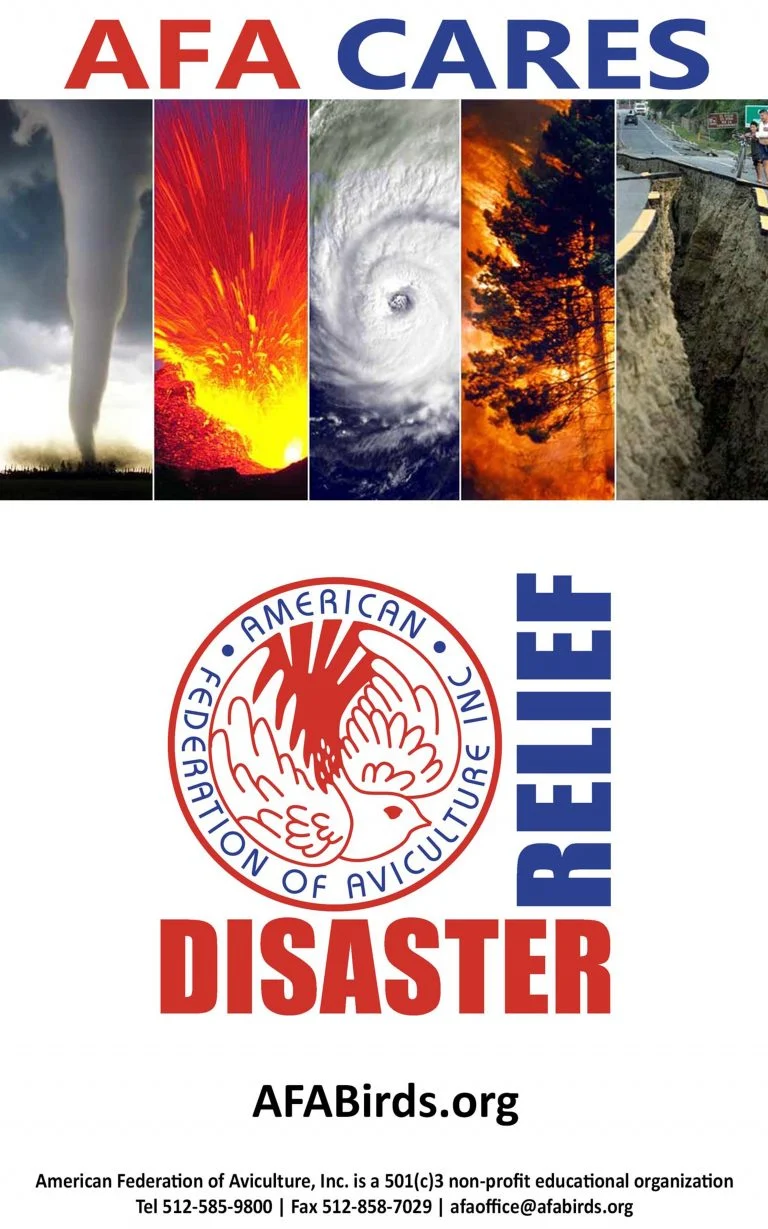
Natural disasters present an unpredictable and profound threat not only to human communities but also to domestic animals, livestock, and captive avifauna. Whether facing the sudden fury of a coastal hurricane, the violent rotation of a midwestern tornado, the sweeping devastation of a wildfire, or the paralyzing impact of a severe winter ice storm, aviculturists and bird owners face unique logistical challenges in safeguarding their animals. The American Federation of Aviculture (AFA) Disaster Relief Team, operating through a nationwide network of regional directors and local volunteers, has established a comprehensive framework designed to mitigate these risks through proactive planning, rapid deployment, and coordinated rescue operations.
Main Facts of Avian Emergency Response
When a natural disaster strikes, the window for effective intervention is often measured in hours, or even minutes. Captive birds—ranging from single household pets to large-scale avicultural breeding collections—are entirely dependent on human intervention during crises. Unlike domestic cats or dogs, which can frequently be leashed or crated with relative ease, birds require specialized handling, secure containment, and strict environmental controls to prevent stress-induced mortality, escape, or injury.
The AFA Disaster Relief Team is strategically decentralized, positioning regional directors and trained volunteers across the United States to monitor localized weather patterns and environmental threats continuously. This decentralized structure drastically reduces response times during emergencies. When disaster zones are declared or severe weather is imminent, local volunteers coordinate directly with affected bird owners to provide logistical support, rescue coordination, and temporary sheltering solutions.
Beyond immediate rescue, the AFA emphasizes that effective disaster management is rooted in pre-crisis preparation. According to emergency guidelines outlined by former CalFire Fire Chief Mary Ellen LePage, bird owners must treat disaster planning with the same rigor applied to human evacuation strategies. This involves maintaining pre-assembled caches of emergency supplies, establishing reliable identification methods, mapping out safe relocation sites, and formulating detailed, written evacuation plans.
Chronology and Phases of Disaster Management
A structured timeline is essential for mitigating the impact of any natural disaster. Emergency management professionals typically divide disaster response into four distinct phases: mitigation, preparedness, response, and recovery. For aviculturists, applying this chronological framework ensures that actions taken before, during, and after an event are systematic and effective.
Phase 1: Pre-Disaster Mitigation and Preparedness (Months to Days Before)
Long before a weather alert is issued or a seismic event occurs, bird owners must establish their foundational infrastructure. This includes procuring and storing collapsible or pre-assembled transport carriers equipped with secure perches and water dishes. Storage solutions, such as ceiling racks in garages or designated emergency closets, ensure these items can be accessed instantly. Furthermore, cages and flights should be standardized with keyed-alike locks to eliminate the dangerous delay of searching for specific keys under pressure.
During this phase, permanent identification protocols must be finalized. Birds should be microchipped and fitted with secure leg bands, and duplicate records proving ownership must be stored securely off-site or in cloud-based digital repositories. Crucially, aviculturists must identify and secure preliminary agreements with secondary relocation sites—such as barns, outbuildings, or commercial properties located outside high-risk flood zones or wildfire perimeters.

Phase 2: The Immediate Pre-Impact Window (72 to 24 Hours Before)
As a disaster approaches, the decision-making window narrows significantly. If evacuation advisories are issued by local authorities, bird owners must act immediately. Delaying evacuation risks catastrophic gridlock on regional transportation routes, fuel shortages, and sudden road closures enforced by law enforcement.
If renting a vehicle for large-scale evacuation, handlers must verify that the cargo area has adequate ventilation to prevent heat exhaustion and asphyxiation in transit. For those electing to shelter in place—a decision often necessitated by fast-moving wildfires or impassable roads—independent power sources such as generators, alongside reserves of non-perishable food and potable water, must be secured and tested. Written evacuation and sheltering plans, complete with veterinary contacts and dietary instructions, must be prominently posted for emergency rescue workers.
Phase 3: Active Emergency Response (During the Event)
When the disaster is actively impacting the region, rescue operations commence under strict safety protocols. Under the Incident Command System (ICS) regulated by the Occupational Safety and Health Administration (OSHA) and local emergency management agencies, access to disaster zones is strictly controlled.
Authorized rescue workers must coordinate with the designated Incident Commander to secure entry permits. Field rescuers utilize specialized gear, including heavy-duty transport crates, bird nets, protective gloves, towels, and cutting tools such as wire cutters or chainsaws, to navigate debris-blocked properties and capture untamed or flight-stressed birds safely. Throughout this phase, maintaining accurate records of paired birds and annotating carriers prevents the permanent separation of breeding stock or bonded companions.
Phase 4: Post-Disaster Recovery and Reunification (Days to Weeks After)
Following the cessation of immediate danger, the recovery phase focuses on animal health assessment, veterinary care, and owner reunification. The AFA assists in locating temporary housing facilities for displaced birds when permanent aviaries have been compromised. Rescuers and regional directors work diligently to cross-reference microchips, leg bands, and written identification logs to return rescued birds to their rightful owners, while providing ongoing nutritional and material aid where local supply chains have collapsed.
Supporting Data and Operational Logistics
Statistically, natural disasters in the United States have increased in both frequency and severity over the past several decades, driven by shifting climatic patterns and expanding human development in vulnerable ecological zones. According to emergency management data, animal displacement remains one of the most complex logistical hurdles during mandatory evacuations, frequently resulting in delayed human evacuations when owners refuse to abandon their animals.
For avicultural operations housing hundreds of specialized or endangered species, the stakes are exceptionally high. The logistical footprint required to evacuate a medium-sized aviary involves specialized transport vehicles capable of maintaining stable ambient temperatures—ideally between 65°F and 85°F depending on species requirements—and preventing drafts.
The AFA’s operational framework addresses these data points by deploying standardized resources:
- Magnetic vehicle signage and official identification apparel to streamline passage through police checkpoints managed by OSHA Incident Command structures.
- Centralized communication channels (accessible via the main business office at 512-585-9800 or via email at [email protected]) that serve as clearinghouses matching displaced birds with emergency foster facilities.
- Emergency toolkits containing wire cutters, heavy-duty gloves, containment nets, and multi-species holding crates to ensure rapid deployment in compromised structures.
Official Responses and Institutional Perspectives
Emergency management experts and avicultural leaders universally emphasize that human safety must remain the absolute priority during any catastrophic event. Former Fire Chief Mary Ellen LePage stresses that while the instinct to protect valuable or beloved animals is powerful, entering an unsecure or officially closed disaster zone without authorization or proper equipment endangers both the rescuer and first responder personnel who may be forced to execute secondary rescue operations.
The American Federation of Aviculture maintains that institutional preparedness bridges the gap between individual vulnerability and collective survival. By fostering local networks of trained aviculturists who understand specialized bird-handling techniques, the organization creates a resilient safety net that operates independently during the critical initial hours when municipal emergency services are overwhelmed by human rescue priorities.
Law enforcement and emergency response agencies routinely coordinate with animal rescue organizations under standardized Incident Command protocols. However, because municipal disaster plans prioritize human life and structural infrastructure, specialized animal welfare operations rely heavily on self-sufficiency, pre-established credentials, and clear lines of communication between private organizations and public safety commanders.
Broader Impact and Implications for Aviculture
The increasing unpredictability of global weather events underscores a broader paradigm shift within the avicultural community. Disaster planning is no longer viewed as an optional precaution for hobbyists in specific geographic pockets, but as a fundamental responsibility of ethical animal husbandry.
The implications of inadequate disaster planning extend beyond immediate animal mortality. The loss of genetically valuable captive breeding populations of rare or endangered avian species represents an irreversible blow to conservation breeding programs worldwide. Furthermore, the psychological and financial toll on aviculturists can be devastating, highlighting the economic necessity of robust insurance policies, secure physical infrastructure, and redundant emergency systems.
By institutionalizing disaster relief through structured networks like the AFA Disaster Relief Team, the avicultural community demonstrates a high degree of professionalization and collective responsibility. As environmental pressures continue to evolve, the integration of rigorous planning, rapid-response logistics, and inter-agency cooperation will remain the cornerstone of protecting captive avifauna against the unpredictable forces of nature. Bird owners seeking assistance, looking to volunteer, or requiring guidance on establishing localized emergency response plans are encouraged to contact the American Federation of Aviculture directly to align their preparedness efforts with national rescue networks.

