


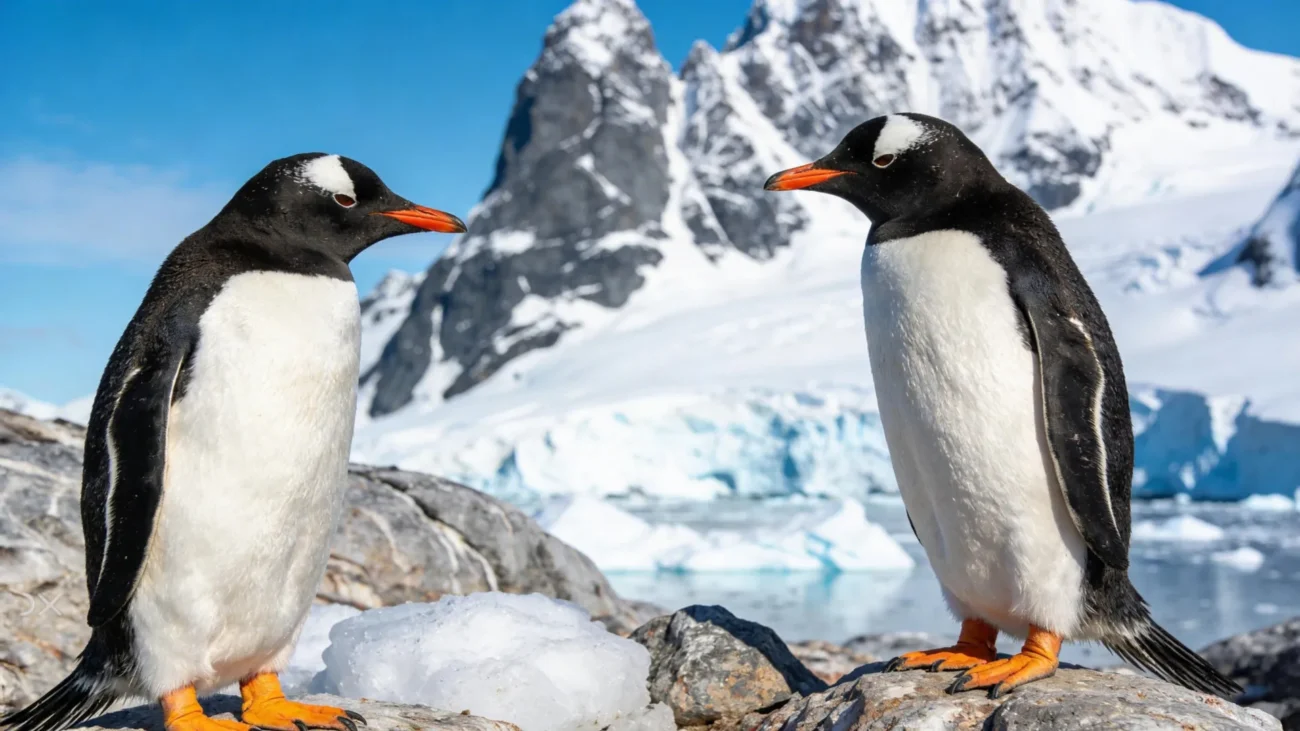
For generations, the gentoo penguin was regarded by naturalists and marine biologists as a single, widely distributed species, easily identified by its contrasting white underside, jet-black back, and signature bright orange-red bill. While iconic polar inhabitants like the four-foot-tall Emperor penguin often command public attention, gentoos have long occupied a unique ecological niche, stretching across vast, isolated expanses of the Southern Hemisphere. However, an extensive international genomic study has fundamentally reshaped our understanding of these birds. By analyzing whole-genome sequences from breeding colonies across their geographic range, researchers have determined that what was once classified as a single species is actually four distinct species. Among them is a previously unrecognized cryptic species native to the remote Kerguelen Islands, marking the first time in more than a century that a new penguin species has been officially named and classified.
The findings, published in the journal Communications Biology, are the culmination of a decade-long investigative effort led by a multidisciplinary consortium of researchers. Spearheaded by senior authors Dr. Juliana Vianna of Andrés Bello National University in Santiago, Chile; Dr. Rauri Bowie, a professor of integrative biology and curator at the University of California, Berkeley’s Museum of Vertebrate Zoology; and Dr. Elie Poulin of the University of Chile, the study brought together biologists from Australia, Spain, Venezuela, South Africa, the United Kingdom, France, Argentina, Monaco, and Brazil. Daly Noll, a graduate student at the University of Chile, served as the paper’s first author, steering a genomic analysis that examined thousands of single nucleotide polymorphisms (SNPs) to untangle the evolutionary history of the gentoo lineage.
A Century of Taxonomic Debate and Genomic Breakthroughs
The classification of gentoo penguins has remained a point of contention within the scientific community for more than a century. Historically, researchers attempted to parse the variations among disparate populations by relying primarily on morphology—observing subtle differences in body size, skeletal dimensions, and vocalizations. Over the decades, various taxonomists proposed as many as six distinct gentoo subspecies, yet a universal consensus remained elusive due to the logistical challenges of sampling birds scattered across windswept, isolated sub-Antarctic islands.
To definitively resolve this long-running debate, the international research team assembled the most comprehensive dataset of gentoo genetics to date. The study analyzed the whole-genome sequences of 64 individual penguins gathered systematically from 10 distinct breeding colonies, covering virtually the entire geographic distribution of the genus Pygoscelis. By comparing these genetic profiles alongside behavioral traits, breeding schedules, vocalizations, diets, and physical characteristics, the researchers moved beyond the limitations of traditional taxonomy.
The genomic data revealed profound genetic divergence that outpaced visible physical differences. While the newly identified southeastern lineage—now designated Pygoscelis kerguelensis—closely resembles its relatives in outward appearance, its DNA tells a story of millions of years of evolutionary separation. This classification of a cryptic species underscores the power of modern genomic tools in uncovering hidden biodiversity in remote ecosystems, proving that visual uniformity can mask deep genetic divides.
Chronology of Penguin Evolution and Speciation
To understand how gentoo penguins diversified into four distinct species, researchers contextualized their genetic findings within the broader evolutionary timeline of the penguin family. Previous work published by Bowie and Vianna in 2019 established that modern penguins originated in the region encompassing modern-day Australia and New Zealand approximately 22 million years ago.
During the early stages of penguin evolution, the Emperor and King penguin lineages diverged from the main trunk, with Emperor penguins becoming specialized inhabitants of the Antarctic shelf, while King penguins adapted to sub-Antarctic islands. A critical turning point occurred roughly 12 million years ago with the full establishment of the Antarctic Circumpolar Current. This massive oceanic conveyor belt facilitated the dispersal of other penguin groups across the Southern Hemisphere, enabling them to colonize isolated archipelagos and eventually reach as far north as the coastlines of South America and Africa.
Within this broader diaspora, gentoo penguins possessed a distinct ecological advantage: dietary flexibility. Unlike many of their avian relatives that rely heavily on a single prey species—such as krill-dependent Adélie or Emperor penguins—gentoos are opportunistic generalists. They consume an eclectic menu of fish, squid, cuttlefish, and krill. This broad dietary tolerance meant gentoos did not need to undertake massive foraging migrations far from their nesting sites.
Consequently, populations that successfully colonized isolated islands began anchoring themselves to specific locations, returning year after year to the same breeding colonies. Over generations, geographic isolation combined with the formidable barrier of the Antarctic Polar Front—a sharp oceanic boundary where water temperatures, salinity levels, and nutrient profiles shift dramatically—restricted gene flow between populations. Researchers estimate that the four gentoo lineages officially diverged between 300,000 and 500,000 years ago, with natural selection tailoring each group’s genome to its specific local environment.
Mapping the Four Gentoo Lineages
The genomic analysis successfully categorized gentoo penguins into four distinct species, each occupying a specific geographic and ecological domain:
-
The Southern Gentoo (Pygoscelis ellsworthi): Inhabiting the Antarctic Peninsula, coastal Antarctica, and South Georgia Island, this is the most populous lineage. It is the only gentoo species currently thriving in extreme polar conditions. Genomic profiling revealed that these birds possess enriched genetic markers associated with heat production, lipid and fat storage, and enhanced light perception—adaptations crucial for surviving prolonged polar winters and intense glare from ice and snow.
-
The Eastern Gentoo (Pygoscelis taeniata): Distributed across the Crozet, Marion, and Macquarie Islands north of the Polar Front, this lineage has adapted to warmer, saltier waters with lower biological productivity. Their genomes show a higher concentration of genes linked to efficient carbohydrate metabolism and superior diving performance, including traits supporting oxygen transport, lung development, mitochondrial activity, and cardiovascular endurance, enabling extended underwater foraging.
-
The Northern Gentoo (Pygoscelis papua): Restricted to the Falkland (Malvinas) and Martillo Islands off the coast of South America, this lineage exhibits genetic enrichments centered around digestion, heart contraction, and muscle excitation. These physiological modifications are believed to support the sustained physical exertion required for prolonged foraging in temperate marine environments.
-
The Southeastern Gentoo (Pygoscelis kerguelensis): The newly recognized cryptic species, native to the remote Kerguelen Islands (often referred to as the Desolation Islands) and likely nearby Heard Island. Situated nearly 2,000 miles from any permanently inhabited landmass, this isolated population evolved in near-total geographical detachment before modern genetic analysis confirmed its distinct status.
Implications for Conservation and Climate Change
While the discovery of a new penguin species is a landmark event for avian taxonomy, it brings urgent conservation challenges into sharp focus. Climate change is rapidly reshaping the Antarctic and sub-Antarctic landscapes, and the four gentoo species face vastly different trajectories.
Using predictive climate models, researchers mapped potential suitable habitats for the gentoo species through the year 2050. Under moderate warming scenarios, the island-dwelling sub-Antarctic species—particularly the newly minted eastern, northern, and southeastern lineages—face severe habitat loss. Because these birds are endemic to isolated island archipelagos, they lack adjacent landmasses to migrate toward as local marine conditions warm.
Dr. Vianna emphasized the precarious position of these sub-Antarctic populations. While the southern gentoo (Pygoscelis ellsworthi) may actually expand its range southward onto the warming Antarctic continent as sea ice recedes, island-dwelling species have nowhere to retreat.
"In terms of climate change, island species that have really low population sizes could be compared with the sub-Antarctic gentoo penguins," Vianna noted. "Galapagos and other island penguin species, because they’re endemic to these islands, will find no place to go after a change in their environment. Those islands are very isolated, and these penguins cannot adapt easily to colonize any other region."
Compounding the threat of climate change are anthropogenic pressures, including warming ocean temperatures, industrial fishing competition for krill and fish, habitat degradation, and invasive predators such as rats and dogs introduced to sub-Antarctic islands. Because these populations are now recognized as separate species rather than localized subspecies, international conservation bodies must revise their frameworks. The sub-Antarctic islands are governed by a patchwork of nations—including Chile, France, South Africa, Australia, New Zealand, and the Netherlands—making coordinated cross-border conservation strategies an imperative for protecting the newly designated species.
The Broader Utility of Genomic Conservation
Beyond taxonomic revision, the unprecedented volume of genomic data compiled by the international team holds immediate value for wildlife management. Dr. Bowie highlighted that whole-genome sequencing has fundamentally transformed how conservationists study species vulnerability and evolutionary adaptation.
Currently, Dr. Vianna and her colleagues are actively scanning these genomic datasets to identify genetic markers associated with natural resistance or susceptibility to avian influenza—a virulent pathogen that has caused devastating mortality events among global bird and mammal populations, including penguins. By pinpointing which colonies possess protective genetic traits, conservation managers can better prioritize intervention strategies and allocate resources to the most vulnerable populations.
As human-driven pressures continue to alter marine ecosystems from the equator to the polar ice caps, the integration of cutting-edge genomics with traditional field biology provides a vital roadmap. The rediscovery of the gentoo penguin not as a single adaptable generalist, but as a quartet of vulnerable, locally adapted species, serves as both a scientific triumph and a timely warning for global biodiversity stewardship.

