


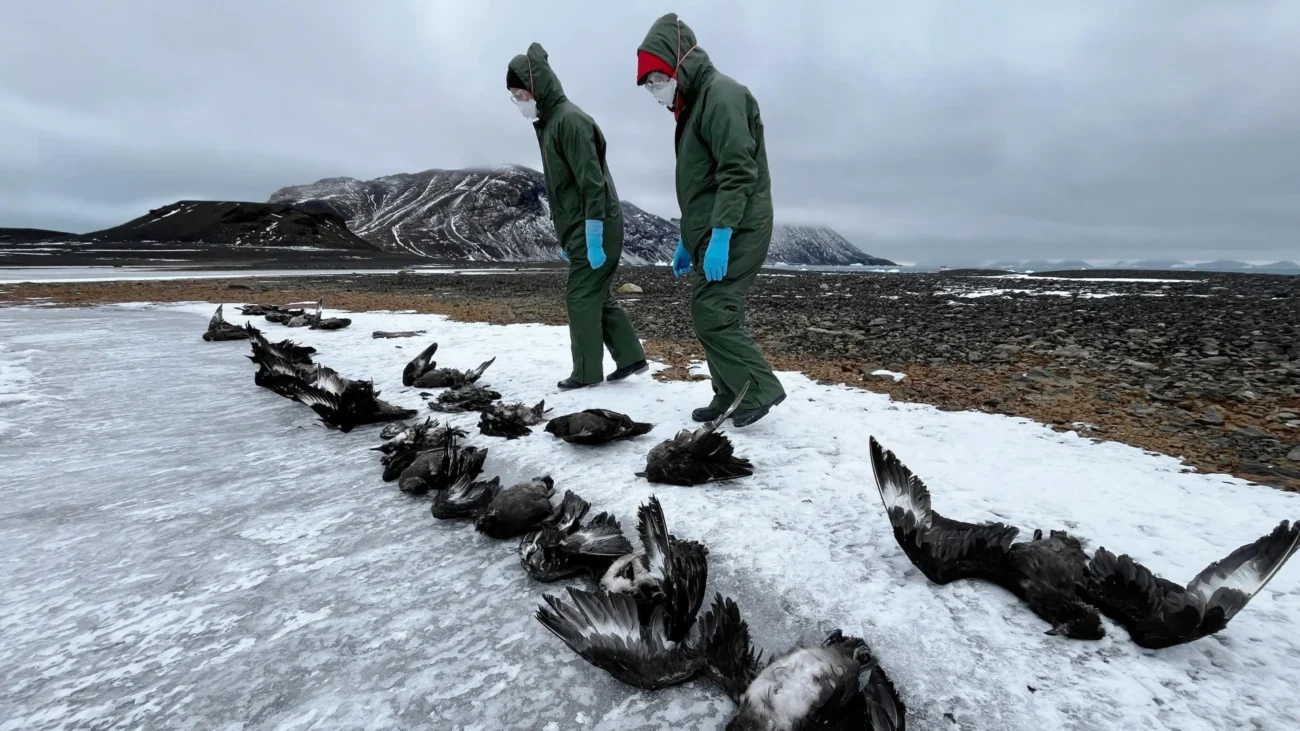
A devastating outbreak of highly pathogenic avian influenza (HPAI) H5N1 has claimed the lives of over 50 skuas in Antarctica during the austral summers of 2023 and 2024. This marks the first confirmed wildlife mortality event directly attributed to the virus on the pristine continent, according to a groundbreaking study recently published in the esteemed scientific journal Scientific Reports. The research, a collaborative effort spearheaded by Erasmus MC in the Netherlands and the University of California, Davis, sheds critical light on the virus’s alarming reach and its potential impact on Antarctic ecosystems.
The Scavenging Seabird: A Vulnerable Link in the Antarctic Chain
Skuas, imposing brown seabirds distantly related to gulls, are integral inhabitants of polar and subpolar environments. Their ecological role as predators and scavengers, akin to birds of prey, positions them as crucial custodians of the Antarctic landscape, diligently cleaning up carcasses. However, this very behavior, vital for ecosystem health, may also be inadvertently amplifying their susceptibility to H5N1 and facilitating its transmission across the vast expanse of Antarctica. Researchers involved in the study highlighted this intrinsic link between their feeding habits and their increased risk of infection.
The initial detection of H5N1 in Antarctic wildlife occurred earlier in 2024 when scientists identified the virus in a kelp gull and two skuas found deceased in January and February. While these findings signaled a growing concern, they lacked definitive proof of the virus as the direct cause of mortality. This crucial distinction has now been established through the comprehensive study.
"We were aware of animals carrying the infection, but this is the first study to definitively demonstrate that they succumbed to the viral infection," stated co-senior author Ralph Vanstreels, a wildlife veterinarian affiliated with the UC Davis One Health Institute within the Weill School of Veterinary Medicine. "This is an important clarification, especially in the nascent stages of an outbreak, as it allows for more targeted and effective responses."
An Expedition into the Antarctic Unknown: Documenting the Crisis
In response to the escalating threat, a dedicated research team embarked on an expedition to Antarctica in March 2024, strategically timed to coincide with the period immediately following the breeding season for skuas and penguins. Their mission encompassed a thorough examination of wildlife across ten distinct sites, spanning the South Shetland Islands, the northern Weddell Sea, and the Antarctic Peninsula.
At each location, any sick or deceased animals encountered were meticulously sampled. Tissue and environmental specimens were collected, and necropsies were performed to ascertain the precise cause of death. While the research team also investigated gentoo penguins, Adélie penguins, and Antarctic fur seals, H5N1 was not identified as the causative agent in these species.
"As the expedition progressed, it became unequivocally clear that skuas were bearing the brunt of this outbreak," Vanstreels remarked, underscoring the severity of the situation.
The presence of H5N1 was confirmed in skuas at three specific locations: Hope Bay, Devil Island, and Beak Island. Beak Island, in particular, experienced a significant mortality event among south polar skuas, painting a grim picture of the virus’s devastating impact.
"We diagnosed high pathogenicity avian influenza as the cause of death for nearly all the deceased skuas we discovered at Beak Island," confirmed first author Matteo Iervolino, a Ph.D. candidate at Erasmus MC in Rotterdam, The Netherlands. "Witnessing the scale of the die-off firsthand was profoundly impactful, allowing me to truly grasp the devastating consequences this virus can inflict on these populations."
Vanstreels further characterized the situation as a "crisis in animal suffering." He elaborated on the virus’s pathological effects, noting that H5N1 attacks the central nervous system, leading to severe neurological manifestations such as contorted necks and abnormal body postures. Infected birds often exhibit erratic behaviors, including swimming or walking in circles, colliding with objects, and even falling from the sky. The researchers emphasized that human activities have played a pivotal role in both the emergence and the propagation of the virus, and consequently, human actions are also central to mitigating its further spread.
The Global Trajectory of H5N1: A Historical Perspective
The H5N1 virus, a formidable strain of avian influenza, first emerged in 1996 on a domestic goose farm in Southeast China. Initially contained within poultry populations, it persisted and circulated for several years before breaching species barriers and spilling over into wild bird populations. This marked a critical turning point, enabling its widespread dissemination.
From its origins, H5N1 embarked on a relentless global journey, permeating poultry industries and wild bird migratory routes across Europe, the Middle East, and Africa. By the early 2000s, it had reached the Americas, and by early 2024, its presence was confirmed on the Antarctic continent, a region historically considered a sanctuary from such widespread zoonotic threats.
The same strain currently decimating Antarctic skuas had previously wrought havoc on marine mammal populations in Argentina, leading to substantial losses among elephant seals and sea lions. Globally, H5N1 has been responsible for the deaths of over 400 million poultry birds. Its adaptability has also allowed it to infect a diverse array of mammals, including dairy cows, mink, foxes, bears, otters, and numerous other wild and domestic animals, highlighting its broad zoonotic potential.
The threat to human health posed by H5N1 is also significant. While human cases are relatively rare, occurring primarily through close contact with infected birds or contaminated environments, the fatality rate is alarmingly high. Of approximately 1,000 reported human infections worldwide, nearly half have been fatal, underscoring the urgent need for vigilance.
"We inadvertently allowed the virus to escape our control when it first emerged in the poultry sector," explained corresponding senior author Thijs Kuiken, a distinguished professor at Erasmus MC. "Once it successfully established itself within wild bird populations, our ability to contain it diminished significantly. Now, it has become endemic in wild bird populations across all continental regions of the world, with the sole exception of Oceania."
The Antarctic Frontier: Mounting Concerns and Calls for Enhanced Surveillance
The arrival of HPAI H5N1 in Antarctica adds a critical new layer of pressure to an ecosystem already contending with a confluence of significant environmental challenges. These include the pervasive impacts of climate change, the burgeoning growth of tourism, the introduction of invasive species, the pressures of overfishing, and pervasive pollution. The delicate balance of Antarctic wildlife is thus being tested on multiple fronts.
The study strongly advocates for the urgent implementation of enhanced surveillance and monitoring protocols to mitigate the risk of further viral spread and to better understand its ecological ramifications. A significant complication in assessing the true impact of the H5N1 outbreak is the scarcity of recent population data for many Antarctic species. The last comprehensive census of Antarctic skuas, for instance, was conducted in the 1980s, estimating approximately 800 breeding pairs. Without updated population figures, it remains challenging to accurately quantify the significance of the loss of 50 birds in the broader context of population dynamics.
"All indicators suggest that this virus is poised to spread further," Kuiken cautioned. "Without robust monitoring systems in place, we risk remaining in the dark about the true extent of its impact. Vigilance is paramount to understanding and responding to this evolving threat."
The HPAI Australis Expedition, a critical initiative that provided the data for this study, received crucial funding from the International Association of Antarctica Tour Operators (IAATO) and Ocean Expeditions. The research itself was generously supported by the European Union, the Consejo Superior de Investigaciones Científicas (CSIC), and PTI Global Health, underscoring a broad commitment to understanding and addressing this emerging conservation crisis. The findings serve as a stark reminder of the interconnectedness of global ecosystems and the imperative of proactive scientific investigation in safeguarding vulnerable environments.

